
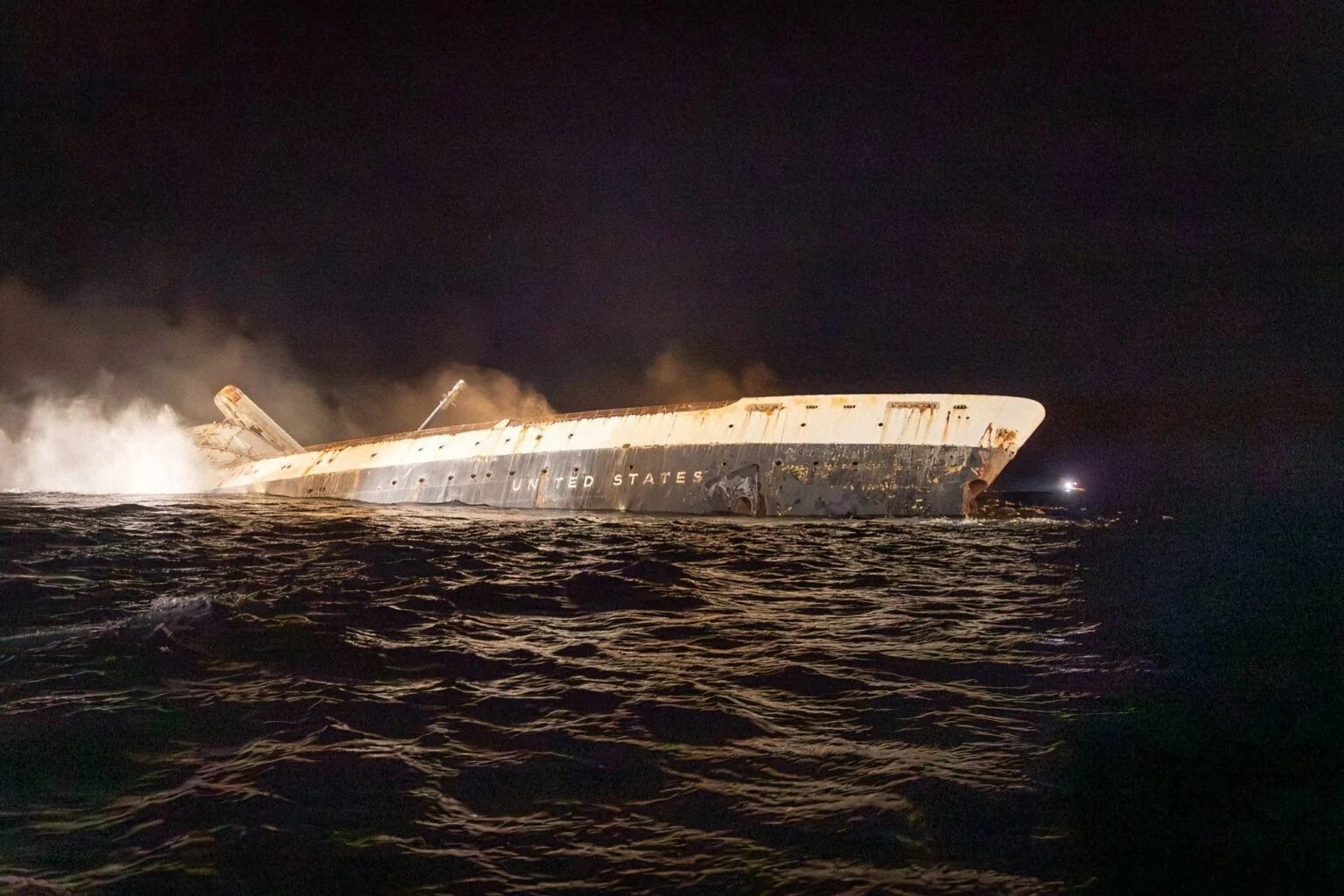
On 11 November 2026, the SS United States disappeared beneath the waters off Florida, deliberately sunk to become an artificial reef. A ship bearing the country’s name, once an expression of American maritime ambition, found its final purpose on the seabed. The decision had its practical explanations, and the preservation of one ocean liner cannot determine a nation’s maritime character. Yet the image invites an uncomfortable question. What does America mean when it calls itself a maritime nation?
Misleading and dangerously, the answer is often assumed to be self-evident: America possesses immense naval power, extensive coastlines, major ports and a history of overseas commerce. Its armed forces operate across oceans, while its prosperity is connected to markets and resources beyond its shores. These facts establish maritime interests and dependencies. Whether they establish a state organised around seapower is a more demanding question.
America’s claim to be a maritime nation therefore rests on less secure foundations than its naval strength suggests. Its relationship with the sea has changed as administrations and Amerians have made choices about commerce, industry, defence and national purpose. At some moments those choices have brought it closer to organising as a seapower; at others they have drawn it away. A navy forms part of that wider political, economic and intellectual undertaking. Its size cannot stand as a measure of the whole.
This distinction needs precision for naval power concerns the development and employment of naval forces. Maritime strategy connects activity at sea with political purposes, commerce, resources, diplomacy and the other means available to the state. A seapower state sustains those relationships through its institutions and national culture. These categories overlap, but moving from one to another requires work. Calling naval strategy ‘maritime’ cannot perform that work by itself. Something I still find some American’s struggle to understand—we should not be surprised they live in a plentiful plant of size and resources.
In The American Sea Power Paradox, I challenged the assumption of an inherent American maritime spirit. American naval ambition has repeatedly gathered around particular objectives: overcoming British power, securing international standing, winning wars and supporting foreign policy. Those purposes can generate enormous fleets. Their achievement does not guarantee that the surrounding society will continue to give maritime affairs the same priority. A justification built around an immediate adversary also becomes vulnerable when that adversary disappears or the political agenda changes.
Captain Alfred T Mahan (1840-1914) understood the difficulty, challenge and opportunity. His account, come variant, of seapower extended through commerce, shipping, national character and government. He also recognised how the resources and opportunities of a rich continental interior could draw attention away from the sea. The British model of what happened after showed something similar play out in real time, not least the agenda of land-thinkers and the other military services. Essentially, America’s material abundance could therefore support extraordinary naval expansion while weakening the domestic imperative to sustain a maritime orientation. The means to become powerful at sea and the commitment to organise as a seapower were different things.
The intellectual development associated with USN Admrial Stephen B. Luce (1827-1917), Mahan and later figures such as Captain Dudley Knox (1877-1960) demonstrates how much effort that commitment required. Historical study, professional education and engagement with political authority helped make the case for American naval power. The achievements of this tradition were constructed through institutions and sustained persuasion. Teaching its history as the expression of a national instinct conceals the labour involved and leaves later generations poorly prepared to repeat it. Something in light of recent question on PME or even USNA education maybe worth remembering.
This is why anniversary celebrations need more historical depth than a continuous story of naval greatness. In my writing on 250 years of American military ambition at sea, I emphasised the importance of decisions to create, sustain and renew naval institutions. The existence of predecessors is part of the story; the political willingness to maintain a professional service is another. An anniversary can commemorate an achievement while obscuring how contingent its continuation has always been.
That tension survived the growth of American naval thought and institutions into the mid-twentieth century. It gives particular significance to the concerns of Chief of Naval Operations Ernest J King (1878-1956) and Secretary of the Navy (later the first SECDEF) James Forrestal (1892-1949) as the Second World War approached its end. The harsh reality, the greatest shock in US Navy and what some still what not accept today is the US Navy’s immense wartime contribution did not settle its position within the postwar American state. The organisation of national defence, the authority of naval advice and the relationship between maritime strategy and national policy grew more contested, till this day. An outcome of the Department of Defense and Department of War.
I have described the Pacific victories from Midway (1942) to Leyte Gulf (1944) as America’s ‘Campaign of Trafalgar’ (1805) : achievements through which the Navy could claim to have fulfilled its promise and secured a place in national memory. Yet, victory did not confer permanent political authority unlike Trafalgar which bolstered the Admiralty’s grip to the last which was a betrayal from within—a story for another time.. That naval power could reach extraordinary heights while its place in government came under renewed challenge is the historical paradox at the centre of all of this Operational success and institutional security did not advance together.
Forrestal’s importance lies here. In my assessment, he understood that preparing the Navy for the postwar world required attention to the organisation of government, civilian oversight and the audiences that controlled resources. Congress and the executive had to understand what maritime power offered. Success at sea would not do the explaining for them. King and Forrestal’s warnings concerned the security of that relationship as much as the forces that would remain after demobilisation.
My PhD research on defence unification approaches those struggles as arguments about how the state would think about strategy and then act strategically. The issue extended beyond the Navy retaining particular weapons or responsibilities. So, could maritime experience continue to inform the formation of national strategy, or would naval forces increasingly be allocated tasks within a framework established elsewhere or subservient to or even service of another military service or engrossed in the tasks set by a government agenda where it turns it back to core maritime duties? Wartime victory could secure professional prestige without securing the institutional conditions through which that experience would shape future policy.
The events conventionally called the ‘Revolt of the Admirals’ in 1949 belong within that wider struggle. My work challenges readings that confine them to aircraft carriers, strategic bombing or officers resisting change. At stake were the Navy’s role in national defence and the ability of civilian oversight to hear competing professional arguments. Describing disagreement as a ‘revolt’ can prejudge whether the argument deserved examination. Congress needed access to the substance of those differences to exercise judgement.
CNO Arleigh Burke (1901-1996) carried that experience into his leadership of the Navy in the 1950s. His response illustrates both American resilience and the costs of adaptation. He helped establish a viable place for naval power within the changed defence system while defending the ability to offer candid advice. In my interpretation, this also meant accommodating a narrower conception of what the Navy could contribute to the military requirements of continental America. Adaptation could secure the service without recovering the full maritime conception of national strategy that earlier thinkers had sought.
The distinction matters when assessing the Cold War inheritance. A navy organised successfully to meet demanding military tasks can still inherit a reduced field of strategic argument. Subsequent generations may treat the accommodation as the natural definition of naval purpose, forgetting the political struggle that produced it. The force survives; the range of questions it is expected to address contracts. That is one way a state can become more powerful navally without becoming more maritime in its thinking.
This is the danger behind the description of the Navy as a continental fighting force operating at sea. A service can become extraordinarily proficient at delivering combat effects while losing sight of the wider relationship between maritime activity and national purpose. Its ships and aircraft then risk being understood principally as additional means of executing campaigns conceived through land and air priorities. Operational excellence can coexist with a narrowing strategic imagination.
The phrase ‘Prussian tactical force’ captures my criticism of a habit of thought in which military performance becomes the organising principle. The target is the reduction of strategy to the fight, rather than every thinker associated with a continental tradition. As I explain in my Corbettian essay, the analysis begins with the state’s purposes and circumstances. Commerce, access, political relationships and the maintenance of peace must shape how force is developed and employed. A navy’s ability to fight is essential; the state must understand what that ability exists to secure.
A practical test follows. Does naval activity preserve the use of maritime communications, sustain political choices and support the interests for which forces were committed? Technical superiority, as I have stressed in my work on the distinction between possessing naval power and exercising seapower, is insufficient evidence of strategic effect. A fleet can perform its assigned tasks competently while the state struggles to secure the conditions it needs. We must examine the relationship between the task and the purpose, including whether the task was framed correctly in the first place.
America’s inland waterways and resources belong at the centre of this argument. The Mississippi River system, the Great Lakes and the connections between inland production and coastal ports make the maritime question much larger than an ocean-going fleet. Agriculture, energy, raw materials and industrial production give America substantial foundations for maritime enterprise. Rivers and lakes connect the continental interior to that enterprise; from seabed to space industries, they should feature in any serious account of what it means for America to be a maritime nation.
These advantages also expose the paradox. The resources of a vast interior can sustain maritime commerce while encouraging a sense of continental self-sufficiency. Their existence does not ensure that government will treat waterways, ports, merchant shipping, shipbuilding and naval power as connected national responsibilities. Realising their potential requires investment in navigation infrastructure, maintenance, skilled people and the capacity to move goods reliably between inland and overseas markets. What matters is how fully America develops those advantages and integrates them into national strategy. A declaration of maritime identity that concentrates on the fleet leaves much of the country’s maritime potential outside the argument and strikes a moral blow at the national strategy.
Shipbuilding is a good example fo what exposes the distance between ambition and execution. In March 2025, the Government Accountability Office reported that a near doubling of the Navy’s shipbuilding budget over two decades had not delivered the planned growth in ship numbers. That’s even without discussing th civilian side of the competitiveness of ports and civilian shipbuilding to other nations. It’s a mix of identified acquisition problems alongside infrastructure and workforce limitations. The issue therefore extends beyond announcing a larger fleet or finding a more persuasive slogan. Plans must survive the practical demands of industrial capacity, stable decisions and political continuity.
This is where the terms and conditions become visible to America’s status as a maritime nation. Maritime ambition is easy to endorse when expressed as national strength, employment or military superiority. Its maintenance requires less glamorous commitments: training people, sustaining suppliers and logistic chain, resolving competing priorities and carrying programmes through changes of administration. The question is whether maritime purpose governs those choices consistently, or remains an aspiration repeatedly adjusted to other demands.
America’s continental circumstances make that tension persistent, this is an inescapable reality. Its internal scale and resources offer possibilities unavailable to smaller, more exposed maritime states. They can also encourage the belief that the sea is an instrument to be employed when necessary, come optionl, with its supporting system maintained on conditional terms. Geography provides resources and pressures; institutions and political choices determine the response. America will not become a seapower state merely by outbuilding or defeating a rival.
The fate of the SS United States is a symbol within this argument, not its proof buit it does show an American maritime enterprise of past, some outdated, but equally an underlining ambition expressed. The substantive question concerns what the country chooses to maintain while proclaiming its maritime identity. A preserved liner would not resolve industrial weaknesses, educate government or provide strategic direction. Equally, celebrating naval strength cannot absolve the state from explaining why the wider maritime system struggles to command sustained attention.
America’s partners also have a stake in this distinction. Dependence on American naval strength does not relieve other states of responsibility for their own maritime requirements. My comparison of British and American seapower politics asked why allies had allowed so much of the burden to fall upon the United States. A system sustained by American resources remains exposed to American political choices. Allies should contribute meaningful capacity and strategic understanding, recognising that their priorities and America’s will not always coincide.
The choices remain, but making them intelligently requires education. Government must understand what seapower entails, which relationships sustain it and what follows when those relationships are neglected. Those claiming to provide that education must also examine their own assumptions. Familiarity with naval capabilities does not necessarily confer an understanding of how a state becomes, or remains, a seapower.
Presumably the navalists have this in hand. But what evidence would justify that confidence? My research on Britain provides grounds for asking. Decades of appeals for more ships, greater public awareness and renewed national pride accompanied the continued erosion of the relationship those appeals were supposed to sustain. The persistence of advocacy cannot be mistaken for its effectiveness. American circumstances differ, but repeating familiar arguments offers no protection against a similar failure.
The comparison also reveals an American advantage that criticism should preserve. The Navy Department survived inside the unified defence structure, and Congress remained a forum in which naval arguments could be examined. Alongside them, professional bodies, historians, civilian mariners and other advocates sustained opportunities for debate. My argument in The US Navy versus Seablindness is that these arrangements matter precisely because American maritime understanding cannot be assumed. They provide means of renewing it. Britain supplies a warning about losing such capacity, rather than a predetermined account of America’s future.
Seablindness becomes an excuse (in every country) when it locates every failure in an ignorant audience. The educators must be examined too. Have they explained national interests, or mainly defended a fleet? Have they adapted to the institutions through which decisions are made, or repeated arguments whose authority has faded? Professional military education and independent civilian scholarship both matter here: officers and officials need the means to question the framework they have inherited, while civilian researchers need access and continuity to reconstruct the experience behind it.
Britain’s experience makes the institutional question unavoidable. Who develops maritime strategic knowledge, who communicates it to government, and who ensures that it informs decisions? Public enthusiasm and professional pride cannot perform those functions alone. An argument that mainly reassures existing naval supporters may achieve considerable circulation while leaving the state’s underlying assumptions untouched. Changing that outcome requires advocates to assess their methods as critically as they assess the politicians they seek to persuade.
The question for America is whether it will make the choices required to be and then maintain seapower—and whether its advocates are willing to change how they understand and explain that undertaking. Success must be judged by the quality of strategic understanding entering national decisions and the commitments those decisions sustain. After so many declarations of maritime identity, it is reasonable to ask what those declarations have obliged the country to do. Until the claim carries those obligations, terms and conditions apply.
On a personal note, I have long doubted the confidence with which America is described as a maritime nation, let alone a seapower state. Even calling it a seapower requires us to explain what we mean beyond the possession of naval force. My research has reinforced those doubts, while also showing how much determined individuals can achieve. As I said in 2026 ‘The Years Navies went missing’ we are on the cusp of the dramatic change in naval power, an argument for elsewhere (my book), but one to keep in mind.
In conclusion: the leadership required extends beyond knowing how to fight a ship or command a fleet. It requires people capable of developing the intellectual argument for seapower and carrying it through education into the reasoning of government and national life. They must understand how the sea, the country’s resources, its economy and its political purposes fit together, and help others understand what follows from those relationships. That responsibility belongs to civilians and naval professionals alike. America’s maritime future depends on whether such leaders are cultivated, heard and prepared to undertake that continuing work.
Further reading and sources
This essay develops arguments from my prior doctoral research and the following papers:
“The American Sea Power Paradox: Why the US is More Naval Than Maritime”.
“America Owes James Forrestal a Great Debt”.
“U.S. Defense Unification and the U.S. Navy 1945–”.
“The Revolt of the Admirals and Today’s Battle Over the Defense Budget”.
“The US Navy versus Seablindness: Par for the Course for America?”
“Learning from the Royal Navy: Lessons for the USN on Sea Power Politics”.
“Educating the State: Why Naval Public Relations Was Never About the Public”.
Historical texts and supporting sources:
• Associated Press, report on the sinking of SS United States, November 2026.
• A. T. Mahan, The Influence of Sea Power upon History, 1660–1783, chapter I.
• Naval History and Heritage Command, Navy and Defense Reform: A Short History and Reference Chronology.
• Eberstadt report to James Forrestal on Defence Organisation, 1945.
• US Government Accountability Office, Navy Shipbuilding: A Generational Imperative for Systemic Change, 11 March 2025.
• James W. E. Smith, Deconstructing the Seapower State: Britain, America and Defence Unification, PhD thesis, King’s College London (2021).