
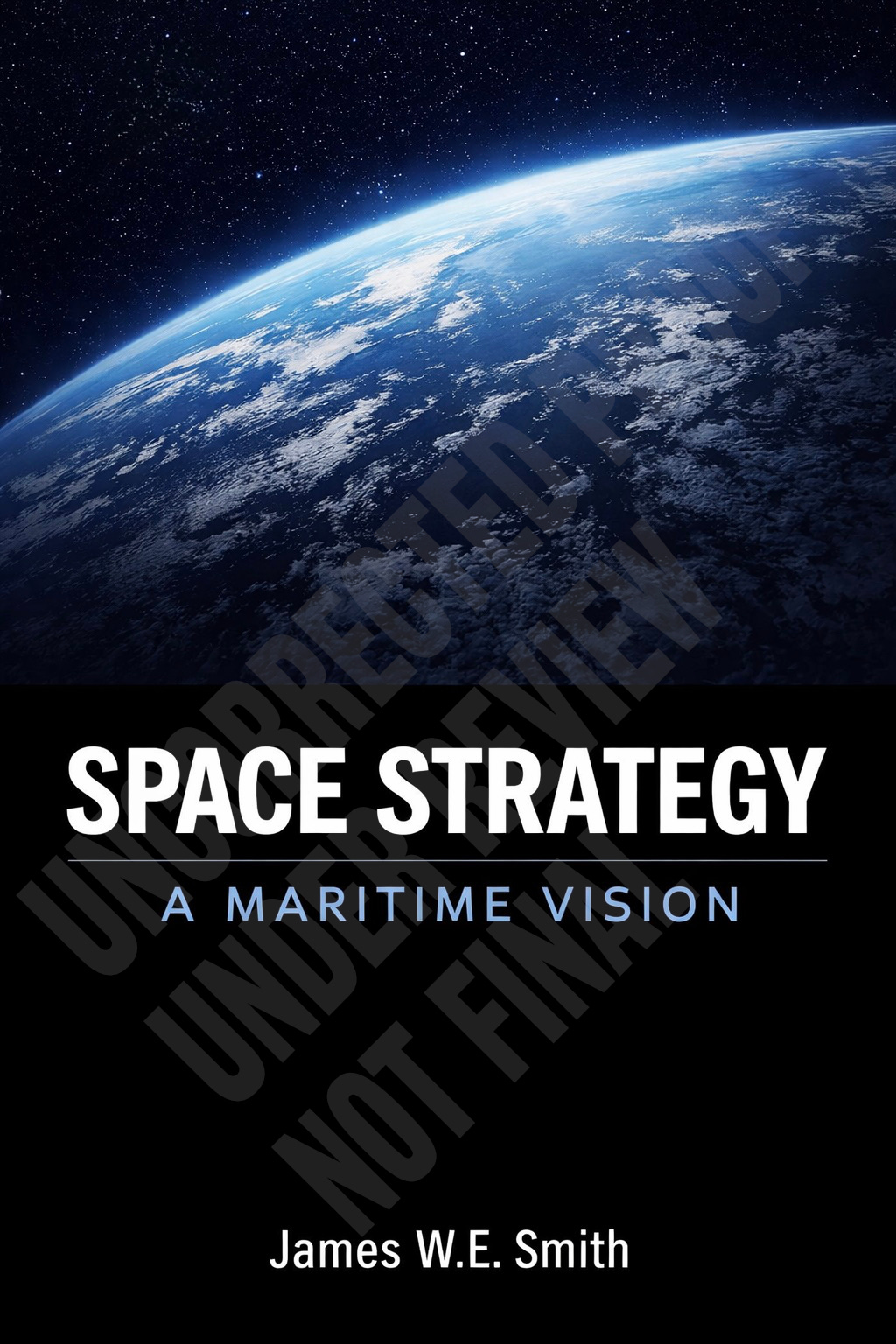
Book Project: Space Strategy
Smith argues that maritime strategic traditions offer a more compelling framework for developing space policy, strategy and doctrine than land-based terrestrial approaches. It presents a new history of both intellectual and practical developments for space and space organisation(s), presenting a challenge to existing narratives on the ‘space race(s)’ and the true roots of strategic space thought than ones commonly found today by space forces and related organisations. By tracing how maritime thought has historically informed strategy—including the often-tense relationships between military branches, historians, and theorists—the work reveals pathways for addressing core challenges in an expanding extra-terrestrial domain: ensuring stable interaction, preventing catastrophic conflict, and navigating increasing competition across cosmic frontiers while asking fundamental questions on the future of humanity in space
The strategic debate about space has often begun in the wrong place. Discussion frequently concentrates on new technologies, military capabilities and the apparent novelty of the domain before establishing the historical and strategic foundations needed to understand how space power is created, organised and employed.
This book develops my longstanding argument that maritime and naval experience provides an essential foundation for thinking about space strategy. It does not rest upon the simplistic claim that space is merely another ocean. Rather, it begins from the recognition that maritime societies, navies and the institutions associated with them have accumulated centuries of experience in connecting distant environments, sustaining activity beyond the land, protecting movement and communications, supporting commerce, exercising political influence and translating national resources into strategic effect.
Navies have also been connected with the development and use of space from the beginning of the space age. Their experience offers an important route into questions now confronting governments and armed forces: what space forces are for, how they should be organised, how military and civilian expertise should be combined, and how activity in space supports wider national strategy.
The book consequently treats space power as more than a collection of satellites, launch systems or military missions. It examines the relationship between strategy, institutions, technology, defence organisation and national power. It also places military activity within a broader environment that includes science, commerce, diplomacy, communications and the infrastructure upon which modern societies increasingly depend.
A central premise of the project is that although the character of space power continues to change, many of the underlying strategic problems are not wholly new. Human beings have confronted comparable questions whenever they have sought to use difficult environments for movement, communication, security, prosperity and political purpose. Maritime history therefore provides evidence and experience with which to test current assumptions about the future of space.
This project forms part of my wider research into strategic thought from seabed to space. It brings together work on maritime strategy, navies and space, the art of Admiralty, defence institutions and the relationship between domain-specific activity and national strategy. Its purpose is not simply to transfer naval vocabulary into a new environment, but to recover forms of strategic thought and institutional experience that can help governments and armed forces approach space with greater historical understanding and strategic coherence.
Release Date / Publisher: Coming Soon / TBA.
© James W. E. Smith