
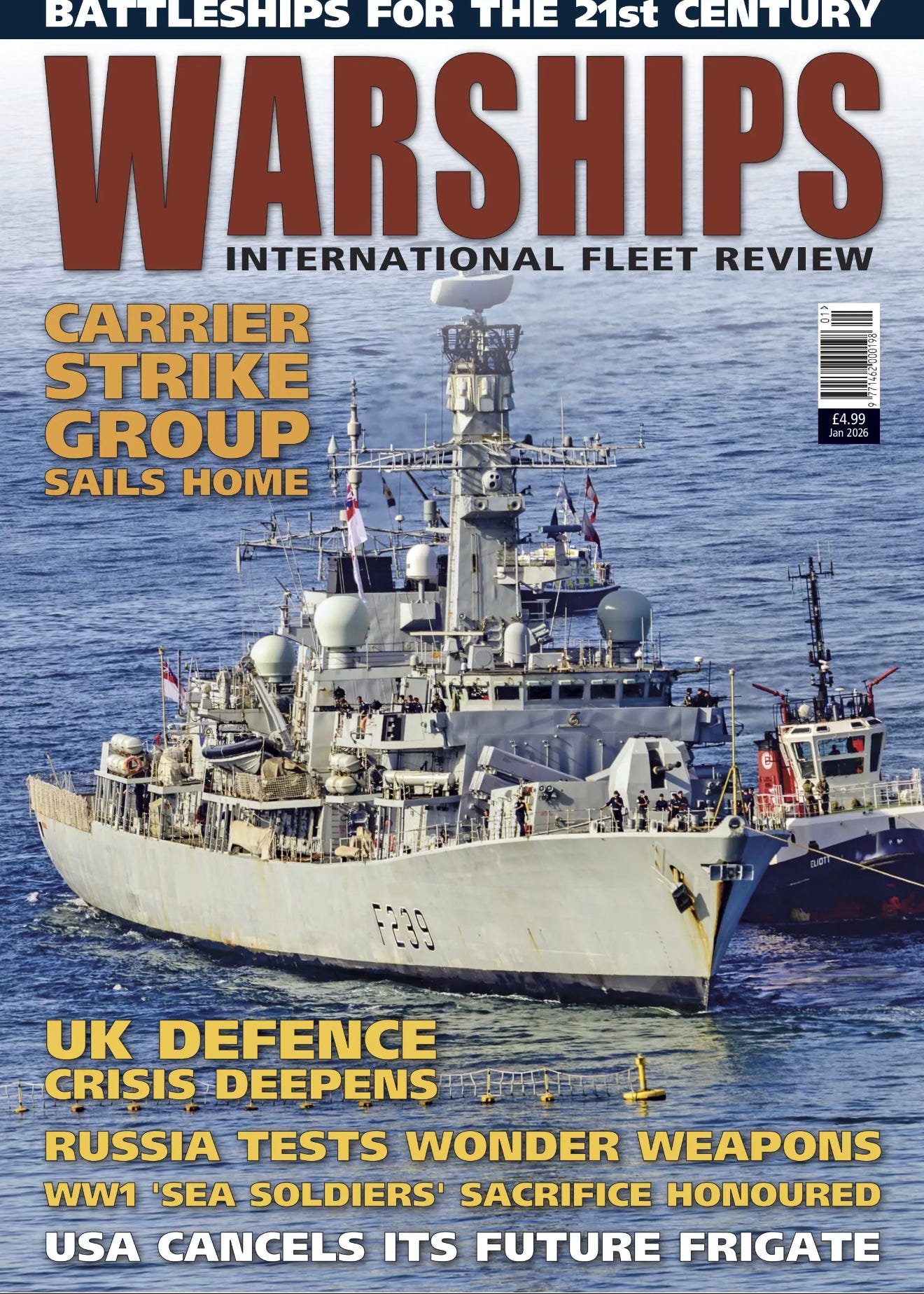
In the January 2026 edition of Warships International Fleet Review, (on sale in e-version and print in the UK & abroad after 19 Dec 2025), I point out restoring Britain to its proven national strategy, alongside fundamental defence organisational change is the key to defending Britain and it’s interests while addressing a litany of issues plaguing British defence. Island nations should not be warmongering, but thinking more intelligently about their approach to contemporary defence threats.
The full article is available in print and e-print. The publishers website is:
https://warshipsifr.com/
Please support publishing where and when you can.
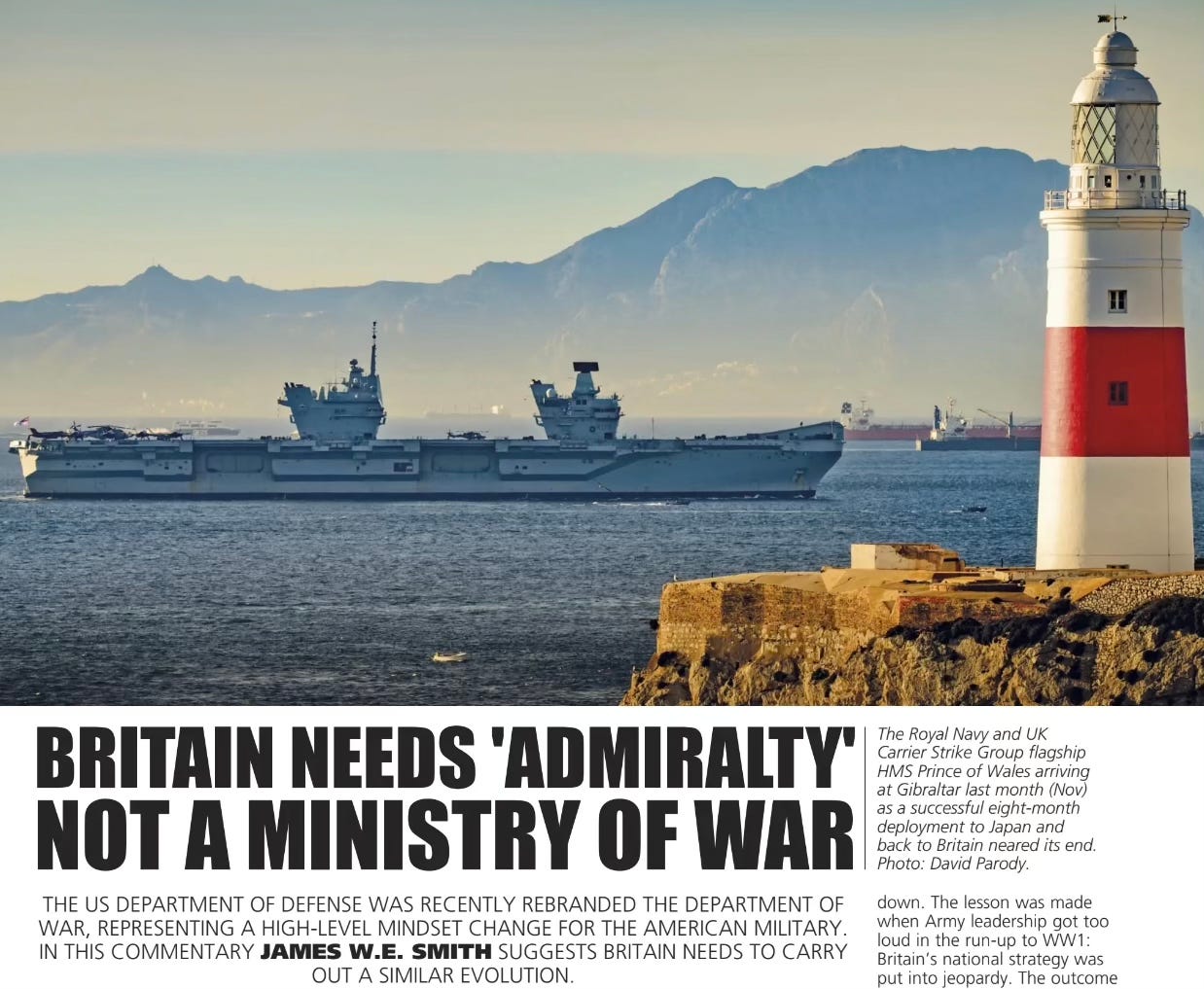
BRITAIN NEEDS ADMIRALTY NOT A MINISTRY OF WAR
INTRO:
The US Department of Defense was recently rebranded the Department of War, representing a high-level mindset change for the American military. In this commentary James W.E. Smith suggests Britain needs to carry out a similar evolution.
ARTICLE:
We are approaching 500 years since King Henry VIII, under the guidance of his once-special advisor, Sir Thomas Cromwell, established a ‘Council of Marine’, a forerunner to the Admiralty.
Although this could arguably be the foundational start of the Royal Navy, professionalism and organisation must go hand in hand; there was far more to it than creating a military force at sea. It was the process of acknowledging the harsh realities of what it meant to be an island, a topic I have touched on before in this magazine, but which it is worth reiterating.
Over the centuries, this has been analysed in different ways, but the reality is that Britain is easily defeated on land, cannot always sustain an army, is resource-strapped, and is often balancing its national finances.
This was obvious to King Henry VIII and Cromwell, who saw ports, sea trade, and merchants as the foundations of a national economy, and therefore something that had to be protected.
To go a step further, a professional military force at sea could not only protect trade but defend the nation from the endless threats of invasion. It could equally signal that Britain would commit national power - with pinpoint precision - to undermine the economy and military endurance of a competitor nation while calling in other Continental nations to ‘gang up’ on a threat to England. This simplified take on British defence strategy need not be expanded. History shows that politicians, when educated, understood the strategy that enabled the collaboration of a powerful, capable global navy with a flexible, professional expeditionary army. It delivered national security over the centuries, the ultimate proving case being the downfall of the French tyrant Napoleon Bonaparte, if not WW2.
Either way, King Henry’s and Cromwell’s argument for the organisation of defence offers some fascinating insight into where we are today: defence of the realm has no other options for national strategy but facing seaward.
And for Britain, national defence historically required that no one person, not even a King, could have total responsibility. It required a government and council of civilians and military that broadly covered the interests of business, as well as professional managers of the Navy. They worked together to ensure that the Government did not adopt foolish ideas, such as turning Britain into a fraudulent land power.
As resources are always limited, experience has proved that it is best not to overcomplicate matters. There was little need for complex organisation, nor did Defence need a powerful army-centric ‘Ministry of War.’ In fact, when Prime Ministers tried, usually to cover up the poor performance of British Army leadership, it was promptly shut down.
The lesson was made when Army leadership got too loud in the run-up to WW1: Britain’s national strategy was put into jeopardy. The outcome was clear: the coffins of our brave soldiers came home in quantities and WW1 became a bloody stalemate. The intelligent way of defeating an enemy power, maritime in foundation, was during WW1 easily disregarded due to a bloated defence organisation, which enabled too many voices who had failed to educate themselves in British strategic history. Defence organisation was further complicated with the creation of the Royal Air Force (RAF). In the end, the insight provided is that when you over complicate defence organisation, the line between defeat and victory becomes more blurred. Things take too long to get done: endless committees debate, money gets wasted, accountability and transparency evaporate. Organisational myopia and stagnation set in. Sounds familiar, doesn’t it?
A lean defence organisation, with tight budgetary controls, should be enforced in nations with a fixed strategy. Even after the creation of a third military service Britain’s the management of the armed forces remained lean and agile. Defence reviews were published –for right or wrong – consisting of a few pages, costed, equipment explained, with the plan detailed. You can find them in Parliamentary records. They put the 2025 strategic defence review document to shame. It is nothing more than a glossy brochure of wishful thinking rather than a plan of long overdue action. Equally, for all the promises of defence reform being better than what has gone before and solving problems, little has (at the time of writing) been delivered.
Britain once had a clear national strategy, and if was still followed - and the organisation built around it - then UK defence today would look very different. National strategy should decide defence organisation.
For navies, this is important, as they have been influential in shaping how defence organisations work, for better or worse, around the world. The wisest naval minds and maritime strategists have understood that being able to educate and communicate about the Navy, considering its business is far over the horizon, is critical to protect and maintain.
It is why they have pushed back on the concept of land-think dominating defence, not out of rivalry, but because there are more moving parts in defence than soldiering.
In the United States the Department of Defense (DoD) has been rebranded into a Department of War in which the naval voice is arguably much diminished. After 250 years of American ambition to be a power at sea, it now appears to be on shaky grounds if navalists cannot assert the truth of military history, which has seen America’s sea power vital to the success of its land forces over the centuries.
It serves as a warning for the British to reject any such notion that might gain traction in the UK. Firstly, any talk of fixed continental commitments should be dismissed and acknowledged as being out of step with the present and future of warfare. We are confronted with a future that spans from seabed to space, with warfare likely bloodier than ever. It will be integrated, complex and paced at a speed faster than the human brain can comprehend.
Secondly, the UK Ministry of Defence (MoD) must be scaled back to a size that it was in the 1950s - hundreds of staff, not thousands, centrally. Thirdly, re-empower British services to run themselves and our Service chiefs to coordinate our strategy and operations closer than ever.
Ultimately, the best medicine for British defence is a good dose of objective reality. Britain must relearn its national strategy, focusing on being the best at the things it can, and disregarding the rest. This may be uncomfortable for many, including the UK Government, which needs to learn the limits of British power; for actually, it has always been the same – for an island nation naval forces and a matching strategy paramount. We know what to call this approach. It is ‘Admiralty’.