
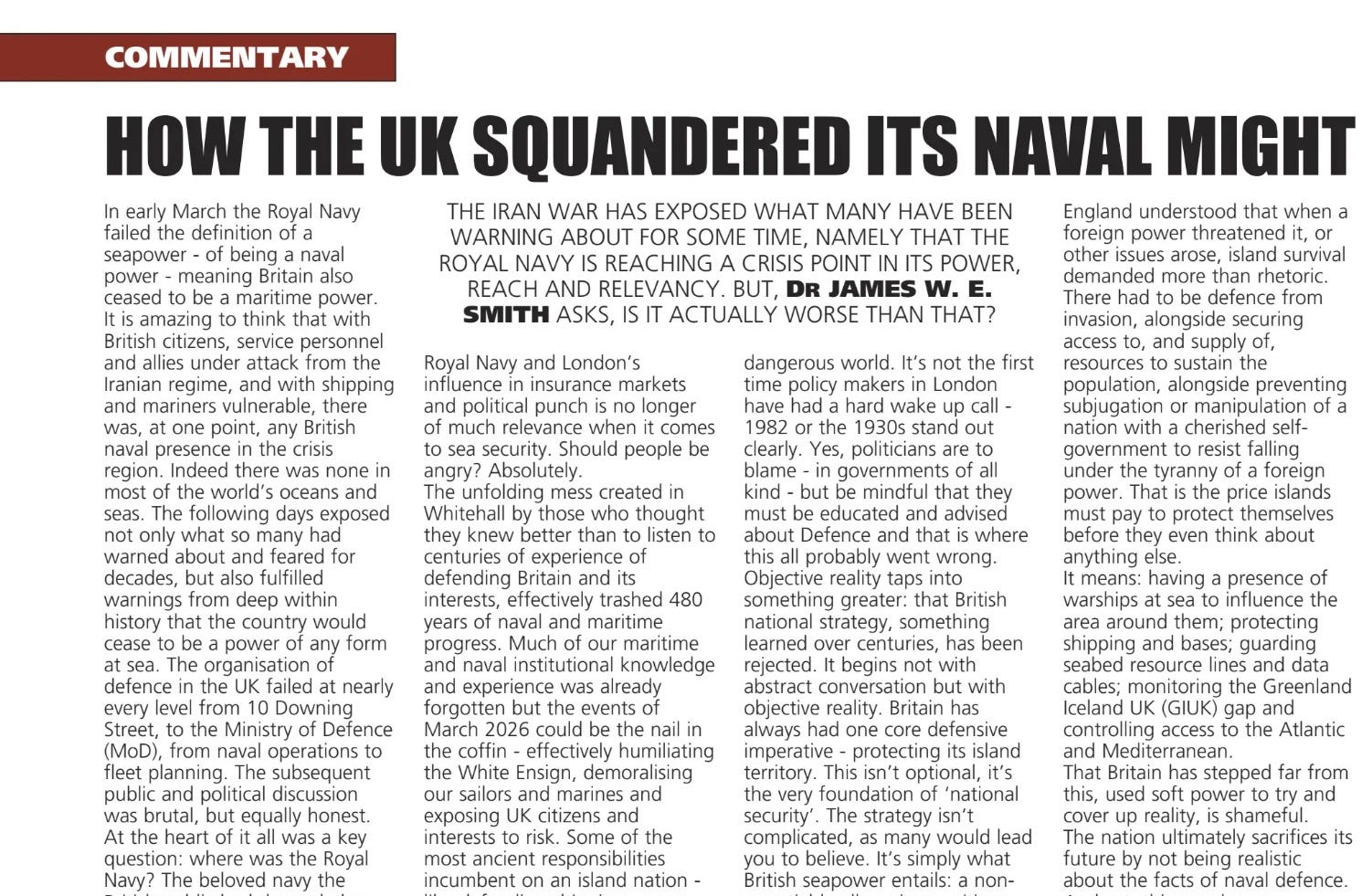
In the May 2026 edition of Warships International Fleet Review, (on sale in e-version and print in the UK & abroad after 20 April 2026), I argue the surface level arguments about the state of the Royal Navy such as seen in the media and social media, does not come close to reality of the actual peril that Britain’s seapower and the state that its national defences are in.
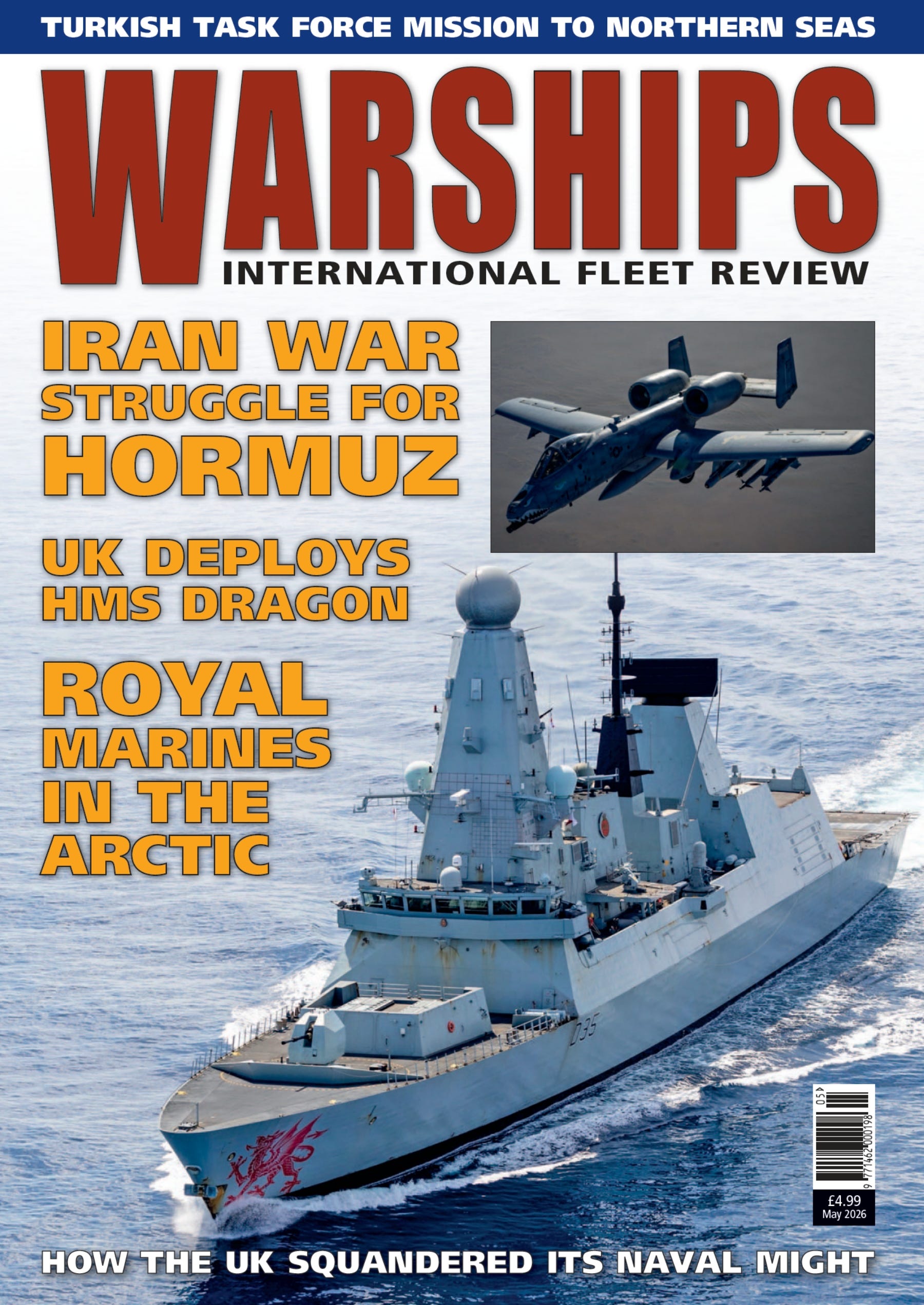
The full article is available in print and e-print. The publishers website is:
https://warshipsifr.com/
Please support publishing where and when you can.
BRITAIN FAILS AS A SEAPOWER
In the week of the 2nd March 2026, the Royal Navy failed the definition of a seapower, a naval power and Britain as a maritime power. Amazing to think that with British citizens, service personnel and allies under attack from the Iranian regime with shipping and mariners vulnerable, there was not, at one point, a single naval British naval presence in most, if not all the world’s oceans and seas. The following days, exposed not only what so many had warned about and feared for decades, but warnings from deep within history that the country would cease to be a power of any form at sea and the organisation of defence had failed at nearly every level from 10 Downing Street, to the MoD to naval operations and fleet planning. The subsequent public and political discussion was brutal, but equally honest, at the heart a key question: where was the Royal Navy? The beloved navy the British public–– England––had depended on for the best part of half a millennium.
There is plenty of blame to go around, if the truth will out, is an open question. Many knew that national and governmental seablindness was heading to a critical moment and it arrived in March 2026. In simple terms, the metrics are clear. Britain wasn’t a seapower because it had failed to guard the lifeblood of the nation through shipping, it wasn’t a naval power because its assets could not be concentrated into a powerful influence at sea, the air and over land, instead warships languished in port. Meanwhile British maritime power all but failed, after a long painful drag over decades, the world accepted the Royal Navy and London’s influence insurance markets and political punch was no longer part of picture when it came to sea security.
Should people be angry? Absolutely. The unfolding mess created in Whitehall by those who thought they know better than to listen to centuries of experience of defending Britain and its interest, effectively trashed 480 years of naval and maritime progress. Much of our maritime and naval institutional knowledge and experience was already forgotten but this could be the nail in the coffin. Effecevitely, humiliating the White Ensign, demoralised our sailors and marines and exposing UK citizens and interests. Some of the most ancient charges for an island nation like defending shipping were thrown in the bin along with an extra punch in the gut when continental nations, rallied their naval forces to the challenge. The British response, slow like a drunkard riddled with slurred Orwellian newspeak to avoid any politician, serving military or civil servant taking the blame for the failure unfolding before the British public’s eyes.
Crisis? Disaster? Failure? The rose-tinted spectacles, nostalgia, overzealous pride for the past and taking every recent decision ‘on risk’ in defence from policy, strategy, procurement and more, rebounded in the face of government. The reality the Royal Navy had proven itself in the Middle East against drone and missile attacks in 2023/2024 and concentrated expertise like keeping shipping lanes clear of mines, to then be withdrawn, shows a fundamental breakdown occurred somewhere in Whitehall and the military command structure.
Some might say ‘good’, a good hard kick in the stomach was what British defence needed in an increasingly fragile world. It’s not the first time policy-makers in London have had a hard wake up call, 1982 or the 1930s stand out clearly. But looking at the political and public decision, it went the direction many expected: shallow, based on numbers of warships and funding when the rot is deeper and goes back decades far beyond the navy. Yes, politicians are to blame but be mindful, they must be educated and advised about defence and in that, we could probably find where this went wrong.
But objective reality over what happened is taps into something greater: that British national strategy, something learned over centuries, has been rejected. British national strategy begins not with abstract conversation but with objective reality. Britain has always had one core defensive imperative: protecting its island territory. This isn’t optional—it’s the very foundation of ‘national security’. The strategy isn’t complicated––as many would lead you to believe—it’s simply what British seapower entails: a non-negotiable all service maritime core to defence that addresses the harsh realities of being an island. Britain has no choice in its defence strategy, because it always had to address maritime commitments, near and far from home, that were directly about the security of the nation. In short: defence of the island realm come first, before any discussions about broader strategic or foreign policy objectives. Geography demands a specific kind of military approach coupled with the fact that Britain has never had meaningful choices about its defence posture—it’s been constrained by its very existence as an island.
History shows even broken and impoverished, England understood that when a foreign power threatened them or issues arose, island survival demanded more than rhetoric—defence from invasion, securing resource lines to sustain the population, and preventing subjugation or manipulation of a nation that had cherished self-government than falling into the tyranny of an foreign power. A duty for all time, renewed and refreshed to reflect the times and what technology enabled. This is the price islands must pay to protect themselves before they even think about anything else. It means having presence of warships at sea to influence the area around them, protecting shipping and bases, guarding the seabed resource lines and data cables, monitoring the GIUK gap and controlling access to the Atlantic and Mediterranean. That Britain has stepped far from this, used soft power like words to try and cover up reality is shameful. The nation ultimately sacrifices its future by not being realistic to the facts of just how delicate island economies, the cost of living and defence of a ‘Western way of life’ stands.
Looking to the future, this maybe an opportunity for the White Ensign and UK defence to consider the best approach is to go back-to-basics. Restore policy and strategy to things history shows we can have confidence in, non-relenting reform of the MoD maybe overdue if any politician will tackle that toxic topic, while restoring both national and international trust in British naval power and the strength of its seapower needs to happen urgently before weakness becomes a further invitation to our enemies to test our resolve, disrupt our country, hurt our allies, or worse.