
There is a generational question within spaceblindness that deserves closer attention. Each generation inherits technologies, institutions and possibilities, arguably civilization itself, that its predecessors had to develop, often at considerable expense, trial, and risk. What was once extraordinary becomes ordinary a bit like technology of today to generations long ago would seem like ‘magic’ to them. The benefits remain visible in daily life, while the effort required to create and sustain them becomes progressively harder to see. Societies can therefore inherit dependence without inheriting an understanding of it. Spaceblindness, in this sense, names a condition in which dependence on space is not matched by understanding of it.
As at sea, blindness can become a convenient excuse. ‘Seablindness’ is a handy term that can conceal the very failures it claims to explain, allowing deficiencies in education, institutional judgement and political leadership to be attributed to a public that supposedly does not understand. As much as I dislike that term, it’s been used for handiness but in that usage has obscured reality. ‘Spaceblindness’ risks serving the same purpose. Before blaming a younger generation(s) for failing to connect with space, we should ask how its significance has been explained, whose responsibility that education was, and whether the story being told gives people sufficient reason to care. Naming the condition achieves little if it disguises how it was produced and excuses those responsible for addressing it.
NASA’s Apollo programme of the 1960s, illustrates one aspect of this problem. For those who experienced the Moon landings and the quest for them as contemporary events, they could represent an extraordinary expansion of human possibility, bound up with the political ambitions and anxieties of their time. For those born after the programme ended, even the Space Shuttle era, including members of Generation Z (born 1997–2012), those past programmes belongs to a historical world they did not inhabit. Generation Z is one instance of that wider distance rather than the whole of it. They can study its achievements, admire its participants and understand its significance without experiencing the connection that those who witnessed it might remember. That distance is not necessarily ignorance, it is a different relationship with the past.
Where younger people say that they cannot connect with Apollo or the Space Race[C1] , there is merit in taking that response seriously. An earlier generation’s ambitions cannot be handed down as obligations. Explaining why the United States went to the Moon during the ‘Cold War’ does not, by itself, explain why a young person should support a particular programme today. Historical significance and contemporary purpose require a connection that advocates of exploration and defence must be prepared to explain.
Nor should we sentimentalise the understanding of older generations. Remembering a launch does not establish an understanding of national strategy or space strategy. Admiration for astronauts does not necessarily explain the relationships between exploration, science, commerce, defence and national policy. A society may celebrate technological and a national achievement while remaining poorly equipped to judge what that achievement is for. In short: enthusiasm can coexist with spaceblindness just as readily as indifference and you can find examples of this in all the domains, land, sea, and air.
This is one reason history must be studied rather than merely commemorated. Its value lies in examining how people understood their circumstances, why they made particular decisions, what those decisions enabled and what they cost, and, critically, how they organised their efforts, and the culture that shaped them from that, to achieve aims. This is called analysis, and the very best strategists who are and were historians, use that process to maximum impact and influence. Reducing space history to heroic individuals, national competition and a succession of spectacular firsts or even the pride of one military service, makes it harder to explain the fundamental quieter developments through which space became part of everyday life, such as the military origins of satellite navigation or the first weather and communications satellites. It also risks leaving younger audiences with a choice between admiring somebody else’s past and dismissing a subject that appears remote from what will be vital for their future.
Yet, distance from the memory of exploration can coexist with dependence upon space. Someone need not be interested in astronauts to rely on satellite navigation, weather information or services supported by space-derived timing and communications. These capabilities operate within larger systems connecting infrastructure on land, at sea, in the air and in orbit. Their usefulness does not require the individual user to understand how the whole works.
That success creates an educational difficulty. The more reliably infrastructure functions, the less reason its users have to investigate it, unless it goes wrong. People encounter the service at the point of use, while the organisations, skills, investment and international arrangements sustaining it remain elsewhere. What arrives as a convenient feature of daily life can disappear from consideration as a continuing national responsibility.
The maritime experience offers a substantial foundation for understanding this relationship. People do not need to remember the transition from sail to steam to depend upon maritime trade. Nor does a society have to celebrate naval history to rely upon the communications and resources passing across the oceans. The strategic requirement is that sufficient understanding exists among the public and those governing on its behalf to sustain informed decisions. Space presents a comparable challenge, and in one respect a harder one: dependence on the sea is visible in ports and ships, whereas dependence on space is largely hidden, and the infrastructure is exposed to debris, jamming and interference. Personal familiarity with the environment will remain limited for most people, while its consequences reach deeply into their lives.
The question ‘why bother with space?’ needs to be examined carefully. It might express doubt about the cost or design of a particular mission. It might ask whether human exploration offers sufficient value alongside robotic science. It might challenge the distribution of benefits, the language of national prestige or the purposes advanced by commercial advocates. These are questions that a serious account of space strategy should be able to accommodate. Answering it requires separating means, the capabilities and infrastructure through which space is used, from purposes, what societies want that activity to achieve.
A broader dismissal of space raises a different problem. It can overlook the dependence already established and assume that the benefits of earlier endeavour will continue without renewed effort. Existing services need skills, institutions, investment and political attention. Future possibilities require decisions about which forms of knowledge and capability societies wish to develop. Neither task is discharged merely because an earlier generation made the first crewed lunar landing. This is the same as military services relying on historical battles.
Dependence on existing space infrastructure does not, however, settle the case for every proposed extension of human activity. Satellite navigation cannot be used as a complete justification for a lunar settlement. The argument must explain the relationship between sustaining present capabilities and developing future ones, including the uncertainties and choices involved. Otherwise, advocates reproduce the very confusion between means and purposes that prevents coherent strategic thought.
There is therefore use as well as peril in generational distance. Its value is that inherited assumptions can be questioned. Those less attached to the symbolism of the Space Race and NASA Shuttle programme may ask more directly what present activity is intended to achieve and whose future it serves, even if with advances in rocket technologies. Remember, those questions can improve strategy. The peril arises if distance from the original endeavour becomes an inability to recognise the continuing effort on which its benefits depend, or a belief that future possibilities will appear without anybody accepting the difficulty of developing them.
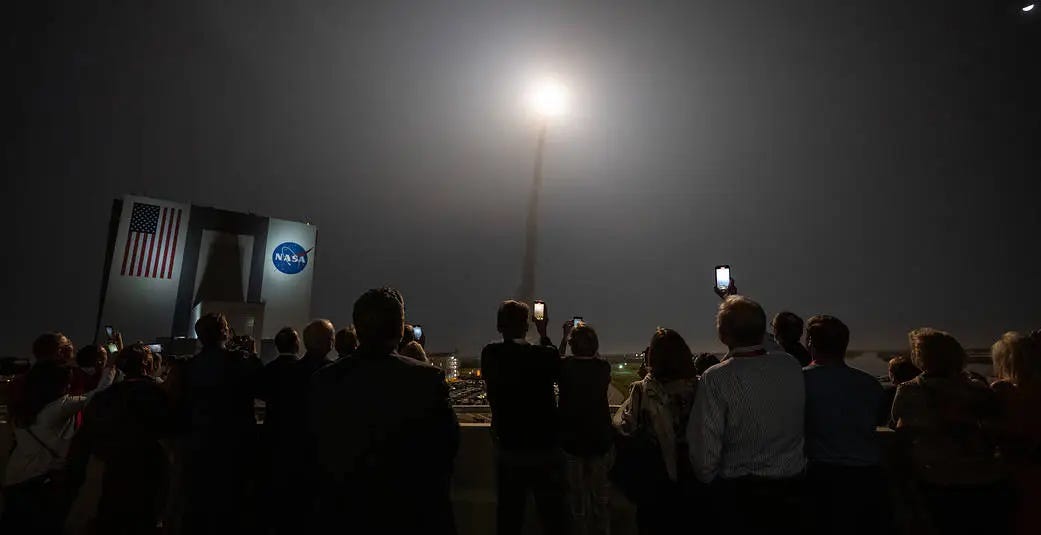
NASA’s Artemis programme offers an opportunity to build a contemporary connection with exploration. Artemis II, which carried a crew around the Moon in April 2026, was the first crewed flight beyond low Earth orbit since Apollo 17 in 1972, and gave everyone born since then a crewed lunar mission to follow as it happened.[C2] For younger audiences, it can be an undertaking whose decisions, setbacks and achievements unfold during their own lives. It offers possibilities for participation through science, engineering, education and debate over what sustained activity beyond Earth should mean. But that connection cannot be secured by presenting Artemis as Apollo for another generation. A programme needs a purpose that people can examine in the circumstances they actually face.
The maritime argument outlined above places that purpose within a longer process: learning to operate in an environment that does not naturally sustain us, accumulating experience and developing the means to remain there (Smith, 2026). Exploration, scientific investigation, communications and infrastructure can create possibilities whose full uses emerge only over time. History provides grounds for taking those possibilities seriously. It does not guarantee that every expedition succeeds, every investment is sound or every promised benefit follows. In strategic terms, the maritime thinking of Sir Julian Corbett (1854-1922) offers more for understanding space than the air-power arguments of General Billy Mitchell (1879-1936) (See Smith, 2019).[C3]
This places a responsibility upon advocates as well as sceptics. Those making the case for exploration and defence must explain uncertainty without treating it as a reason to promise anything they dream of. Those questioning it should consider how the opportunities they inherited became possible, and what choices might preserve or enlarge those available to their successors. The purpose of strategic education (strategic studies) is to equip both to exercise judgement.
Education must consequently extend beyond communicating the excitement of rocket launches or improving familiarity with scientific facts. It must explain how space activity connects with the organisation of society, the exercise of political power and the provision of services people already regard as ordinary. Each has a part in making those relationships intelligible: universities should teach space in maritime strategy with land strategy; museums should show the infrastructure behind everyday services as well as the spacecraft; and space agencies and governments should explain openly what the nation depends on and why (Smith, 2025).[C4] Public understanding cannot be left to occasional moments of spectacle, crisis or private money-making.
Generation Z and younger should not be treated as a single audience with a single attitude towards space. The argument here identifies a problem of generational renewal that requires investigation, rather than assuming that an entire age group is indifferent or uninformed. The same question will confront those who follow them: how does a society sustain an understanding of capabilities whose creation lies beyond personal experience?
Spaceblindness can be reproduced whenever dependence passes from one generation to another without sufficient understanding of the responsibilities accompanying it. Apollo’s memory cannot perform that educational task indefinitely, and Artemis’s achievements will not perform it automatically. Each generation must be able to connect the experience it inherits with the purposes it chooses to pursue. A spacefaring civilisation will require that continuity of understanding as surely as it requires the machines and technology that carry it beyond Earth.
Supporting papers
The argument draws on the following papers by James W E Smith.
Corbett Offers More on Space than Mitchell (2019).
Education and Understanding: The Strategy for Sea and Space (2025).
NASA’s Artemis Programme and the Maritime Road to the Stars (2026).
Space is a Science. Space Strategy is an Art. (2026).