
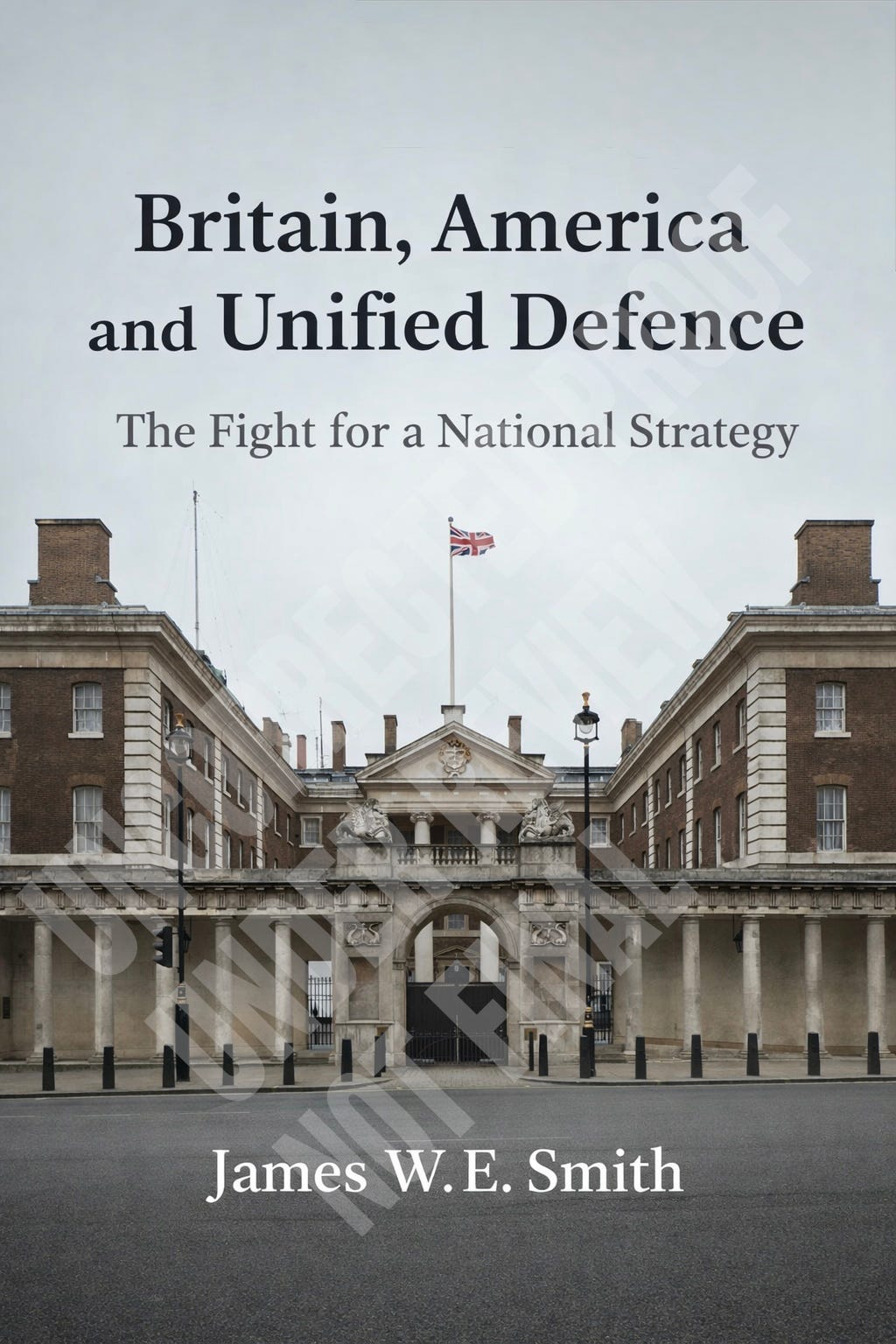
Research Monograph
This research monograph represents the culmination of more than twenty years of research into strategy, maritime power, defence organisation, and the institutions that shape strategic thinking. While rooted in doctoral research, it draws together a much broader programme of scholarship, exploring many of the themes introduced in the Research Guide. It seeks not only to contribute to historical understanding, but also to inform contemporary debates about strategy—from seabed to space—institutions, and national power.
Although my work encompasses strategic thought, applied history, defence organisation, maritime strategy, national strategy and emerging domains such as space, these subjects are not independent fields of enquiry. They are connected by a broader research programme concerned with one enduring question: how do societies develop, sustain and apply strategic judgement? This question lies at the centre of my work and provides the intellectual framework that connects my research, teaching and engagement with government and defence.
I begin from the premise that strategy is not simply the formulation of policy or the direction of military force. Strategy is an intellectual discipline. It is a way of thinking about uncertainty, competition and the relationship between political objectives and national power. Like any discipline, it requires study, debate, criticism and continual refinement. Strategic judgement is neither innate nor accidental. It is cultivated over time through education, historical understanding and institutional experience. My research therefore seeks to understand not only how strategy is practised, but how strategic thinkers are developed and how strategic knowledge is preserved across generations.
This perspective draws heavily upon the tradition established by Sir Julian Corbett, whose work demonstrated that strategy cannot be separated from history, politics or education. Corbett viewed history not as a catalogue of lessons to be mechanically applied, but as a means of developing judgement. Historical study encourages reflection, exposes complexity and develops the intellectual habits necessary for understanding new strategic challenges. That philosophy continues to shape my own approach. Rather than searching the past for simple analogies or prescriptive solutions, I use historical inquiry to examine enduring strategic problems, asking why institutions succeed or fail, how strategic ideas evolve, and what historical experience can contribute to contemporary decision-making.
Central to this research is the belief that strategic understanding resides not only within individuals but also within institutions. Governments, armed forces and professional organisations accumulate knowledge through experience, education and reflection. They become custodians of what might be described as corporate experience—a body of institutional knowledge that enables strategic thinking to mature over time. Without such institutions, societies risk repeatedly confronting familiar strategic problems without the benefit of accumulated understanding. My work therefore examines how institutions preserve, challenge and renew strategic knowledge, and how organisational structures influence the ability of states to think strategically.
You may wish to read the primer below.
Book Release Date 2027 / Publisher: Coming Soon / TBA.
© James W. E. Smith
How Do States Organise for Strategy?
A primer on my forthcoming book
James W. E. Smith
Governments are regularly urged to think more strategically. They are asked to look beyond immediate pressures, connect their policies and bring national resources into a coherent relationship with national purposes. But through which institutions is that work supposed to happen? Who preserves the experience it requires, develops the arguments, advises political authority and helps turn strategic judgement into action?
My forthcoming book investigates how states organise themselves for that task. It is worth being precise about what kind of question this is. The book is not concerned with how armed forces are organised for warfare — the arrangement of fleets, the disposition of troops, the shape of commands. It is concerned with how a state organises itself for strategy: a different and, I would argue, much larger question, because it is not really about administration at all. It examines the relationship between strategic thought and institutions through the contested history of defence unification in Britain and the United States. At its centre is a question that reaches beyond military administration: what happens to a state’s capacity for strategy when it changes the organisations through which strategic knowledge is developed, preserved and put to use?
The inquiry began with questions I first explored in 2005 about Britain’s changing relationship with the sea. Through my subsequent research, including my Master of Research and doctoral thesis, Deconstructing the Seapower State: Britain, America and Defence Unification, the problem widened. ‘Seablindness’ described an important condition, but tracing its causes led towards the institutions through which government understood maritime interests and related them to national strategy.
The book substantially rewrites, expands and reframes that research. The abolition of the Admiralty is its principal case study, examined alongside the experience of the American Navy Department — the most illuminating example available of a state consciously organised for strategy, and for that reason the clearest lens through which to examine what organising for strategy actually requires. It is not, however, the book’s subject in itself. Through their histories, it explores how strategic knowledge becomes embedded in institutions, what those institutions enable governments to do, and what is at stake when they are reorganised or abolished.
An institution carries more than its immediate responsibilities. It accumulates experience, sustains relationships and gives particular forms of expertise a place within government. It can preserve knowledge beyond individual careers and connect that knowledge to changing circumstances. A record can survive the retirement of everyone who understood what it meant; a responsibility can be reassigned on paper long before anyone works out that the judgement behind it went with the people who left. These functions help shape the questions political leaders consider, the alternatives presented to them and the means through which decisions become action.
That relationship works in both directions. Strategic requirements influence the institutions states create. Once established, those institutions influence how later requirements are understood. Organisation can sustain the capacity for strategy while also constraining it. Examining that relationship requires asking what an institution was built to accomplish, how it performed those functions and what happened when its position changed.
Defence unification brings those questions into focus. The familiar account presents the concentration of authority as a rational response to the complexity of modern warfare. Separate service departments meant duplication and rivalry; centralisation promised coordination and coherence. Seen from the existence of today’s defence institutions, the process can appear to have had an obvious destination.
Yet proposals for amalgamation were repeatedly advanced and rejected. Governments with direct experience of war and national danger considered alternatives to unified defence. Britain’s eventual settlement in 1964 therefore requires explanation on its own historical terms. Why did arguments that had previously failed succeed? What did their advocates expect unification to achieve? What did opponents believe would be lost?
The longer history is essential to understanding what was being reorganised. Beginning with the Council of the Marine in 1546, the book examines how experience became institutional knowledge and how that knowledge contributed to national strategic choice. The Admiralty’s responsibilities extended beyond administering the Royal Navy. It provided a historical embodiment of a wider capacity for strategic governance: connecting professional and civilian expertise, institutional memory, education and advice to the purposes of the state.
Different strategic experiences also produced different traditions of thought. The British maritime tradition and the continental military tradition associated particularly with Prussia developed contrasting understandings of national power. Their significance extended beyond the environments in which armed forces operated. They concerned how political purposes related to resources, geography, military force and the wider world. Institutions gave these perspectives continuity and authority.
My argument is that the triumph of unified defence accompanied a wider displacement of Britain’s maritime conception of national strategy by continental military thought. Understanding that relationship requires bringing intellectual and institutional history together. The organisational dispute concerned the strategic assumptions through which Britain understood its interests, as well as the distribution of administrative responsibilities.
American experience is central to explaining the British outcome. The United States underwent its own prolonged struggle over defence reorganisation. Recovering the Navy Department’s perspective brings important arguments about strategy, authority and political responsibility into view. It also makes it possible to examine how American organisational experience, and the lessons attributed to it, entered British debate. The two histories illuminate different choices while also revealing connections between them.
The book draws on government and departmental records, private papers and previously unavailable material from both sides of the Atlantic. Access to collections not available to earlier researchers, alongside material recovered through Freedom of Information requests, has enabled established interpretations to be tested against contemporary evidence. These sources help recover arguments and institutional perspectives that later accounts omitted or represented differently.
That evidence also raises a second problem: how the history of unification came to be understood. An account presenting reform as the necessary culmination of progress can make earlier alternatives seem irrelevant. It can turn strategic objections into little more than obstacles overcome. The book examines how a particular interpretation acquired authority, and why that mattered for the organisation whose creation it purported to explain.
The consequences extend beyond historical writing. If an institution’s origins are understood as proof of its necessity, later reform can concentrate on making the inherited structure work better while leaving its underlying assumptions unexamined. Recovering the choices behind unification restores the possibility of asking whether the organisation itself remains appropriate to national strategic purposes.
Those purposes extend beyond defence. Coordinating armed forces and employing them effectively are indispensable responsibilities, but national strategy must also connect political, diplomatic, economic, industrial and other means. An organisation capable of managing military power does not automatically encompass that wider task. Administrative integration and operational cooperation cannot, by themselves, demonstrate unity of national strategy.
The point of reference throughout is therefore the state’s capacity to think and act strategically. Neither an armed service nor an inherited organisational arrangement is treated as an end in itself. Where the evidence favours a particular service, capability or form of investment, the book says so; where it exposes institutional self-interest, inter-service rivalry, distortion or misrepresentation, it does not disguise them simply because they originated from a particular uniform, department or institution — the Navy’s included. Nor does setting aside service advocacy mean accepting the present organisation of defence as a neutral or permanent starting point. If organisation exists to serve strategy, organisation itself must remain open to examination. G. K. Chesterton described tradition as “giving votes to our ancestors” — a reminder that the historical record is not simply what has passed, but a body of experience with a legitimate claim on present judgement, if anyone still asks it. This book does not begin with a blueprint for reform, and it does not assume in advance what its conclusions should be. It begins with a historical question, and follows it through before asking what, if anything, it demands of the present. The loyalty here is to national strategy — its making and its application — not to the preservation of any particular institutional arrangement or military service. Whether the findings support adapting existing institutions, recovering neglected functions or developing new arrangements depends on following the evidence through to its consequences.
This is what the book offers: a history of the relationship between strategic knowledge, institutional choice and national action, examined through one of the most consequential transformations in modern defence. It asks how states learn, how they preserve what they have learned, and what happens when the organisation created to serve strategy begins to determine the boundaries within which strategy can be imagined.
The book is due in 2027. Further details will follow as publication approaches.