
In the May 2025 edition of Warships International Fleet Review, (on sale in e-version and print in the UK & abroad after 22 April 2025) I consider a ‘revolution’ (a very unbritish word!) that is, ironically, needed to return the UK to the ‘British Way of War and Peace’.
The full article is available in print and e-print. The publishers website is:
https://warshipsifr.com/
Please support publishing where and when you can.
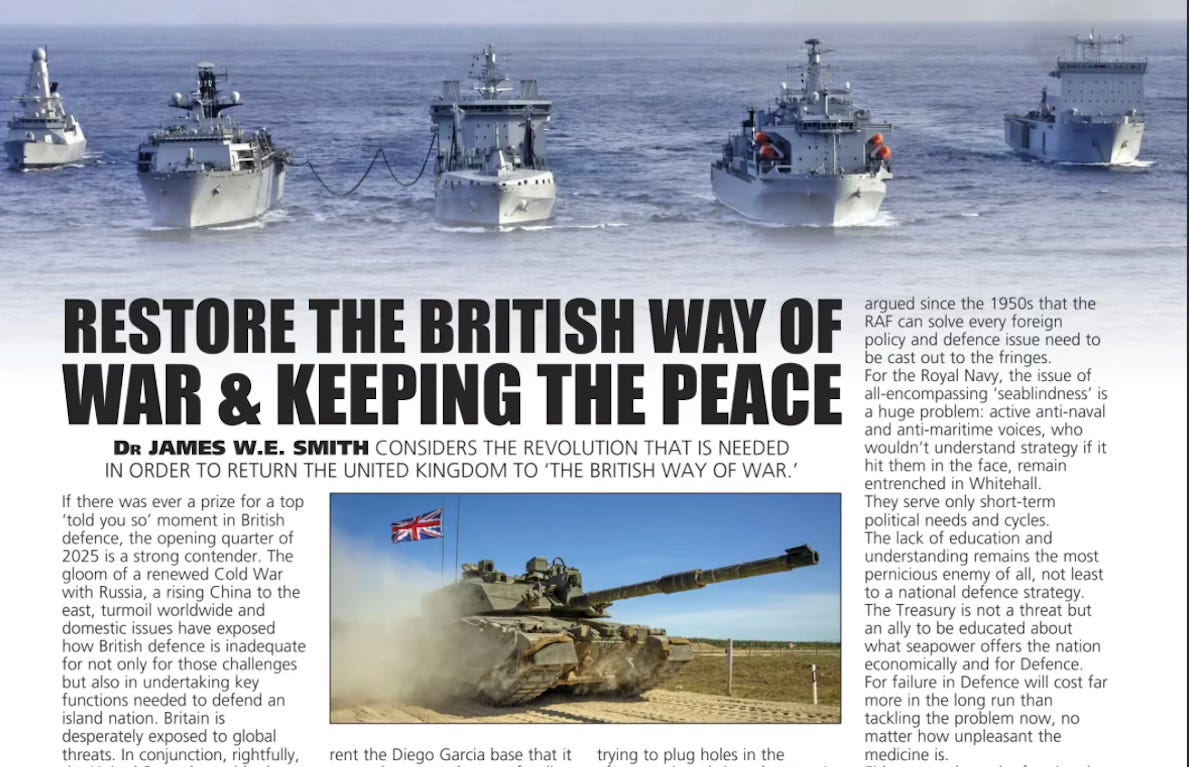
RESTORE THE BRITISH WAY OF WAR & KEEPING THE PEACE
Put the Navy-Army Team at the Centre of British National Defence
If there was ever a prize for a top ‘told you so’ moment in British defence, the opening quarter 2025 is a strong contender. The gloom of a renewed Cold War with Russia, a rising China to the east, turmoil worldwide and domestic issues have exposed how British defence is inadequate for not only for those challenges but also in undertaking key functions needed to defend an island nation. Britain is desperately exposed to global threats.
In conjunction, rightfully, the United States has told other countries to do more for their own defence. The exhaustion of world policing and the campaigns of the early 21st Century have broken the Americans, akin to how the British felt after WW2, with a desire to save the lives of services personnel rather than embarking on misguided land campaigns far away.
The current UK Government’s initial response to all the turmoil was a panicked public relations exercise to be seen as increasing defence funding and goals, all while trashing the on-going Strategic Defence Review (SDR), making it irrelevant like previous ones. Talk is cheap; walking the line another matter. Presuming the strategic disaster of the Chagos deal proceeds -with the UK paying billions of pounds to rent the Diego Garcia that it currently owns - the new funding for Defence will be like expecting a flour sieve to hold water.
There is little pleasure when the facts have been exposed so bare, for many warned this day would come. Many have drafted shopping lists of unaffordable equipment and capabilities, which are difficult to procure, presuming that they will be ready for conflict at a time of Britain’s choosing. The history of war is shows that you have to be ready to fight with what you have at the time, which may well not be when you choose. Which is why Defence is a long-term chess game rooted in a national strategy.
In Britain, lists of new equipment tend not to reflect geography, the requirements of a national strategy and cleave to the idea that Britain can be a great land power.
The harsh reality is that Britain is a small island that is financially broken, potentially unable to feed itself, barely able to manufacture anything and dependent on the flow of data and goods plus resources via seabed cables and pipelines and ships.
Any intelligent adversary who is studying history – and they are - and our texts on strategy, doctrine and warfare, knows how to strangle Britain, subsequently knocking it out of alliances. Or crippling those alliances by not allowing Britain to focus its military power at and from the sea.
Throwing mediocre amounts of money at Defence is akin to trying to plug holes in the aforementioned sieve, but won’t change the fact that it’s a sieve. Rearming Britain when, for example, it can barely make steel means that the dynamics have changed considerably even if understanding what British national strategy should be restored. The hill to climb has become a mountain - something that was avoidable. Power, oversight, leadership, direction, and action are required, which Parliament and military service chiefs used to have.
This should be a moment to look broadly at British defence and foreign policy. Both need to be wholly rebooted and the Royal Navy reconstructed. The era of deconstruction of a national strategy with maritime at its core - which started in 1914 and came into effect after the 1960s - must end.
The first is to understand that vast portions of Defence over recent decades have not delivered and cannot continue as is. Succeeding defence and military organisational reviews have all been as useless, or they would not be occurring as often as they have.
Instead, the reform of Defence and the Royal Navy must be unsentimental, unrelenting, and grounded in national strategy, which surely puts island security first.
Preserving and bolstering nuclear deterrence and Anti-submarine Warfare (ASW) should come first. Second on the mend list must be the relationship between Army and Navy - long undermined – and which should be built on the latest technologies. The nihilistic airpower theorists who have argued since the 1950s that the RAF can solve every foreign policy and defence issue need to be cast out to the fringes.
For the Royal Navy, the issue of all-encompassing ‘seablindness’ is a huge problem: active anti-naval and anti-maritime voices, who wouldn’t understand strategy if it hit them in the face, remain entrenched in Whitehall. They serve only serve short-term political needs and cycles. The lack of education and understanding remains the most pernicious enemy of all, not least to a national defence strategy.
The Treasury is not a threat but an ally to be educated about what seapower offers the nation economically and for Defence. For failure in Defence will cost far more in the long run than tackling the problem now, no matter how unpleasant the medicine is.
Either way, the task of national education on maritime strategy and Navy - an endless task - must address ‘seablindness’. However, the tactics of past decades for dealing with it have failed. The connoisseurs serving the same old approach ignore that the UK Government has cut warships, failed to support shipyards, and hollowed out capabilities; in short, governments have not been listening.
Fortunately, Britain does have a unique advantage it can call on in hours of need. Not, for now, Drake’s Drum or King Arthur, but 500 years of history and its examples. That is, ever since King Henry VIII started to codify a British way of war and keeping the peace into the national mindset. That experience of defending the nation is vital. If the Admiralty existed, the message would be clear: maritime strategy and the close relationship between Army and Navy would give the Govt the broadest options and global reach. That’s all the UK Govt needs to know; options matter internationally, and the Navy-Army team can offer it in a neat, efficient package and smaller MoD. Educating people about this is all that matters. It’s time to think wisely and plan boldly. Sooner or later, the ‘smash glass in emergency’ moment will come; the question is not if, but when.