
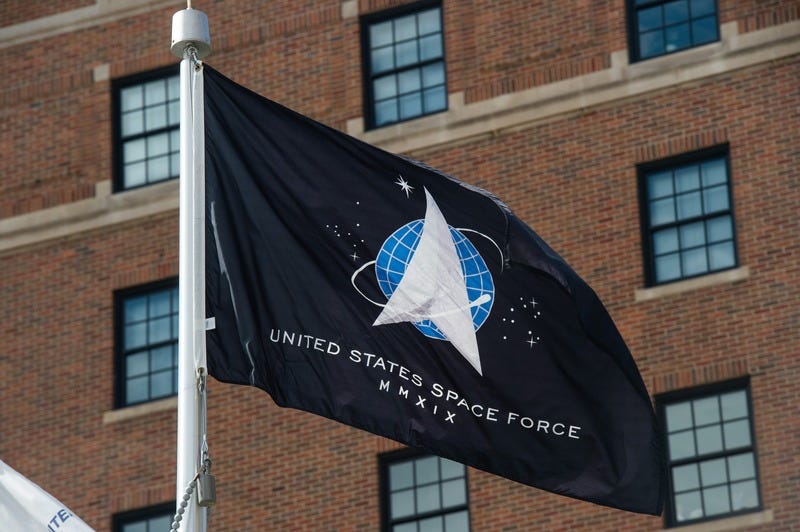
Nations rarely create new armed services. The United States has done it twice in eighty years: in 1947, when the air force became independent of the army, and in December 2019, when it created the Space Force. These events are rare and rightfully so, they matter because they force open questions that are normally kept firmly shut mostly out of lack of education and equally of where the answers may lead. How many services does a nation need? What should each do? How should they be organised, funded and directed to serve a national strategy?
In 2019, those questions were not asked, while the United States accepted that space needed its own service, they then placed it inside the Department of the Air Force and moved on. It was a decision made to close a debate, not to open one when it should have. Even at the time it was a compromise. The administration’s stated goal had been a separate Department of the Space Force, “separate but equal” to the Air Force, but its request to Congress in March 2019 placed the new service within the Air Force, on the model of the Marine Corps within the Department of the Navy. Arguably, an old score from the 1940s the USAF want to settle with the U.S. Navy. The result is a service that exists because space demanded something new, housed in an institution built for something else just as its own pilots and other services warned during the opening years of the so called ‘space race’. Space did not require a new service grafted onto an existing institution. It required, in fact Space demanded, an institutional arrangement designed for its particular strategic character, and the creation of the Space Force should have prompted a fundamental reappraisal of defence organisation as a whole.
Any honest argument must begin with the Air Force’s record. For six decades its excelled at various parts of America’s military space mission, and every service now depends on, or having worked in conjunction, with what it built: launch, missile warning, communications and navigation. That achievement deserves recognition, and the people who delivered it deserve respect. But that record is exactly why the question matters. Space outgrew the arrangement that nurtured it. The issue is not whether the Air Force did its job well. It is whether any institution built around one domain should be the permanent home of the service built for another. This is an argument about design and strategy, not about people.
Space is not simply another domain to be added to a list, this isn’t the same argument as cyber. It is the domain through which all the others now connect: a commons, like the oceans. A warship’s communications, an army’s navigation, an aircraft’s targeting, a nation’s financial transactions and its weather forecasts all run through orbit. Take space away, and modern military power and modern economic life would struggle to work. Space is also where military power is more tightly bound to commerce, science, law and diplomacy than anywhere except the sea. Commercial constellations carry military traffic while scientific missions share orbits with reconnaissance satellites. A single anti-satellite test can scatter debris that threatens everyone’s use of the environment for decades, including the country that fired it. No other military domain is so thoroughly shared, or so easily ruined for everyone.
An environment like that demands institutions designed for it. It needs a culture built around persistence rather than sorties, sustained presence rather than individual missions, and integration rather than ownership. It needs an organisation able to think across the civil, commercial and military boundaries that space erases. None of that comes ready-made from an inherited structure, the last, it could have been was abolished by 1964. With that in mind, space deserved something unique. America’s dependence on it made providing that a strategic necessity, not a bureaucratic preference.
The history of defence organisation teaches a lesson that keeps being forgotten: organisation is never neutral. The department that houses a service educates its officers, writes its doctrine, controls its budget and supplies its vocabulary. A new service placed inside an existing department inherits all of that, whatever anyone intends. This is not a charge of bad faith. It is simply how institutions behave. The Space Force’s advocates spoke of a blank slate, but a blank slate cannot sit inside a department with settled assumptions, relationships and priorities. The slate arrives already written on. This will hold American’s military space mission back and potentianly its civilian one too.
Behind the 2019 settlement lay a belief so familiar that it is rarely questioned: that space is naturally an air force matter, a vertical extension of air power. It is a cultural myth, and as new archival research shows, the historical record does not support it. The earliest institutional strategic thinking about space came not from an air force but from a navy. In 1945 the British Admiralty was already considering what rockets and operations beyond the atmosphere might mean for national strategy. In October that year the US Navy’s Bureau of Aeronautics set up the first American military study of satellite feasibility, and the Army Air Forces’ famous RAND study of 1946 was, in part, a response to it. The Navy built America’s designated satellite programme, Vanguard. It fielded the world’s first satellite navigation system, TRANSIT, and the first electronic reconnaissance satellite, GRAB. Its people formed the nucleus of NASA’s Goddard Space Flight Center, and naval officers made up more than half of NASA’s astronauts in the programmes that reached the Moon. That’s without plunging into the record before the Second World War where the record of the Royal Navy and U.S. shines.
The Air Force’s primacy was real, but it was made, not found. Its staff claimed satellites as early as 1946, arguing that they would essentially be an extension of strategic air power. The argument rested on an assumption it never tested: that air power was strategic in the first place.That claim became policy through an administrative directive in March 1961. One of the Navy’s chief space planners concluded at the time that nothing beyond the Air Force’s own insistence had made space its mission. The directive stood until 1970, and six decades of practice turned a bureaucratic decision into what looked like a law of nature. When the Space Force was created, the myth decided its house.
The two environments work differently. Air power is exercised in pulses: aircraft fly a sortie and return. Space power is exercised through persistence. A satellite on station operates continuously for years, far from home, with little capacity to be repaired or recalled. That is closer to a warship on a distant station than to a sortie. Even the language records how the thinking narrowed. The civilian agency created in 1958 was the National Aeronautics and Space Administration. “Aeronautics” literally means air-sailing, a word that acknowledged shared roots across traditions. “Aerospace” dropped the nautical half and turned a common endeavour into one service’s domain, extended upwards. Doctrine that still calls space “the ultimate high ground” shows how far that inheritance reaches. In orbit there is no up or down, and advantage depends on energy and position, not elevation. The template has spread well beyond the United States. France renamed its air force the Air and Space Force in 2020, and allies have too often adopted the same model by imitation rather than by analysis of their own circumstances or asking the questions that matter, what again, space demands, space deserves.
Creating the Space Force should have triggered a fundamental review of defence organisation as a whole. Whether NASA was or is independent from the air force or space force is an open question, one I answer elsewhere but on the defence side, a reset would have asked how many services a modern nation actually needs, and whether the divisions set in 1947 still reflect how warfare works or that taxpayers are caught paying for a Cold War juggernaught which in itself was based on dodgy analysis of the Second World War. It would have asked what each service’s roles should be now that every domain depends on space and cyberspace. It would have asked how resources should be allocated so that budgets follow national priorities rather than inherited shares. Above all, it would have asked how the parts should fit together to produce a coherent national strategy, rather than a collection of service doctrines competing for attention.
These are not new questions. They are the questions unification in 1947 claimed to settle. It did not settle them, and each new strategic demand since has been met by adding structures rather than rethinking the whole. Goldwater-Nichols in 1986 strengthened joint commands and the Chairman of the Joint Chiefs, but left the service departments intact. US Space Command was re-established in August 2019, and months later the Space Force was placed inside an existing department. Each addition was followed by fresh efforts to integrate what the additions had divided. Unity of effort, a naval contribution, unification’s founding promise, has been pursued by multiplying organisations and coordinating them afterwards.
Had those questions been asked, one option deserved serious consideration: a department built on the naval, or better, a maritime model. The irony of 2019 is that the Space Force was explicitly modelled on the Marine Corps within the Department of the Navy, yet the analogy borrowed the wrong lesson. The Department of the Navy does not work because one service sits inside another. It works because it is organised around a strategic environment, the maritime, rather than a single domain, and because it has long integrated forces that operate across several domains at once. The Royal Navy’s closer cooperation with the British Army in the Age of Sail shines as an example of coordination by command than forced subservice by unification. For America, the U.S. Navy sits under one civilian secretary, it brings together a navy on and under the seas surface, a Marine Corps on land, and aviation of both services operating from carriers and ashore. It is, in effect, a multi-domain department that predates the term. Navies always have been to some degree because they want to not just have the advantage at sea but influence over at land, a perfect analogy for space. A department built on that model, bringing together naval, Marine, air and space forces around the environment that connects them, from the seabed to orbit, should have been on the table: this for now the model I believe in although is dependent on lawmakers taking the future of defence organisation seriously again. The struggle between navy and air force has been disastrous for defence in many nations, when they are the inheritors not viewing the world as it is, not some dogmatic view of land-battles, but far more complex and now it could ruin space. But such a merger of navy and air force would have forced the right question: how to organise defence around the connections through which a nation lives and fights, rather than around the boundaries between its services.
Instead, the moment was spent on the narrowest question available, where to put the new service, rather than the broadest: whether the structure around it still made sense. The costs are already showing, and many are structural. In the 2026 NDAA, Congress required the Space Force to train and assign equal numbers of operations and acquisition officers, reflecting a divide that long predates the service itself. Debates over who should advocate for the Space Force are sharpened by its position as a service without a civilian-led department of its own. A May 2026 draft NDAA even proposed dissolving the Space Development Agency and the Rapid Capabilities Office, two Space Force organisations with semi-autonomous acquisition authority. Reorganisation continues piece by piece, with no reset to guide it.
The deepest argument against the 2019 settlement comes from how warfare now works. The communications that bind a modern force run from undersea cables on the seabed, through the sea and the air, to satellites in orbit. Cut a cable or blind a satellite and the whole system suffers. National strategy today must be conceived as one continuum from the seabed to space, not domain by domain. That continuum demands structures that cut across domains and integrate them on equal terms around a national purpose. Nesting one service inside another does the reverse. It builds hierarchy where there should be integration. It subordinates the newest and most connective domain to the assumptions of an older one, and it reinforces exactly the domain-based thinking that seabed-to-space strategy exists to overcome. You cannot integrate from the seabed to space by placing space beneath the air.
I make no secret that my research is rooted in naval and maritime history, and some will read the argument for a naval model as special pleading. It is not a claim that space belongs to the Navy. When the question was live in the early 1960s, naval leaders were themselves divided: some argued for a combined, all-service approach, while others warned that taking on space would strain a navy already under pressure to justify itself. The maritime tradition matters here not because of who owns it, but because it was built to think about environments as connected wholes, and that is exactly what space now demands. The same principle applies to every service. When a mission becomes a means of justifying an institution, institutional purpose begins to displace national purpose, and the organisational boundaries of defence become the conceptual boundaries of strategy. That is wrong whichever service benefits. No service has a permanent claim on relevance simply because of its past. This is now about seeing Earth and Space as maritime, something air force and navy can do if they choose to, now naval and air power.
Critics of reorganisation are right to warn against moving the deck chairs. Analysts have cautioned that any future Department of Space would need clear objectives, or risk simply reshuffling boxes. But that caution cuts both ways. The problem in 2019 was not too much reorganisation. It was reorganisation without strategy: a new box added to an old chart, without asking what the chart was for.
The Space Force was the right decision. Its house was the wrong one, and the reset its creation should have prompted never came. Space demanded an institution designed for it. The integration of warfare from the seabed to space demands that the whole of defence organisation be looked at again, starting with national strategy rather than service boundaries. What that should look like is a larger question than one essay can answer. But it will be answered. The only choice is whether it is answered by design, or forced by failure.