
Abstract: Dr James W.E. Smith will explore that while understanding of the utility and science of wargaming and its professional practice in civilian and military communities has advanced, knowledge of the art and philosophy of wargaming remains misunderstood and underserved. James will critically analyse the meaning of questions and themes like: “Who does wargaming serve?” and ‘the history of wargaming’. He will explore the ‘use and abuse’ of wargaming where its role in the development of strategy and influence on defence policy has often been misunderstood along with its fundamental relationship with strategic studies and roots in military history.
Lecture: (Text presented as read)
It’s a great pleasure as member of the King’s Wargaming staff to deliver a keynote lecture especially during King’s wargaming week. When I crafted this lecture, I made the title a statement but reflecting not just on this week’s events but the years of research here at the wargaming network, I’ve added a ‘question mark’ at the end, perhaps setting the tone for this lecture.
So far at Wargaming week we’ve engaged in discussion and panels across research problems, respectability issues, nuanced questions from supply and demand including complexity, immersion, accuracy, validity and effectiveness, to name a few. I’m not going to deep dive into those again but instead take a step back to look at the broader picture of where we are in the 21st century, reflecting on not just my own experience but what I’ve learnt from we reignited wargaming here at King’s.
You’ve probably not seen many of the core staff since the creation of the Wargaming network back in 2017, because we’ve been working tirelessly from day one to deliver on our ambitious agenda. At the core of that agenda, as is the King’s tradition:
is research.
Our goal:
To advance the theory and application of wargaming as a method of inquiry and a method of learning and teaching.
It’s worth recapping on the roots and progress of the Wargaming Network, including future direction as it somewhat interweaves with this lecture topic. Afterall, research into wargaming and the direction it takes shapes our understanding of the relationship between the science of practice with the art and philosophy of wargaming.
In 2018 the School of Security Studies identified wargaming as a priority area for research with the goals of advancing and democratising wargaming education, developing wargaming as an academic discipline and applying wargaming to generate and deliver big ideas in service to society.
That was a rather bold statement to make, for it reflects the oscillating nature in which interest, use and application of wargaming whither that be in education, academia, research, government and the military had had over the past century, right around the world. Academia remains cautious that for example wargaming has no fixed terms of reference, while other fields and disciplines do.
It’s easy to sit behind the castle walls of the bastions of the professional application of wargaming, like professional military education while both in the halls of power, and places of education and research perspectives on the use of wargaming has had a far more complicated, difficult, and convoluted path. To the point in which, one day wargaming was the ‘in’ thing, the next it seemed of niche professional use or that of the hobbyists, although as important as they are.
From my own research background in History and Strategic Studies, where applied history is the foundation of strategic thought and theory, I can say this:
If you can’t communicate clearly and coherently something complex particularly to non-subject matter experts, like high-level decision makers and in that explain include plainly and convincingly the ‘why’ and ‘how’ you can’t admit you entirely know the thing you are talking about, trying to advance or preserve.
This underlines and was one of the foundational pillars to why the team that came together in 2017, made up of: Professor Phil Sabin, Dr Ivanka Bashkava Dr, Anna Nettleship, Dr Aggie Hirst and myself.
Joined later by Dr David Banks, PhD and Masters students. It’s a young and diverse team with broad interests and vast research expertise which I, maybe bias-ly believe, sets a positive message for the future of academic wargaming research.
The team provided the evidence to the university that there needed to be place where research, collaboration, and debate outside what had become viewed as the traditional places of wargaming,
--usually defence colleges and even then,
so often relegated to the basement or loft could take place. We’ve started building the repository for games, digital and print publications at the King’s library and the Liddle Hart Archives are working to create the database of games, papers and archival materials by wargamers that will in time serve as a future research tool.
So, we have not been standing still.
Historians have a rather soft spot for wargamers in that sense for they know that wargamers come from all walks of life, a broad church and with different interest areas beyond obvious professional military tactical application. Historians are so often relegated to dusty little offices and left to get on with their own thing,
--mostly because historians like it that way,
but sometimes historians like wargamers particularly in the latter half of the 20th century feel they can be wheeled out when required and then promptly returned to their dungeons.
In War Studies this problem was circumvented because the roots of the department, long before the formal creation of the Department in the 1960s, is in applied history. A methodology that respects facts, where history can be used without its abuse, to gain insight from for contemporary discussions on topics like national defence strategy, policy, and doctrine and beyond.
But the message in that bold statement was due to analysis that had identified that not only did wargaming lack the body of research as a method of inquiry beyond its operational or practical use:
--which often came in classified form,
but critically that it never stood up to rigorous academic scrutiny. The oscillating nature of interest in wargaming by government or higher education was never going to end if a body of scholarship was not built to support it. It is because wargaming lacked the body of work and consistent effort in a place of research that could enable that body of work to pass the test and set a benchmark to be able advance wargaming as a field[JS1] .
We identified this as a root problem akin to a self-fulfilling prophecy that needed to be resolved and therefore why wargaming needed research hubs and those hubs needed to be based in nexuses away from biases or influences that had seen wargamers retreat to all too often places such as a small expert community and mostly in classified military environments.
You can look elsewhere for this point on maturity and body of research. If you were to say look at domains
––land, sea and air––they have been able to call on a body of scholarship––rooted in the historical method of applied history––for generations, if not centuries when considering their role in broader national strategy and statecraft. These domains were only integrated into a national defence strategy only after scholars had assembled a substantial body of research based on experience and felt confident to develop coherent outcomes from it. No wargaming should be no different.
Advancing the field of wargaming meant that understanding of what wargaming can and cannot offer was a matter of education and although founding the wargaming network was a moment of intellectual excitement, it was clear there was a high to climb and we are still climbing it.
But while wargaming contains analytical potential, there are challenges to producing reliable knowledge through wargaming about questions into the 21st century. On the positive, some look to add wargaming to their toolset to support investigation and study on contemporary questions and challenges, such as:
Future health crisis, addressing an era of renewed great power competition, how emerging pressures over culture, finance and resources could impact national and world events, and advancing thought on less accessible mediums like the strategic use of space and the global commons that is the oceans that maintain civilisation as we know it and so critical to our infrastructure, equipment that runs on the seabed.
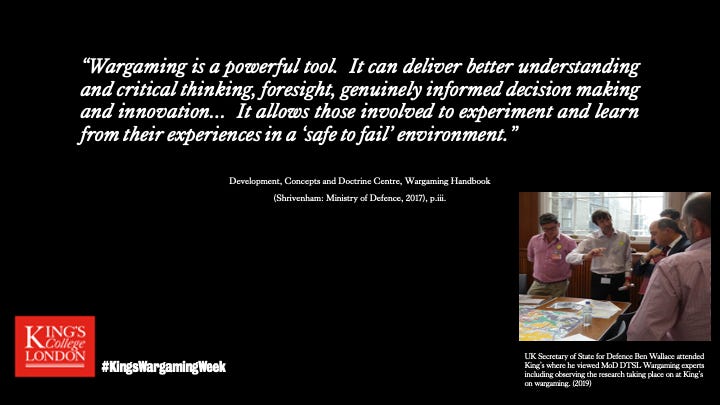
However, while wargaming’s value as a method for learning and teaching is growingly accepted, its value as a rigorous academic method of inquiry remains contested even with growing high-level attention from the states anf goverments. Here in the UK you can see the growth in high-level attention such as with the Ministry of Defence’s Wargaming Handbook from the Development, Concepts and Doctrine Centre. Its opening pages confidently state:
Quote:
“Wargaming is a powerful tool. It can deliver better understanding and critical thinking, foresight, genuinely informed decision making and innovation... It allows those involved to experiment and learn from their experiences in a ‘safe to fail’ environment.”
End quote.
Another example of the UK Secretary of State for Defence attended a wargaming event here, observing wargames and learning about research taking place at King’s. You can find examples of this in other nations such as America, Australia, Japan and France.
It’s natural for the state to search out for all tools it can to use to address questions that it has, wargaming is one of them. Yet most tools can be equally abused as used. Wargaming will face the same challenge that those who are trying to educate and inform on strategy or thinking about policy and doctrine faces:
That theory’s, concepts, results, outcomes, analysis and so on do not fit or convince or or trustwothhy or responsive into neat little political cycles or newsbites.
Rather educating and inform is an enduring task.
Wargaming being embedded and most importantly understood, remains a question of turning short-term positive momentum and perpetual ‘ups and downs’ of interest into something more sustainable, in short: ensuring civilian and military decision makers across a range of areas, transition from viewing wargaming as a:
‘nice optional’
Into a tool they want to keep in their arsenal. A tool not to be kept in the back pocket and rolled out as and when but instead is equally part of a package to innovate, reflect, test consistent, transitory or new problems but nor must it be over sold or abused by opportunists who see it as a solution to all their problems. It is a serious tool that requires effort to sufficiently update to address the times it is used in.
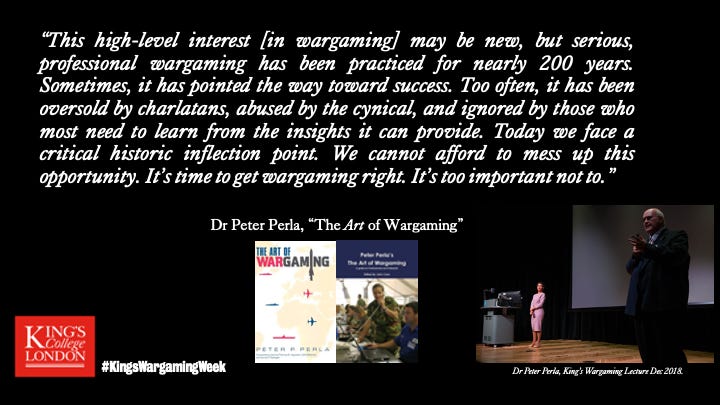
In our inaugural keynote, our first public wargaming seminar back in December of 2018 we launched with a lecture by Dr Peter Perla. Dr Perla’s seminal book:
“The Art of Wargaming”
Was first published in 1990 when the topic of wargaming wasn’t as popular as it is today. The lecture opened from quote from his work:
Quote:
“This high-level interest [in wargaming] may be new, but serious, professional wargaming has been practiced for nearly 200 years. Sometimes, it has pointed the way toward success. Too often, it has been oversold by charlatans, abused by the cynical, and ignored by those who most need to learn from the insights it can provide. Today we face a critical historic inflection point. We cannot afford to mess up this opportunity. It’s time to get wargaming right. It’s too important not to.”
By introducing wargaming at King’s in this way, clearly a point was made it was time to get wargaming right. For there are many different parts to this puzzle, some of that our speakers in our public seminar series have addressed over the years and more than I can not alone cover here today.
We’ve tackled some of these issues head on at King’s to contribute to ending the uncertain nature of interest in wargaming.
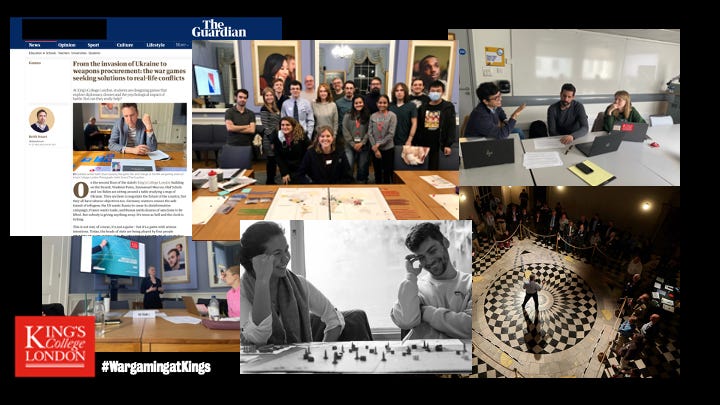
To date: we’ve now hosted over 20 wargaming lectures from a broad and diverse set of backgrounds, interests and uses for wargaming. Our MA Wargaming and Short course in Wargaming are arriving shortly and we’ve gained multiple PhD students from around the world to study and research wargaming. All with highly unique and targeted questions that will build the whole.
Elsewhere a contingent of MA wargamer designers have delivered new wargames, founding buisnesses and who have left King’s to go onto commercial success. We hosted the new media and British press last year for wargames highlighting students work and every year we offer an introduction on wargaming to all King’s staff and elsewhere students are invited to trial the CSAGE wargaming. During the COVID pandemic we held an online conference with King’s Medical School to how wargaming can support thinking through future health crisis.
And of course, the King’s wargaming staff have been busy releasing their own papers and upcoming publications.
All of this has had a general theme of diversifying wargaming’s culture and democratising it intellectually which is why Wargaming is sat in the School of Security Studies enabling collaboration with research across War Studies and Defence Studies because wargaming cannot and must not sit in isolation. Access to world-class experts of topics such as nuclear deterrence, strategic theory, international relations, defence policy, cyber warfare and a long list after that can share knowledge but also feedback how wargaming could be useful and its limits for them. This is all part of that process because if wargamers exist in an echo chamber than the reality is that policy and decision makers will continue to question the efficacy and relevancy of wargaming if they cannot see how it is part of the jigsaw in which to answer questions because they are not questions of wargaming, wargaming is supporting answering questions that originate from these other fields and areas.
To use a phrase:
wargaming cannot be about wargaming for wargaming’s sake nor can it be a solution in search of a problem.
There are of cause concerns that the professional wargame could consider, my particular favourite flags are some of the following statements from the wargaming community:
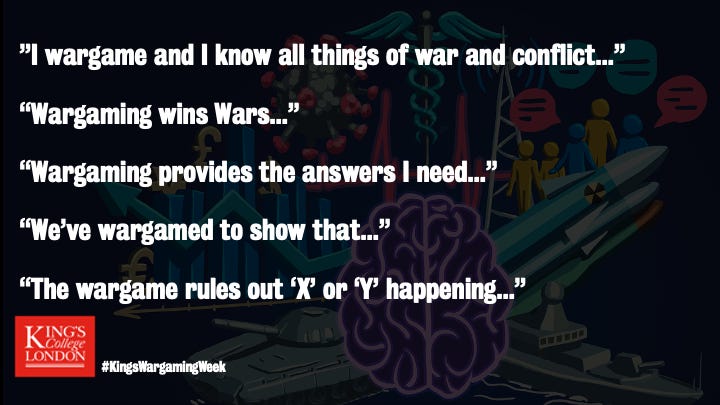
“I wargame and I know all things…”
“Wargaming win’s wars”
“Wargaming provides the answers I need?
“We’ve wargamed this to show that…”
Are these statements of fact or where is the body of scholarship to prove any of these statements?
Are these kind of approaches wise where overstating what wargaming can and cannot do?
What happens when the expectation in Government or the military is that wargaming is the ultimate tool and has been advertised to provide answers of certainty?
–for those of us in history and strategic studies, we know the dangers of technological absolutes entering the minds of military and civilians alike…we’ve seen it time and again particularly after 1945 where there is always the next best thing rather than understanding it takes a cohesive whole of all sorts of things and tools to help shape policy, doctrine, operations and so forth and equally you could argue this applies to medicine, cyber, banking, social and environmental.
Can to some degree statements like this as interest in wargaming and its professional usage be setting up wargaming for failure?
I wonder if we could reverse one of those and say, if wargames are bias to give an answer that is wanted or needed, it’s a sure way to negatively impact the outcome of a war or conflict if you move the chess pieces to give you what you want to hear and that is reflected in policy, doctrine, force structure and so on. One can only hazard a guess at the frustration of military or civilian leadership who are told to have excessive faith in just the outcome of model or wargame, it becomes a matter of over promising and under delivering.
Wargamers of course must be wise to not set up wargaming for failure in the 21st century as interest increases, rather then look for clear defined answers, it’s the journey weither designing, executing or researching wargames, it’s that safe to fail environment and try new things and explore new ways.
Perhaps a superior way for wargaming is at the heart of wargaming:
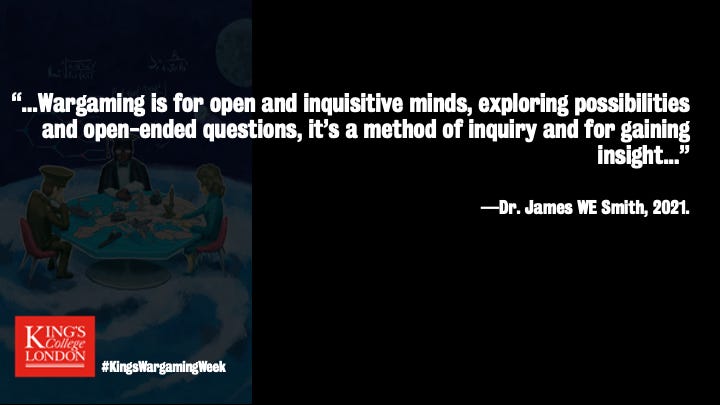
‘Wargaming is for open minds and exploring possibilities, it’s a method for inquiry and for gaining insight…’
We really like this word: ‘insight’ in strategic studies and history. It brings in the sound methodological practice of focusing on experience and recovering the useful past, analysing it provide insight to support addressing contemporary questions.
This very much leads into the core questions that cannot and should not be avoided, ones that kept fresh in mind as we bring on new generations by placing wargaming in a multi-disciplinary cross disciplinary environment. These questions being:
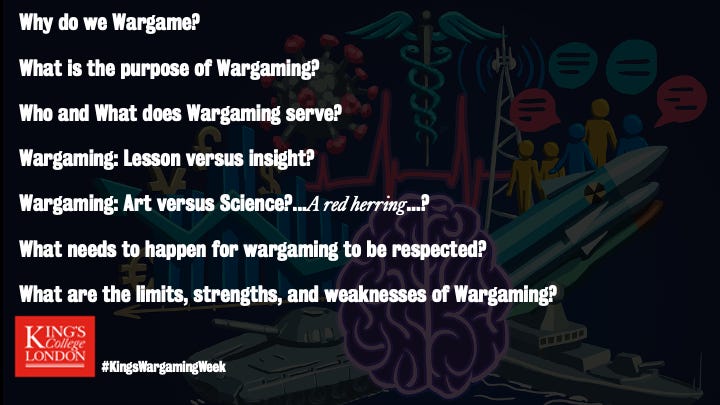
Why do we Wargame?
What is the purpose of Wargaming?
Who and What does Wargaming serve?
Wargaming: Art versus Science?
What are the limits, strengths, and weaknesses of Wargaming?
I imagine if I asked around the room for answers to these questions, I’d probably get a range of answers, even if some would be similar to others there would certainty be variations.
I can’t do a deep dive into them today and there are some fantastic scholars from around the world who have really focused on them who are worth reading, some we’ve featured in our public wargaming series.
However, I’d argue these questions are philosophical ones, but not ones that should ever be disregarded as we move forward with advancing wargaming as a field into the 21stcentury. For I side with that wargaming is a field and not a discipline.
These questions are the philosophical roots of wargaming, for the roots of wargaming are not in science but anthropological in origin as they are about decisions and decisions made by humans. By keeping these questions at the heart of wargaming we can avoid statements which can lead to pitfalls that raise suspicion and doubt adding to that oscillating nature I mentioned earlier of how government, the military and academia view wargaming.
I’ve got a historical case study of new research to share with you, I completed here at King’s. It builds on the themes I have just mentioned and why those aforementioned questions are important.
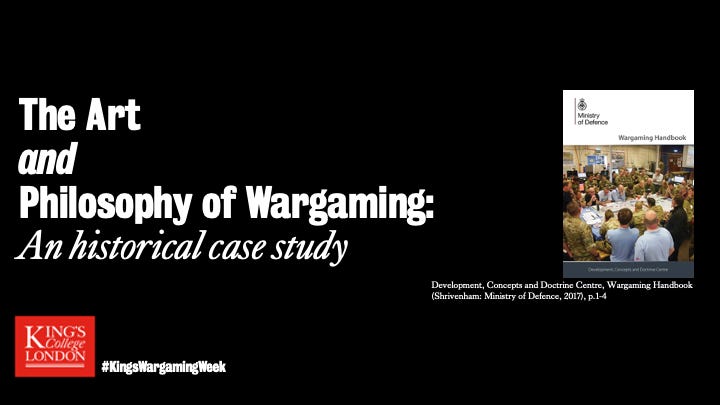
The 2017 UK Ministry of Defence handbook marked a positive turning point in the acceptance of wargaming as a tool for defence, security and intelligence, its free and open access to download. In other nations, similar publications already existed or on there way, bringing the knowledge and expertise of countless individuals involved
However, it underlined two problems. As I mentioned earlier, public and high-level decision maers understanding of wargaming is often based that a view of wizardry that takes place in the lofts or basements of the defence establishment. A natural outcome when academia has not yet built up the body of scholarship to support theory and practice. The other is developing understanding of the history of wargaming, which is somewhat lacking and to date, the history of wargaming has often been left to hobbyists who lacked the resources to rigorsly resolve historical queries.
Without knowing where wargaming has come from, the journey it has been on, it’s unlikely we can chart a permeant positive future that breaks this cycle of engagement and disengagement by government, business, organisations and so on. In short:
“Without knowing the history of wargaming––the why, the how and where––we will struggle to develop its future.”
If you turn to the introduction to wargaming pages in the MoD handbook, the history of wargaming is a small section in which it details German wargaming, rather skims the British army adaption in 1905 and then jumps to the US Naval War College’s interwar gaming which seemingly has grown to be the home of naval wargaming ever since.
This is rather bizarre being an island nation to imply that no other form of wargaming has taken place to develop wargaming as professional field. A potential oversight, but we can build on that with academic research
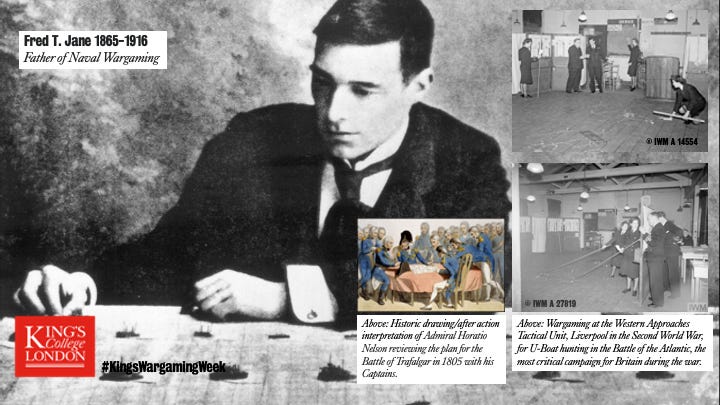
Fred Jane who by 1906 had popularised not only wargaming but wargaming to the public and government including the Admiralty?
Or why was the war defining efforts of the team of men and women in World War Two developing bespoke and novel forms of wargaming to aid convoy protection and destruction of enemy submarines omitted and relegated to a footnote later?
The efforts of these trailblazers and pioneers have been fundamental to the development of wargaming. Professionalising and developing institutional memory in the past to have impact on policy, strategy and both operational and tactical doctrine. So, the justification and examples of how wargaming had real world impact exist. It’s just after 1945 where we have seen this oscillating relationship of how wargaming is taken seriously or not and it is not a coincidence that efforts of the aforementioned often forgotten.
So academia has a huge role in wargaming rather that be theory or practice to ensure debate and discussion on wargames is democratised because doing so opens up greater avenues of understanding.
I’ve picked on this particular case study for another reason because we now know two new things:
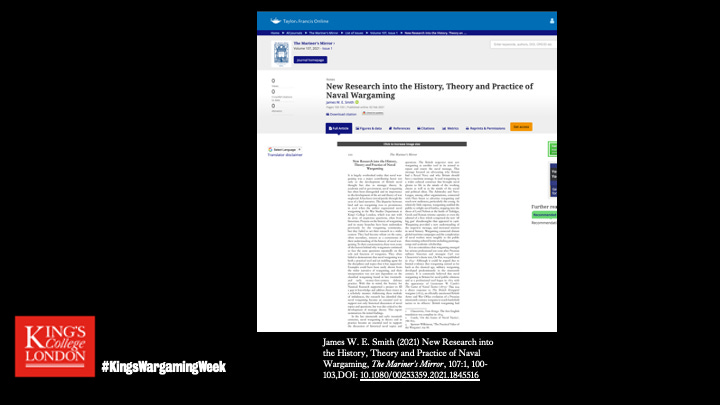
The first wargaming in Britain started before Prussia in the 1820’s. Two Prussian army officers developed a set of Instructions for the representation of tactical manoeuvres under the guise of a Kriegsspiel, or rather a wargame. In fact, evidence points towards it probably starting in the Georgian Navy, the Royal Navy, in the second half of the 1700s. I’d need an entirely separate lecture to talk you through that and research is available in a journal that starts to lay out this argument.
I’ve always been cautious over the terms ‘modern and contemporary wargaming’.
I suspect we could hypothesise that wargaming was around in the classic period with Roman’s, Greeks and Persians but evidence would be key to that argument. Today we have to think in roots to the contemporary period. That foundational 1st phase in the 18th and 19th, second phase 20th century and maybe the in the 21st century the 3rd generation.
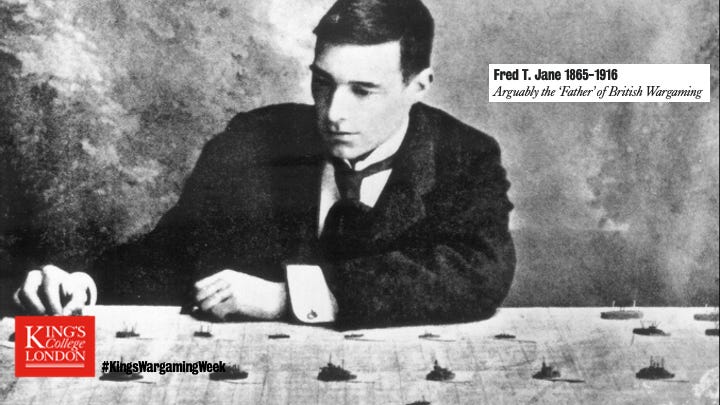
Returning to Fred Jane is important because the narrative of wargaming in this nation shows that wargaming went beyond a mere matter of practice or technical considerations but culture, policy, strategy, history and more.
Wargaming was a major contributing factor to the development of British naval thought and maritime strategic theory in the early 20th century. Naval wargaming in theory and practice became an essential tool to support both historical and future discussion of naval and military topics and questions.
It feeds into a bigger debate and study because wargaming is serving a task that is not science, as war and peace is an art and not a science. It’s practical execution the latter, so there is symmetry.
Jane was an example that on the surface our knowledge is about ‘who made what’, yet so many times these innovators where not doing wargaming for wargaming sake but because they wanted to achieve, gain insight or understand something else, something bigger.
Jane understood that Britain had to use every tool at its disposal to get a strategic advantage due to the reality of an island. It was his wargames and understanding of the need of promote the naval message – advocacy for the Royal Navy – that was equally significant. His contribution to wargaming alongside his cultural impact was important. Jane was one of the few who understood the need to modernise advocacy for the Royal Navy. Failure to modernise the message would leave the service vulnerable to growing challenges to the Admiralty’s prominence in Whitehall, and the loss of maritime influence in government. These challenges to the Admiralty and Royal Navy reached a conclusion between 1964 and 1966, with the end of the Admiralty.
Jane supported by the Admiralty and Navy League, amongst other organisations connected with Fleet Street to advertise wargaming and reach to new audiences, particularly the young. At relatively little expense wargaming enabled the public to refight naval battles, stepping into the shoes of Lord Nelson at the Battle of Trafalgar or Nile, Greek and Roman trireme captains, or even the Admiral of a fleet comprised of the new iron and steel warships.
Importantly, wargaming connected distant global maritime campaigns and the complexities of naval warfare more tangibly to the public and government policy makers far more than existing cultural forms including paintings, songs and in some cases, scholarship.
It is no coincidence that wargaming emerged for serious professional use soon after Prussian military historian and strategist Carl von Clausewitz’s classic text, On War was published in 1832, something Jane was advised about because the British Army’s subsequent direct response for Prussian wargames, the British Kreispell in 1872 was a warning flag to how continental ideas to national ways of war could seep into minds by all sorts of ways including wargaming.
It was of course Clausewitz famously wrote that
Quote
´in the whole range of human activities, war most closely resembles a game of cards´.1
End quote
Avoiding continteal ideas seeping further into British Army thought was prime, because these ideas are dangerous and threatened understanding of the British way of war which is maritime. Maritime because as an island Britain’s resources are scarce, prolonged land wars impossible and the combination of a need for economic war and blockade are vital. Jane advised on wargaming to and listened closely to
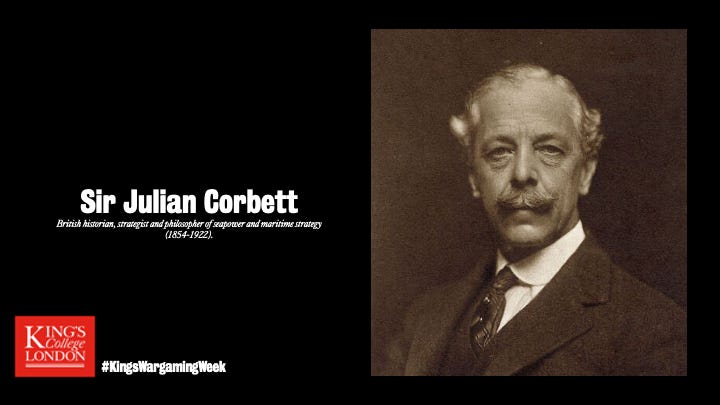
Sir Julian Corbett.
Corbett was Britain’s greatest strategic thinker to have ever lived and as a great strategists he had to be a historian. Corbett had achieved insight to create war plans by recovering the useful past although he focused on use of British maritime power to maintain the peace. He assembled a vast body of historical research and analysed trends, facts and evidence by using the sophisticated methodologies in which to recover enduing insight from the past. He studied as far back as the Spanish Armada of 1588, and on the basis of analysing centuries of British military, foreign and national strategic effort, he began to develop coherent national strategic doctrine, underling with evidence facts and realities to how Britain waged war and peace. In short, he had asked the question of how Britain had managed to secure itself and grow to be a great power as a relatively weak island. He proved to decision makers as an official Government historian having worked closely with the Admiralty and Naval officers, that maritime strategy was at the core of national strategy and policy.
This was his interest behind wargaming and it was bought into war courses for civilian decision makers and senior naval personnel.
The British army wargame of 1872, an officially sanctioned British Army and War Office evolution of the Prussian 19thcentury wargame has risen to teach battlefield tactics to its officers. The Admiralty endorsed naval wargaming, dismissing British Army Officers fear of invasion, considering the Royal Navy remained supreme. British wargaming had become another front where foolish advocates of land focused continental thought attempted to displace British maritime strategic policy. The powerful potency of Admiralty support with its influence in Whitehall, ensured that British naval wargamers had started developing their own wargames in under twelve months from the War Office games taking place to not only start the field of naval wargaming but to add another tool in it’s pocket to support the wider task.
The founder of the modern naval history profession and arguably war studies, long before Sir Michael Howard founded War Studies in the 1960s, King’s Professor Sir John Knox Laughton RN (1830-1915) recognised wargaming’s utility, which was furthered by Corbett.
--so side note, King’s engaging with wargaming has been happening since the late 1800s, so we are a good home for these types of discussions.
Naval wargaming very much a British product and long before the US Naval War College really took over in a serious capacity perhaps in the 1930s but certainly post-1945 and computerised era through to today.
Corbett linked wargaming to his history and strategy lessons on the Royal Naval War Course at Portsmouth and Devonport. Corbett was not interested in the practical considerations of wargaming, he left that and encouraged professional wargaming staff but, he promoted wargamings use to officers for tactical considerations in Devonport and Portsmouth.
More importantly, it was the games that took place at the Royal Naval College, Greenwich.
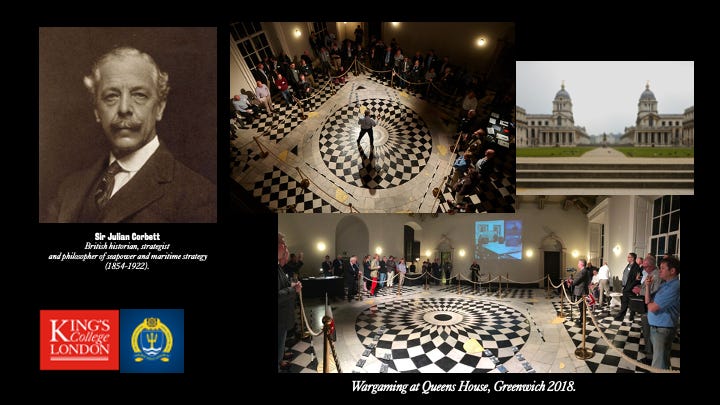
It’s one of the reasons in 2018 in partnership with my colleagues from the US Naval War College, we hosted wargames in Greenwich, not just to mark the centenary of the First World War but emphasis this important connection.
Corbett was concerned that if land perspectives of warfare shaped wargaming too much, it would undermine not only the necessary close cooperation of army and navy but by thinking only in land terms which is a default for a human for its where we live,
that in the case of Britain, it would complicate understanding and confuse high level decision makers of the bespoke national strategy that Britain had developed through maritime strategy.
Prussian ideas, that wargaming is purely tactical or for armies are something to be guarded with to this day. This is demonstrated as wargaming’s usefulness with the pace of technology has expanded to support addressing a range of challenges from crisis and risk management such as pandemics, disaster planning, terrorism, nuclear deterrence, cyber and emerging domains like space warfare through to more of course to the more classic military tactics and exercises.
As Fred Jane was equally interested in the practical development of wargame rules, he saw the other side. Corbett never focused or was interested developing the practical side of wargaming and naval wargaming. Corbett advanced how it can be used as a tool to educate on ideas and history rather than what the outcome of game or the parameters of a set of rules. It was a utensil or tool to be used but rarely gave clear cut answers and attempts to do so were pursued, they were approached with suspicion. There are issues with even the best designed wargame: a flaw in the process which is usually the human––who inevitably overlooked something, is biased, or modified the game one way or another as the real world can never be duplicated to identically.
Corbett invited senior government officials, the City of London, military, and business leaders to view the wargames and listen to historical lectures because it was a highly useful way in which to make concepts and theory of national strategy and distant military campaigns more tangible to whose who would fund it and have the final say over policy, doctrine and strategy.
However, it was noted, that if wargamers sat in basements not getting enough fresh air and sunlight they become disconnected from the reality of the task but also overconfident to the limits of wargaming, rather it’s not a holy grail to win wars. Instead that required engagement that rested ultimately in what Corbett demonstrated which started with the study of history.
Corbett stopped short at permitting wargaming decide policy as the task to inform the policy-making of national policy was a strategists task, but reflected that wargaming was a useful tool to gain insight from. It was for wargamers and wargames to help identify, test and shape tactical considerations and answers, as occurred in World War Two at ground-breaking Western Approaches Tactical Unit in Liverpool as the campaign for the Battle of the Atlantic in the Second World War.
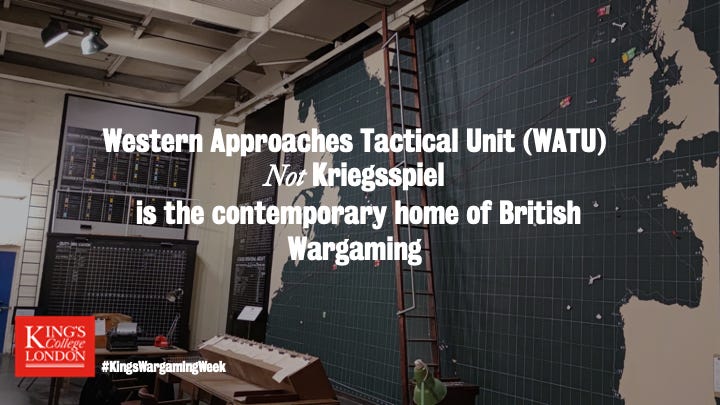
A campaign that was both war deciding and the supporting the maritime campaign central to Britain. Naval wargaming, like all forms of wargaming, has had a difficult and unsteady relationship with government. In the 1930s the UK government had reservations about wargaming. However, wargaming became absolutely fundamental to efforts in the Second World War particularly those of retired British naval officer Gilbert Roberts and his team. A team predominantly made up of the WRENS at WATU. They helped secure victory in the Battle of Atlantic by using, designing, testing and applying new methodologies to naval wargaming whose output were soon disseminated to the fleet. Winning the Battle of Atlantic, 1939-1945, was more important to Britain’s survival than the desultory air battles in the summer of 1940. Unless shipping and convoys were protected from the U-Boat threat Britain would be forced to capitulate. Winning the battle of the Atlantic wasn’t an ‘maybe’ could be addressed but there was no choice, it had to be won and contrary to claims by other historians, every other battle the nation was engaged in was a secondary priority that had little hope of success if national logistics were not secure. It frames the efforts of wargamers at WATU central to this process as they integrated wargaming, intelligence, R&D to defeat the U-boat menace. Today new evidence points towards wargaming reducing the main battle of the Atlantic from 5 years to just 20 months. Although the campaign was 1939-1945, the longest military campaign after that of the Napoloenic wars, the actual battle took place between 1941 and 1943, after which the U-boat threat was never going to deter allied war plans.
WATU is the best example of a useful successful research wargame, since the limited calculable and variables allowed for constant iteration between WATU’s game and real-life experience in the Atlantic which permitted the WATU team to develop a highly effective tactical model of reality.
Beyond the military, wargaming for education is but one tool, and arguably there are better ways to teach history. This sharpens the argument of wargaming as tool in the arsenal to get minds to engage and give players a deeper and more enduring feel for the underlying dynamics of a given type of task or challenge by involving them in simulated decision making as part of a process of active learning.
Wargaming of course does take liberty by great simplifications and gross exaggerations where the complexity of the real world is too difficult to replicate in a perfect model, particularly how humans are imperfect. The key words related to games or wargaming isn’t “war” or “games” but “people” and “decisions”. Youu learn this from not the practice of contemporary wargaming but studying the history of wargaming.
Arguably WATU represents the start of contemporary British wargaming post-1945. Yet those classic tactical roots today are not enough when warfare is inherently more complex, political, social and even cultural. Not just in Britain but elsewhere in the world wargaming again had difficult relationship with government and the military after 1945. One that in the 21st century I think the tide is now turning on. But I also suspect the future of wargaming is fraught with dangers and pitfalls, where momentum must be maintained and pitfalls avoided because the future message of wargaming is one of relevance as part of a greater whole, particularly as wargaming has left the tactical confines some time ago.
Therefore wargaming is more than just ‘wargaming for wargaming sake’ or some of the overselling of more questionable statements I mentioned earlier.
So why am I bringing this up after a micro lecture in history and strategic studies? Well wargaming is a welcome tool in our intellectual arsenal whither that be military, private business, government, or education but a future that requires methods of inquiry which connect professional wargamer, academic and those who know nothing about wargaming, however all have a mind to learn but are asking different questions,.
Corbett is a good example of that. There is a heritage to draw strength from as the proven case study already exists whereas a tool has been used to inform and power research, debate, discussion on important questions. I think this an encouraging tale to take home and communicate as I know so many seek to advance not just the but develop understanding and respect for wargaming in many walks and jobs and roles. It underlines why the history must be properly understood.
The Practice of wargaming may very well be a science but I’d argue the art and philosophy of wargaming is about understanding its place amongst the whole, where the history of wargaming already tells us about the limitations and strengths of it. Science is always tempting to default view of wargaming particularity as wargaming is dominated by analysts who want to disprove or prove new or old hypotheses. There are always eyes as Peter Perla and Phil Sabin concluded in their own lectures here, to look to the future to broaden understanding, diversity, democratisation and participation through next generations.
Peter Perla concluded and I quote:
“Wargames entertain. They stir the imagination. Wargames educate, they inform the intellect. Wargames engage, they stimulate the intuition.”
But we now I’d argue we are perhaps entering a 3rd new generation, that initial work of the 19th and 20th century, the transitory and serious stage of the 20th century and now into the 21st century where clearly the interest in wargaming is in a new renaissance.
Serious Wargamers must build on the work before, reaching critical mass were we move beyond questions like:
What is wargaming?
and
why do we wargame, or how does this work,?
We move into: How do we embed wargaming usefully into contemporary questions wither they be on climate, technology or the future study of war? How do we do this accessibly beyond not just the wargamer but individuals, groups, governments who are asking serious probing questions.
Yet to look forward is to be mindful of historical underpinning of wargaming as it is the foundation of everything wargamers do. You can hardly think about the future without revisiting the past. An irony as wargames so often drive wargaming hobbyists and professionals to study history, which in turn has drove more wargaming and returned to the study of history.
It reminds us our past as well as future is about human interaction irrelevant of AI, technology, computing power or if it takes place on the seabed or space.
In conclusion the key thread in the art of and philosophy of future wargaming is ensuring that wargaming remains a useful tool with a permeant presence therefore breaking the cycle of interest and disinterest towards it wither that be military or professional civilian.
Wargaming remains relevant not because of the next best version of a game or method but by constantly being benchmarked and reflecting upon by these key questions. Yes, to some degree they philosophical questions but they act to safeguard and by doing so keeping wargaming advancing and developing fresh ideas to be useful and relevant to the times in which new and old games serve.
If we keep asking these questions rather than resorting to well-travelled and familiar lines which are insular in approach than I suspect wargaming has only a bright future and academia will step up to the plate to build that body of scholarship very much needed to act as a foundation in the future. It’s going to take the community and the network of wargamers, and not just dedicated wargamers to keep the message relevant and cast away suspicion, something we have experienced first-hand in academia.
The key questions for me is always going to be:
Who and What does Wargaming serve?
It’s why I chose the example I did today to explore. As many have said about the next generations and wargamers future, it requires the context of the past to point out its usefulness in the future.
You’ve seen this through the work of the very best historian and strategists like Sir Julian, and how sub-fields like naval wargaming were initially not just exploring tactical questions, as the view maybe now, but they were serving a bigger process.
It’s a question of the narrow mind towards wargaming and an interest in part of a broader community that seeks to understand war, the world around us and where possible save lives. Going beyond the tactical shows us in the past, how wargaming has been at the centre of helping inform and educate on debate and policy which is a strong position to come from.
So my objective today has been more to give you something to think about but I hope to encourage the point that wargaming as a field maybe practically and operationally a science but it serves the art of war and peace.
Thank you so much for listening.
C V Clausewitz, On War, edited and translated by M Howard & P Paret (Princeton NJ: Princeton University Press, 1976), p.86.