The Corbett Project: Corbett 100 in Review (2026)
The Past, Present and Future

Looking back on Corbett 100
Corbett 100 began in 2019, identifying key gaps in Corbett’s legacy: his historical works remained accessible but underexplored, his personal records were dispersed, and his strategic methodology needed contemporary refinement. The project aimed to secure and digitalize primary sources, commission a substantive biography, update his seminal texts for modern readers, and systematize his applied history approach for military and strategic studies.
Initial phases included intensive collaboration with archival institutions and military communities, where Corbett’s influence had long been recognized—incorporated into curricula and referenced by professionals across generations. Global conferences then became dynamic platforms, bringing together hundreds of participants including historians, veterans, and military personnel. These gatherings generated substantial scholarly output, with numerous papers and panels exploring Corbett’s enduring relevance to contemporary strategic challenges.
Professor Andrew Lambert writes:
Corbett 100, launched in 2019, is a high impact seapower and maritime strategy forum named for British strategic theorist and historian Sir Julian Corbett (1854-1922), the pre-eminent analyst of maritime power, both historical and contemporary. Not only did Corbett have significant links with KCL, including delivering major lectures in the Great Hall, but the revival of intellectual engagement with his work interest began at KCL in the 1970s, in the Dept. of War Studies in where Professor Bryan Ranft made Corbett’s work a core element of the curriculum, republished Corbett’s core text Some Principles of Maritime Strategy of 1911, and supervised a series of doctoral students, alongside his leading role in defence Education at the Royal Naval Staf College, and providing contemporary analysis of the rising Soviet Navy to the Royal Navy. Ranft’s work also laid the foundations for the creation of the Joint Services Defence College, the subsequent privatisation of advanced level defence by KCL. War Studies has expanded that role in the subsequent decades, with a significant focus on global maritime strategic issues, contemporary and historical as major elements in and postgraduate taught programmes and research degrees. War Studies is universally recognised as the centre of excellence in this field, recruiting a significant body of international students and scholars. Corbett emphasised that relevant strategic thinking for the future had to be built on a combination of theory and national experience, using historical case studies to master the key elements of British practice before publishing his core text.
The objects of the founding group were and remain to link contemporary practitioners and analysts, historians and defence educators, to support and promote the latest academic research through international conferences, of which there have four to date, initially at KCL, then in the Australia Defence Forces Academy, the United States Naval War College and the Ecole de la Marine in France. This truly global academic project has established a key role in linking defence academics, historians, and military educators across the world, to facilitate intellectual exchange and promote understanding. The success of the initial round of conferences has generated an research group come network, which will continue to develop research and discussion on the critical role of maritime, rather than merely naval strategy, a critical distinction that Corbett emphasised. He demonstrated that Britain was (and remains) a globally engaged maritime strategic/economic operator in a world dominated by continental military polities, a distinction that remains critical to contemporary policymakers and historians. Corbett’s place as a critical figure in the evolution of British and more general maritime strategic thought has been emphasised, a critical contribution to current debates on preparing for future challenges and conflict. The relevance of Corbett 100 is clear from the fact that the signatories of the AUKUS agreement have each hosted a Corbett 100 event. This marks a significant shift of emphasis from previous strategic assessments.
The directors of the Corbett 100 project are Professor Andrew Lambert, (KCL), Dr James E. Smith (KCL), Dr Mark Bailey RAN, and Professor David Kohen, United States Naval War College. Three of them have Ph.Ds from the War Studies Department.
In only seven years Corbett 100 has made a major impact on global approaches to maritime strategy, intimately linked to the sustained engagement in development of academic naval history. Key outputs from Kings staff will be submitted to the upcoming REF exercise, notably Andrew Lambert, The British Way of War: Sir Julian Corbett and the battle for a national strategy, Yale University Press, London 2021, Selected works from Dr James WE Smith, and elsewhere titles such as David Kohnen, King’s Navy: Fleet Admiral Ernest J King and the Rise of American Sea Power, 1897-1947.
From Corbett 100 to the Corbett Project
The future of Corbett 100 is the overarching, Corbett Project. The future is focused on a Corbett publication and the Corbett forum. Both are detailed below.
Corbett Papers
Professor Andrew Lambert and Dr James WE Smith have moved at pace to complete important archival and record keeping activities with all of Corbett’s [and related] paperwork. This has included working with the UK National Maritime Museum Greenwich, various Societies and King’s College London.
To that end, papers held by King’s College London are now permanently on display and protected in the Liddell Hart Archives, Strand, London. This includes expanded naval collections across the College library and archives.
Digitalisation of Corbett’s paperwork are somewhat complete and due to various legalities remain under ‘the care of’ the Laughton-Corbett Research Fellow [Dr James WE Smith].
Since, the project began, further papers of Sir Julian’s have been found and acquired which will need to have the ‘same treatment’ applied to them as the aforementioned. Some of them, having never been seen before, will go towards informing publications before they enter the public domain.
Codifying Corbett 100
Corbett 100 has generated substantial content across conferences, publications, and diverse media platforms. The project systematically curates and preserves the most valuable contributions for current and future readers.
Central to this work is an upcoming edited volume produced by the Corbett Committee. This publication serves dual roles: functioning as an official “Corbett Proceedings” record while also serving as an educational resource that advances dialogue about his work and legacy. Contributors from global academic, military and professional communities explore these themes, examining both foundational principles and evolving interpretations of maritime strategy, offer insight from historical case studies, and explore the enduring contributions of Corbett’s work to the 21st century.
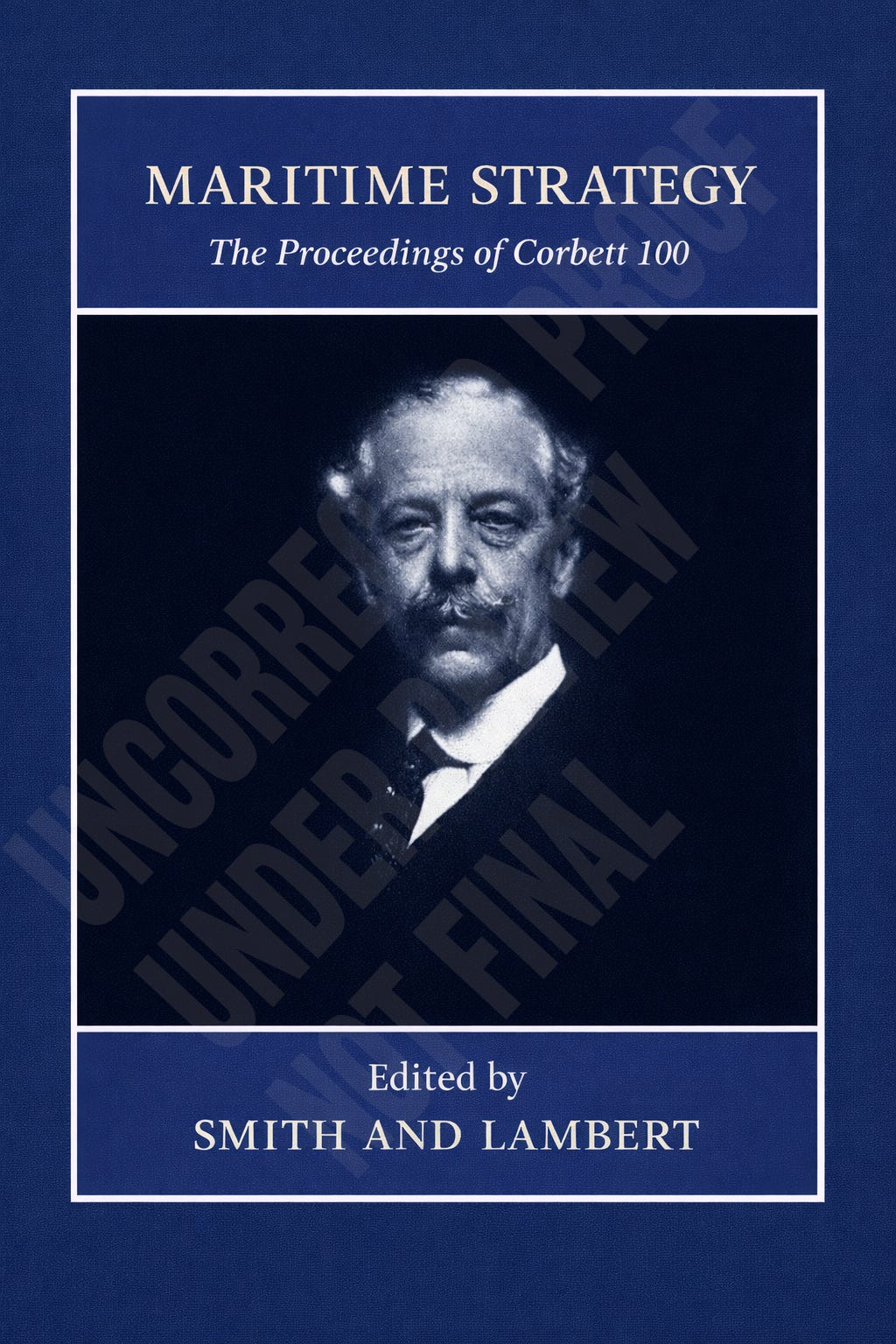
Corbett Project Events
We will continue to run select international events in online, in person through seminars or lectures as appropriate. This may included gatherings of Corbett minded scholars from the network of the Corbett Forum, or focused events such as book launches or arranged along timely questions or themes.
The Corbett Forum
The Corbett Forum which is the next step in the project as a result of this series of conferences. This is intended to be a loose affiliated international network of scholars with an interest in seapower and maritime strategy. The conferences, seminars and events was an array of international events networking thinkers and practitioners. It was also a test of international networking. A scholarly interest in seapower in general and in Sir Julian Corbett’s work on the philosophy of seapower and maritime strategy are central.
The intent of the cycle of work conducted by the Corbett 100 group has been to expose the continued relevance of Corbett to the 21st century. The workshop in 2025 at the Ecole Navale again proved this relevance, such as the importance of the Indo-Pacific.
As a part of the outcomes of this series of events, we are forming The Corbett Forum. This is intended to be an informal, loosely collaborative network to keep scholars and practitioners informed of our general lines of research for mutual assistance and to prevent duplication of effort. Members will be encouraged to network and mutually assist with:
relevant strategic developments in our respective countries and other matters of interest,
fostering exchange of information and ideas,
assisting each other collegially where possible, building networks, and
preventing duplication of research.
We will execute this through a private LinkedIN Group and a Newsletter. For protection of data the ‘Secretary’, one of the committee in conjunction with King’s College London keeps a database of scholars to support that network.
If you are interested please contact me.
Small selection of further reading:
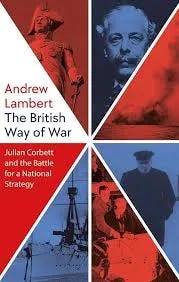
Book (2021) | The British Way of War: Julian Corbett and the Battle for a National Strategy | Andrew Lambert
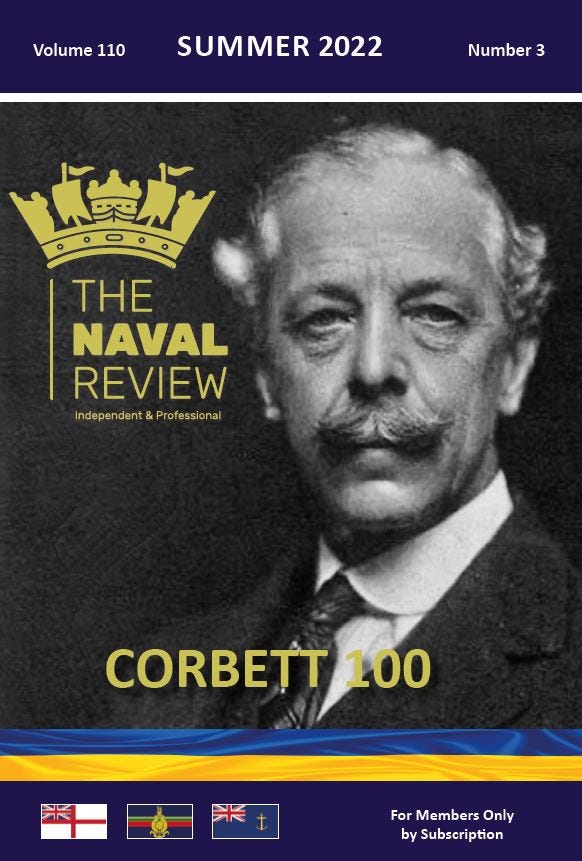
Journal Vol CX (2022), Issue 3 | The [UK] Naval Review Corbett 100 Edition | UKNR
Thinking about Seapower | Andrew Lambert
Some Principles of Maritime Strategy Making in the Royal Navy Today | Kevin Rowlands
War in Ukraine: Strategically What Would Have Corbett Said? | Geoffrey Till
Corbett 100: A Long Hard Look in the Mirror | James WE Smith
Paper [2022] | Re-learning from Corbett: Applied History to the rescue of Strategic Thought | James WE Smith
Paper [2025] | A Future for British Seapower and the Royal Navy | James WE Smith
Paper [2025] | Learning from the Royal Navy: Lessons for the USN on Sea Power Politics | James WE Smith
Online Seminar [2023] | Corbett and the Imperial Japanese Navy | Hiraku Yabuki
Online Seminar [2022] | Sir Julian Corbett as a Historian, Educator, and Strategic Thinker | Defence Studies Department / JSC Shrivenham
Online Seminar [2021] | The British Influence Upon American Visions of ‘Sea Power’ and History | David Kohnen
Podcast [2021] | Sir Julian Corbett, Jutland and the Concept of ‘Decisive’ Battle, and the educational value of experience.| Andrew Lambert
Also see Australian Naval Institute publications.