
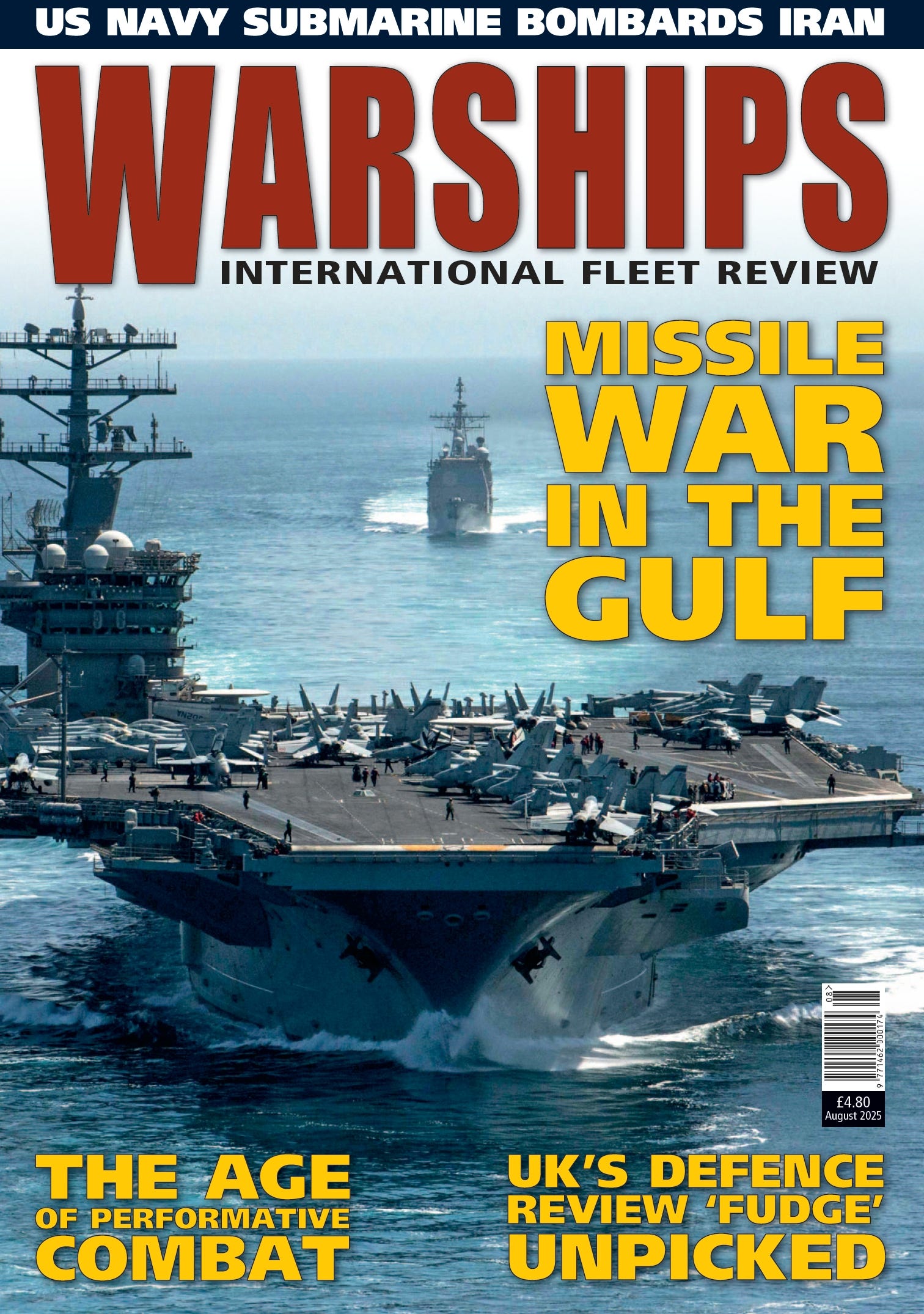
In the August 2025 edition of Warships International Fleet Review, (on sale in e-version and print in the UK & abroad after 18 July 2025) I analyse the recently published UK 2025 Defence Review document. I continue to advance the argument 'strategy is dead' and defence organisation isn't working
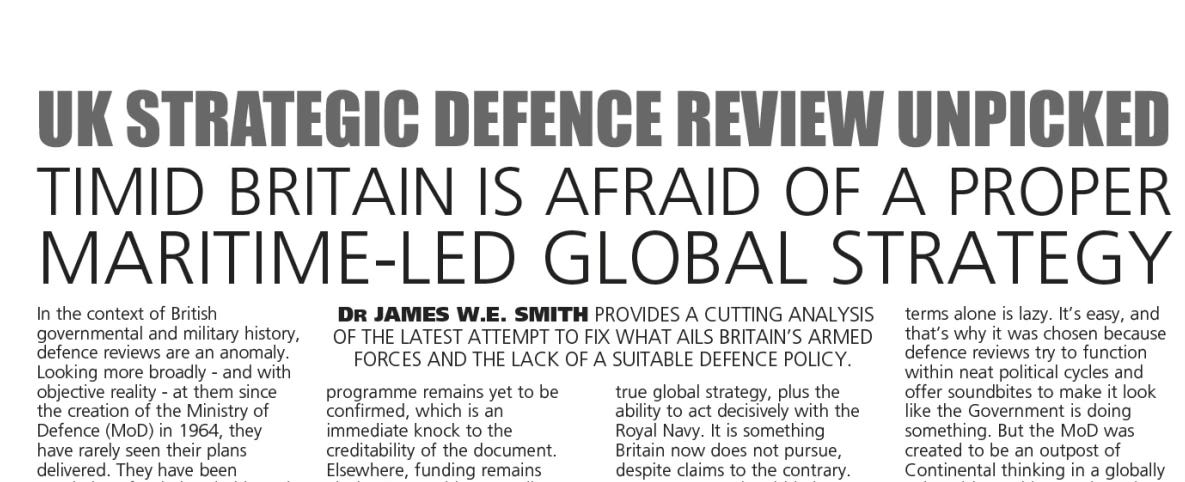
The full article is available in print and e-print. The publishers website is:
https://warshipsifr.com/
Please support publishing where and when you can.
WHO DO DEFENCE REVIEWS REALLY SERVE?
In the context of British governmental and military history, defence reviews are an anomaly. Looking more broadly and with objective reality at defence reviews since the creation of the Ministry of Defence in 1964, they have rarely seen their plans delivered, regularly unfunded and ultimately never come to fruition. That British defence reviews seldom work is nothing new; the reviews of 1966, 1981, and 2010 still cast long shadows, the latter crippling defence and foreign policy options for Britain to respond to a hostile world to this very day. Defence reviews, at their core, are an import to defence, along with other things, from an American continental model of defence organisation: alien in substance and near impossible to make work in an island like Britain. Hence, endless defence reviews and organisational changes demonstrate an organisation in constant flux whose plans are exposed to be pointless, and the fact other factors often defeat those plans demonstrates it to be neither an effective nor efficient organisation.
The 2025 defence review could have easily hit the shredder on publication, literal taxpayer-funded waste. At 140 pages in length, it was a brochure, wish list, and hope list, full of aspirations, which, in defence, are about as good as wearing tin foil on your head in a nuclear blast. Equipment changes like the reduction in naval and maritime assets were made during the review, and much of the equipment programme remains yet to be confirmed, an immediate knock to the creditability of the document. Elsewhere, funding remains elusive, even with contradictory messages between government departments. Those with a basic understanding of finances can see the vast gap between wants and reality where even a modest uplift, considering inflation, and disasters like the strategic and fiscal cost of the Chagos deal, from 2.5% through to 3.5% GDP on defence couldn’t deliver what the review or world affairs require. That hard, transparent, honest talk on equipment and finances is absent in a review undermines the point of the whole exercise because if the ‘workings’ cannot be shown, then any remaining credibility is destroyed. Parliamentary records evidence how the process used to work in the early MoD and service ministry era––when the military services and the service chiefs rightfully had greater influence and could speak without fear of persecution by rivals or risk of political revenge––with far greater transparency and, ironically, better coordination with the Treasury and cross-government.
Behind the political pantomime is something more concerning and has plagued Britain for too long: the illusion of Europe or the World. Britain once knew it had to perform great power foreign policy on middling power budgets and tight resources. This requires strategy, something Britain does not have. That dealing with the attack on national maritime lifelines in the Red Sea swiftly and decisively, or being able to contribute to deterring tensions with China, seemingly cast to one side, seems fundamentally naive. If government forgets the basics of islands along with that major economic shock that would come from conflict with China, it will line up issues potentially far worse than the bloody half of the 20th century.
This raises a more profound concern: to understand what it means to be Britain is to understand the fragile intelligent balance between resources, finances and assets of defence. Our forebears knew this, a strategic doctrine developed over centuries, from the defence of England by King Henry VIII in the Solent through to the Battle of the Atlantic. You cannot hide in an island nation and hope regional matters can contain world events or that purely technological advantage will save the day. Since at least the battle of Agincourt in 1415, there have been claims of ultimate weapons and enablers such as nuclear, cyber, space, drones, hypersonic and now Artificial Intelligence (AI), will change warfare. Yet, we still find young men shooting across trenches at one another, such as in Ukraine. Beware of false prophets and misleading directions as tempting as they are, driven by often nebulous and sometimes military service and industry interests, while experience trumps it all.
The review is a blast from the past, and one can wonder why it took so long and exactly what evidence was given; it’s not truly forward-thinking nor grounded in strategic experience. Pointlessly withdrawing the Royal Navy to the North Atlantic when it has global capability, no matter the glitzy words used, the idea of an Army on the Rhine (or Ukraine) and the RAF as ‘defender of the realm’ and that ‘NATO’ is the ‘be all’ clearly shows government advisors have become part of the wallpaper in Whitehall and disconnected from the modern world, let alone the population of Britain, and they need to go. The RN’s mission is presented as a priority, yet priorities are not necessities; meanwhile, the British Army seems as lost as it’s ever been, and the RAF continues to peddle it’s the precious child that defends the realm––a lie circulated since at least 1945––and therefore cannot be touched.
In conclusion, thinking in NATO alone terms is lazy; it’s easy, and why it was chosen because defence reviews serve neat political cycles and soundbites to make it look like the government is doing something and the MoD was created to be an outpost of continental thinking in a globally vulnerable maritime nation where the illusion of options is the most dangerous of all. European countries need support to develop their own solutions focusing on what they are good at and what an adversary to the east fears most, good land and air assets. In contrast, Britain must return to its role on a global, national strategy with maritime at its core.
The 2025 defence review is a reminder that the MoD, as is, isn’t just right for Britain, nor is it following a sound model, but because at the root of all of this is a presumption that war and conflict will fit the MoD and ultimately treasury’s timetable—yet time and again, to this very day, that has not been the case throughout history. Nations have to fight with what they have at the time, which means Britain operates with what it has at the time the call comes and right now, let alone in the future, that’s paper thin both in intellect, substance and assets. If anyone can say defence is in good shape, the reality is far grimmer: Cabinet, Parliament and Whitehall do not understand defence, and that shouldn’t just concern you; it should keep you awake at night in a darkening world which is interconnected, global and from seabed to space. Ultimately, another defence review fails because it serves political power and treasury officials, not an honest discussion on the protection of the British people and their interests.