
Very few people are ‘Corbettian’. The word gets attached to plans, miltiary doctrine and theory like ‘limited war’, to doubts about ‘decisive battle’, and sometimes it just means “not Mahan”. That is a reference to Alfred Thayer Mahan (1840-1914), the American naval officer and historian whose The Influence of Sea Power upon History (1890) made him the best-known naval strategist of his age, and the thinker Corbett is usually and wrongfully set against.
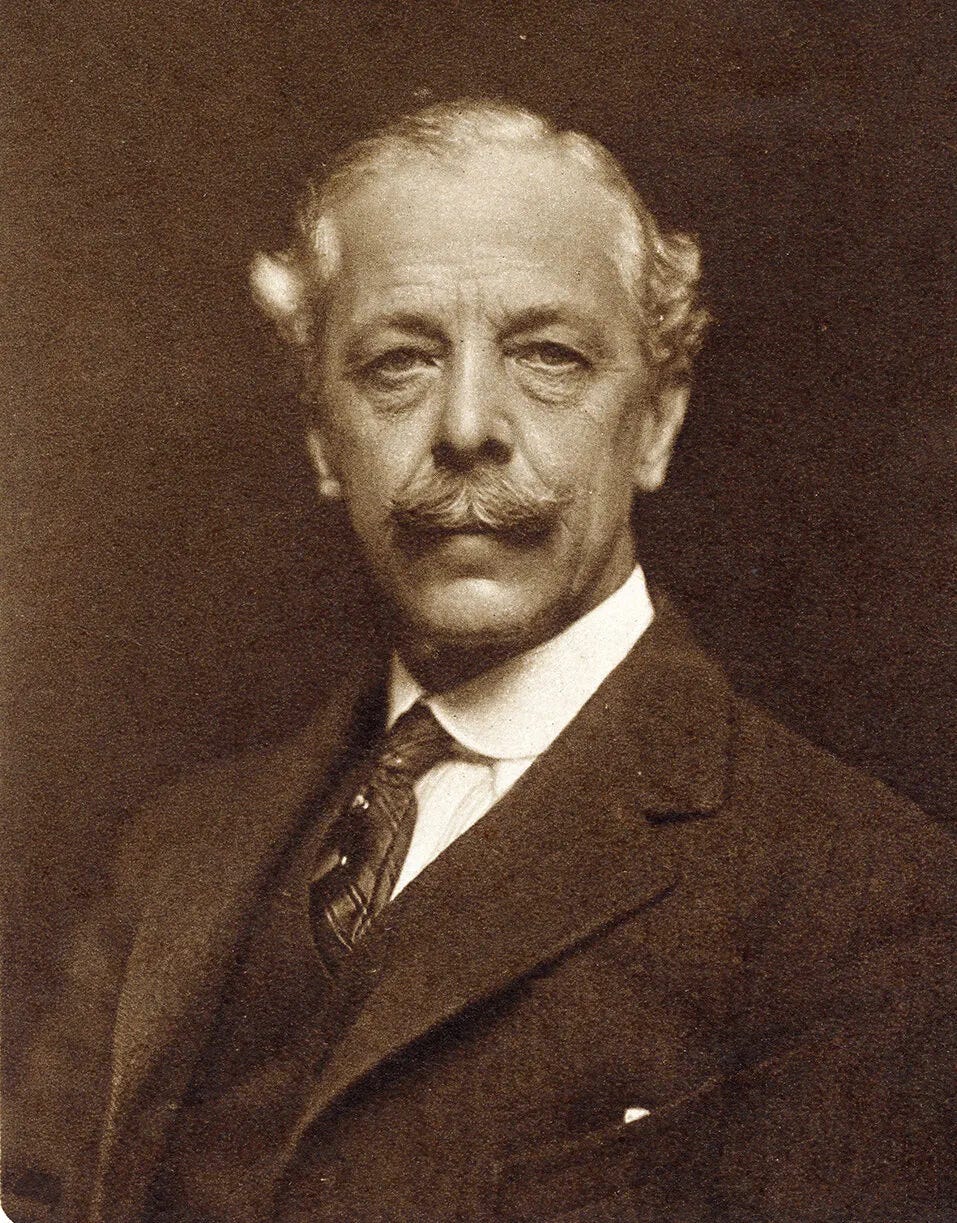
Sir Julian Corbett (1854-1922) died before he could finish his work, and the influence of his thinking faded. It was also taken. Basil Liddell Hart (1895-1970) tinkered with Corbett’s ideas, claimed them as his own in the “British way in warfare”, and disparaged Corbett in the process. It was a start of a process that Sir Micheal Howard (1922-2019) later completed, giving Corbett the boot and with it the erosion of understanding the influence of maritime affairs upon the state amongst historical accounts, policy and more. That Hart’s actions happened early, in the interwar years, when Corbett most needed defenders resulted in damage that was amongst the hardest to undo. Some of his defenders and educators of his work, he had taught or influenced, among them British naval officers Herbert Richmond (1871-1946) and Ernle Chatfield (1873-1967). They did their best to keep it alive through the interwar years and beyond, while a few American naval officers and scholars tried too, but it never recovered its standing. Bryan Ranft (1917-2001) and Andrew Lambert began its revival after the 1970s, and it is Lambert above all who, since 2001, has put Corbett back where he belongs: among the great strategists, in the company of Clausewitz if not his equal. That is a striking thing to say about the author of one of the great books on strategy, and it is also a warning. A tradition that survives through a few devoted followers and a handful of scholars is fragile.
To describe oneself as a Corbettian is to accept an intellectual responsibility. The designation should tell us how a person thinks and the standards to which they hold their own arguments. Corbett was offering something much larger than a naval doctrine. He offered a way of viewing the world, in war and in peace, from logistics to money to humanity to defence. He also offered a method for reaching it: the sophisticated analysis of experience. This paper argues for that view and that method, for the habits that follow from them, and for the institutions, civilian ones above all, without which they do not survive. It is open to anyone who wants to understand how the connected parts of war fit together, whether the aim is to keep the peace or to fight a conflict. It ends on what I think is the real prize, which is protecting a state’s capacity to think and act strategically. Three relationships run through what follows: historical understanding informs strategic judgement, education allows that judgement to be shared and finally, institutions decide whether it reaches the people who can act on it.
Corbett was a civilian and a historian, not a sailor. He lectured to serving officers on the Naval War Course at Greenwich, worked closely with the Admiralty, served as an official government historian, advised government committees on defence and became allies of naval officers, amongst then Admiral John Fisher’s (1841-1920) closest ally. He could say things to politicians and civil servants that naval officers could not. His value lay in standing outside the profession while understanding it well enough to translate it for the people who controlled its fate. Being Corbettian therefore has nothing to do with uniform or rank. Civilians and officers can share it, and it works best when both do. His own position was also an argument, which I return to below.
This is why there is speak of ‘ways of war and peace’. Strategy is the continuing work of securing interests, sustaining relationships and preventing the circumstances in which force becomes necessary. War sits inside that responsibility. A discussion that begins only when fighting starts has already left out most of what makes strategy matter. A Corbettian sees the whole system, starting with what the state is trying to achieve, and is therefore unimpressed by counts of ships, aircraft or brigades. Many numbers of people answer “how many?”, and the Corbettian’s first question is “for what?”
The starting point is the (nation) state itself. What sustains its security and prosperity? Where are its dependencies, geography? What interests must it protect, and what resources can it reasonably commit? A strategic argument needs answers to these before it can explain the forces required. Beginning with an inventory of capabilities leaves the most consequential part of the reasoning unfinished.
This is where the contrast with the Prussian tradition matters. The continental military tradition, associated above all with Prussia, grew from the circumstances of a land power: borders that can be crossed, armies that can march, a resource base large enough that the state can choose its doctrine and absorb mistakes. Its instinct is to focus on the fight, the battle, the campaign and the tactical problem, and to treat everything else as support. That makes sense for a continental power, but it carries a bias. It narrows strategy to the application of force, and it produces strategists who ask how to win the engagement before asking why it is being fought. Maritime thinking is a different approach and starts at the opposite end of asking questions. For example, an island with scarce resources cannot choose to ignore the sea, so it has to ask what it is protecting, what it depends on, what it can afford and how to get the greatest effect from limited means. Those questions make better strategy than the tactical ones, because a nation that cannot answer them will find that victories in battle do not add up to a policy.
The fairest test of that claim is Carl Von Clausewitz (1780-1831), because he is the strongest case the continental tradition has while also being the closest intellectual relative Corbett has. Both insisted that war serves political purpose, and Corbett can fairly be read as Britain’s answer to him, building on the insight and not rejecting it. But in the end Corbett bests him, and the reason is scope. Clausewitz wrote about war: its nature, its friction, its relationship to politics. Corbett wrote about how a state uses force alongside trade, blockade, finance, diplomacy and alliances in pursuit of its aims, with war as one instrument among several. That is a larger subject, and it is the one governments actually have to manage. Clausewitz also theorised from the experience of a continental power. Corbett grounded his work in the experience of a nation that survived on limited means and could not afford to confuse winning a battle with achieving its purpose. Corbett was building something the Prussian tradition never quite produced: a method for educating the people who make national strategy, through applied history, through institutions, and through the partnership of civilian and officer. The target of my criticism is therefore not Clausewitz himself so much as the land-centric, tactical inheritance that followed him, the habit of treating the world as a battlefield and strategy as something that begins when the shooting does. We can see this today throughout many War Colleges, militaries, domain specific military services and government thinking. It’s simplification and means education as failed because people think in frankly, dumber terms. Strategy is not difficult, learning to think strategically is another matter, one that requires sustained effort.
There is also a plain human reason why land-think dominates. People live on land, so their existence revolves around what happens there, and the business of navies takes place over the horizon. Land-think is the default instinct of almost everyone, including most politicians and many soldiers, and airmen and now space forces and even plenty of misguided naval officers. The maritime view is the less natural one and has to be taught: often and repeatedly.
That brings us to the method, which I think is Corbett’s greatest achievement and the part we are losing today. Corbett did not arrive at his conclusions by theorising from first principles or by selecting convenient episodes from history. He assembled a vast body of historical research on centuries of British military, foreign and national strategic effort, and he analysed trends, facts and evidence from it using sophisticated methods. From that evidence he drew out the patterns that endure, and from those patterns he built a coherent account of how Britain had waged war and peace and why it had done so. Lambert’s point is that the key to sound contemporary strategy lay in combining sophisticated historical analysis with strategic theory. Only someone working at the level of a master of applied history could have done it. However: note what the method is not. It is not a search for lessons to be applied mechanically, and it is not a catalogue of famous victories. It is the disciplined study of a large body of experience, tested against evidence, in order to build judgement for problems that have not yet arrived.
In practice the method asks demanding questions. What did decision-makers know? Which alternatives were available? How did political objectives interact with economic resources and military possibilities? Why did one combination succeed, and what stopped another from doing so? Comparison then needs a second judgement: which features of the earlier case matter to the present problem, and where are the limits? Technology may change the means while leaving questions of purpose and dependence untouched, and a change in political or economic circumstances can make an attractive precedent misleading. That is the character of war changes little, even if the circumstances do.
That is why it is better than the alternatives. Much of what other fields offer in its place is theory, assumption and guesswork. Theory alone can spark an idea, but the day after it is dismissed another takes its place, which is the habit of a reactive mind and not of a strategic one. Guesswork about the future nature of war rests on little evidence, and it flatters whoever is making it. None of this is of use for policy, strategy or guiding the modern military away from chaos and towards sense. Experience, properly analysed, is a different kind of thing. It has been tested by events, it can be checked by anyone willing to read the sources, and it is freely available, which is far better than relearning its lessons or ‘insight’ the costly and hard way. This is also why historians matter, and not as a decorative addition to the study of strategy. Corbett’s example shows that properly trained historians belong at the heart of the policy-making process, because they are the people equipped to recover experience and turn it, translate it, into something decision-makers can use. The work has to be open-ended and ambitious, avoiding closed questions and lazy assumptions. It is hard, and it is hardest where the pressure to produce a quick answer is greatest. A pressure that has grown in the modern world.
None of this is hostility to theory. Concepts make relationships intelligible and give people a language to test competing arguments, and Corbett himself combined theory with historical analysis. The problem is theory protected from evidence, which can gain institutional authority while losing explanatory power. A Corbettian should be alert to that in the theories they favour too.
It is also an art that is being lost. Strategy has always been an art and not a science, and by that I mean the art of thinking about strategy and then acting strategically. The two halves cannot be separated. Thinking without action is commentary, and action without thought is reaction. Corbett’s method is the discipline that makes the first half sound, and the institutions described below are what make the second possible.
After 1945, the creation of unified defence displaced applied history, and theory, guesswork and assumptions about the nature of future warfare took its place. Debate shifted towards technology, force and the particular application of power in a particular context, and scholars who wanted to use history found themselves arguing against technicists and theorists whose horizons were short and operational. Space is the current example. The literature on space warfare is long on confident theory, often borrowed from airpower, and short on experience of application and influence. The remedy is to do what Corbett did: look back at the experience of other environments, above all the seas, rather than abstracting from nothing. If that kind of analysis is not valued, nor the ideas it produces, nor the institutions that exist to recover experience and process it into usable form, we condemn ourselves to repeat the mistakes of the past. It will hurt, in body bags.
Corbett’s own survival shows how thin the thread is. After his death his followers kept the work going through the interwar years, Ranft and Lambert revived it after the 1970s, and his present standing owes most to Lambert’s work since 2001. That is a poor basis on which to keep any art alive. So the task is threefold: protect the art of strategy where it survives, rejuvenate it where it has weakened, and educate about it so that the next generation of strategists, officers and officials knows what it is and why it matters. This is complicated in a higher education environment, and often, a PME environment, which is disinterested.
Several habits follow from this way of seeing. The first is to treat geography as fact, not sentiment. Britain’s way of war was not an imperial fashion. It grew from being an island with scarce resources, which meant defending the home base and its supply lines before pursuing ambitions abroad. That is why the charge that Corbett and the British way of war are “imperial” is nonsense. The reasoning predates the empire, survived it and rests on a map. Today that map runs from seabed to space. Trade still moves across the surface of the sea, but data and finance flow along the seabed, physically or digitally, and all of it is backed by infrastructure in orbit. The geography a strategist has to read has more layers than it once did, but the logic is unchanged: a state that depends on these pathways cannot afford to ignore them.
But geography still requires interpretation. Its consequences depend on economic organisation, technology, alliances and the character of potential opponents. For example, recognising Britain’s maritime dependence opens an inquiry into how that dependence should be secured under particular conditions. Corbett also wrote in imperial Britain, and that setting belongs in any serious assessment of his work. But naming the period an argument came from does not settle whether it is right. We still have to examine the reasoning and see where it travels and where it does not. It was never hostile to armies either. Corbett’s account is of army and navy working together, with a mobile army supported from the sea, alliances, trade and economic pressure all doing their part. Which is why continental commitments are ruinous for an island because they cost it the ability to focus on the sea in exchange for benefits that rarely arrive. Commitments for other nations, require careful thought.
The second habit is to use history for judgement and not for answers. Corbett was more interested in what should have happened than in what did, and that is what separates applied history from the lessons-learned kind. It explains his distrust of easy analogy. When someone says a present problem is just like an earlier one, the Corbettian asks what was different and whether the difference changes the answer. Isolating military history in lessons-learned doctrine does little for national aims, because it detaches the lesson from the reasoning that produced it.
The third habit is suspicion of false prophets. Every generation announces a revolution that has supposedly changed strategy itself: strategic bombing, atomic weapons, precision, computers, stealth, and now space, probably AI next. A revolution in the means available to the strategist should never be mistaken for a revolution in the nature of strategy, because strategy remains a matter of human purposes, fears and mistakes, and of an opponent who is trying to impose his own will through advantage, dominance or other means. Space is the current test. Better satellites and launch systems do not answer the strategic questions they raise. It is not enough to transpose sea control into orbit. What is worth borrowing is the method: study the evidence, ask how to think and not what to think, and let theory follow experience.
The fourth habit is to accept that the work is unfinished and to be wary of heroes. Some Principles was meant as a living document. A Cold War generation that kept calling for “another Corbett” or “another Mahan” missed the point, because both men were products of their eras, pulling the levers available to them to influence the debates of their time. The same applies to setting Corbett against Mahan and forcing a choice. They complement each other, much as the civilian historian and the naval officer should. Turning Corbett into scripture, with principles quoted confidently and applied without thought, would betray what he was trying to do. It is entirely possible to quote him while ignoring the method that made his work worth quoting.
The fifth habit is the one most often forgotten: keep people in the picture. A way of seeing that includes money and logistics also has to include humanity. On the morning of the Battle of Trafalgar (1805), Lord Nelson (1758-1805) wrote in his diary that “humanity after victory” should be the predominant feature of the British Fleet. The maritime tradition treats the sea as an environment that shapes everyone who works on it, and it holds that a navy’s purpose is to keep war at bay from a position of strength, ready to defend its nation and global lifelines if it must. Strategy that has no place for people is incomplete, and a framework that sees only force keeps producing strategists who treat peace as an interval between wars.
That brings me to the sixth requirement, which is institutional. Corbett did not work alone. He wrote and taught within a network that gave his ideas an audience, tested them and carried them into government. The Admiralty and its civilians worked closely with historians like him, and together they preserved experience, educated successive generations and connected specialist knowledge to the people who had to decide. Strategic judgement is not only a property of individuals. It accumulates in organisations that remember, challenge and renew what they know. Corbett’s principles were not set aside because they were outdated. They faded because the machinery that carried them was weakened, and without it even sound ideas struggle to reach anyone who can act on them. An assumption can become embedded in budgets, educational programmes and career structures until it looks like a condition of serious discussion, and challenging it looks like a departure from professional common sense.
This is where Corbett’s own position makes the argument. He was a civilian historian teaching serving officers at the heart of their professional education, and that was no accident of recruitment. Officers bring something no civilian can: practical experience. But a miltiary career crowds out sustained study. Appointments rotate, operational demands press, and promotion rewards other things. Trusting every officer to become a serious student of history and strategy while doing all that was always too much of a risk, and institutional habits, once absorbed, narrow how a mind works. Civilians can offer what that career structure cannot: years of sustained research, continuity, and the independence to say what serving personnel cannot. Corbett could say to politicians what even Fisher could not. Internal think-tanks and professional military education answer to government and are bound by civil-military relations, so they cannot always say what needs saying. It is no coincidence that when the military has struggled to reform its own thinking, it has often been civilian historians who came to the rescue.
For professional military education the implication is plain: it needs civilian faculty, and specifically trained historians, because they are the custodians of the method. I do not mean the occasional guest lecturer or a seminar slot, but a permanent, respected part of how officers learn to think, with the time and security to do real research and the standing to disagree. Lambert’s account of the War Course shows that it worked in an informal, unplanned way, which was both the secret of its success and the reason it was so easily forgotten. What was once left to chance now has to be built deliberately. The relationship also has to run both ways. Serious academic training costs years of time and money, and as I have argued elsewhere the number of civilians working in this field is declining. Expertise paid for at that price cannot be summoned on demand and then ignored. A Corbettian service treats civilian scholars as partners and not as an audience, and the government and the services need to fund, protect and listen to them.
The audience for this education is wider than the armed forces. Politicians, civil servants, business leaders and those shaping public debate also set national purposes and allocate resources, and they need the understanding to assess strategic advice.. Professional military education also makes an essential contribution while civlian universities reach people whose responsibilities will extend beyond the services. Both need room for sustained inquiry and informed challenge..
This is what I mean by the Art of Admiralty: the institutional work of communicating and educating maritime strategy and/or a national strategy across government and national life. There is an ecosystem of business and government which interlaces to this which is build and needs to be maintained overtime: for some nations its easier than others. Specialist knowledge has little influence if it cannot enter the reasoning of those who decide priorities. ‘Seablindness’ is the same problem seen from the other end but that’s just a handy term to admit failure to understand a problem. It is not enough to observe that people know too little about the sea without asking how they were expected to learn. A Corbettian accepts some responsibility for that communication, including the hard work of making complex relationships clear without reducing them to slogans.
It also helps to be clear about where this sits in current scholarship. British writing on seapower since the end of the twentieth century has drawn on two broad approaches: the sea power tradition associated with Professor Geoffrey Till, and the Corbettian tradition of applied history and the philosophy of maritime strategy, which Professor Andrew Lambert carries forward. The difference is one of approach and not of hostility, and both have contributed a great deal. On the question this paper asks, the line is clear. Lambert’s The British Way of War recovers Corbett’s own method, serious historical analysis combined with strategic theory and applied to a nation’s actual circumstances. That is the sense in which he is Corbett’s heir, and why Corbettian thinking is better understood as a method than as a body of doctrine. Nothing here is a judgement on the quality of Till’s work.
Doubling down also means being clear about loyalty. Corbett wrote to improve the state’s strategic judgement, not to advance a service, and The Spectre of Navalism exists for a reason. Navalism, the policy of maintaining naval interests, is a natural attitude for professionals who focus on ships and tactics, and it has its uses. But the Corbettian is not a navalist. A navy that treats Corbett as a source of arguments for its budget has misread him, while a navy that treats him as a source of better questions has not. The Corbettian is as willing to criticise a navy’s habits as anyone else’s. Where the evidence favours naval investment, that should be said. Where it shows self-interest, rivalry or wishful thinking, that should be said too, whichever uniform it comes from.
Cooperation between the services is necessary, but treating every disagreement over strategy as institutional rivalry risks shutting out the debate through which mistaken assumptions get exposed. Strategic judgement means telling a defence of organisational advantage from a defensible alternative conception of national strategy.
Because this is a way of seeing and not a naval doctrine, it can be turned into questions for any strategic proposal in any domain. What political purpose does it serve, and could that purpose be met some other way? What does it assume about the opponent, and what follows if the assumption is wrong? What does it need in logistics, communications and money, and who controls them? How does it combine with the state’s other instruments? What does it do to the prospects for peace, and to the people involved? What evidence is being drawn on, how large a body of experience stands behind it, and what is different now? And who is responsible for preserving and challenging this thinking once the people currently doing it have moved on, and who teaches the next generation to think this way? None of these is about ships, which is the point. They work for space and cyberspace as readily as for the sea, and for a treasury official as readily as for an admiral, because they concern how a state reasons about power, resources and the world beyond its borders.
One more thing should be said about Corbett himself, because it is the last reason he outlasts Clausewitz in my view. He did not live to finish the job, and Andrew Lambert’s account of his last years shows what was lost. Corbett objected in private, but his considered reply would have come in the closing pages of the Official History and in a revised Some Principles of Maritime Strategy. Neither was completed. His energy went instead into a fight with a politician protective of his reputation, and into dealing with an Admiralty Board whose members, though War Course graduates, had let the central lessons slip.1 The past has an educational role which is why Strategy must be national, and not belong to any one service where a sound grasp of how history shaped doctrine has to be spread widely and intelligently. What joined them was a test. For Corbett, history was the final check on any theory, provided it was accurate, carefully considered and consistent.
If Corbett had lived, it would have likely resulted in a second version of Some Principles of Maritime Strategy, he would have developed his thinking on how defence should be organised, and to carry on his work on national strategy-making. Preparations for The Second World War may have been different if that work had been completed and distributed. I put that as a possibility and not a certainty, since no one can know. But the direction is clear enough, and so is the cost of not taking it. The work was never finished, and Corbett fell into obscurity. His followers did what they could, but it fell to Ranft and Lambert to revive him, along with some efforts in the United States. But since 2001 it has been Lambert’s work that has restored him to the standing he deserves. Also, that unfinished business did not die with Corbett. In my own work on national strategy and defence organisation I have tried to carry some of it forward.
So, to be a Corbettian strategic thinker is to see the connected whole: purpose, geography, logistics, money, diplomacy, institutions and people. An ecosystem to some degree of interconnected relationships. It means treating peace as the main business and war as an instrument, and staying loyal to the state’s interests before any service’s. Above all it means practising the art of strategy, which is the art of thinking about strategy and then acting strategically, and the method that makes it possible: the sophisticated analysis of experience, which is better than the theory, assumption and guesswork offered in its place and is why historians matter. It requires the independence to challenge a comfortable interpretation and the discipline to revise your own when the evidence demands.
It also means finishing what he could not. Teach the past as education and not ornament. Therefore:
A) Insist that strategy is national, whatever uniform the argument wears.
B) Spread an intelligent understanding of how history shaped doctrine well beyond the few who study it.
C) Hold every theory, however fashionable, to history that is accurate, carefully considered and consistent. Theory that cannot pass that test is guesswork with a fancy vocabulary.
Corbett’s work reached us by a thread: a few pupils, then a few scholars, and a revival that only just saved him from being forgotten. It does not have to stay that thin. What he left is a discipline, to think about strategy with the best evidence there is and then to act on what it shows, and a discipline can be taught, funded and protected in a way that a reputation cannot. A state that has it, from the seabed to space, can keep the peace and, if it must, fight a war it understands. A state that lacks it will keep paying to rediscover what was already known. Very few people are Corbettian. The work now is to make more of them.
Andrew Lambert, The British Way of War: Julian Corbett and the Battle for a National Strategy (Yale University Press), pp. 429–430.