

From the Red Sea’s trade routes to Whitehall’s policy frameworks and into classroom curricula, a persistent issue emerges: seablindness, and now, it is breaking the Royal Navy. Land-centric thinking in Britain has repeatedly undermined national strategy, where maritime strategy is its core, leaving tactical competence decoupled from strategic vision.
Over the past twenty years, I’ve dedicated thousands of hours, acquired academic qualifications, and invested significant financial resources to examine how organization shapes strategic thinking and action. My focus has been on understanding the relationship between structure and behaviour—essentially, whether organizations can achieve desired outcomes. In the defence context, this distinction isn’t theoretical: it determines winning from losing. At the heart of my work is a world view, one of Planet Ocean than Planet Earth. How we perceive our world drives every strategic decision. The maritime perspective leads to a specific analysis: understanding phenomena collectively called “seablindness.”
Over the past decade, I’ve been disseminating findings through multiple channels. The “Art of Admiralty”1 approach emphasizes one thing first: communicating and educating about the seas becomes paramount. More directly, I’ve explored the actual reality of “seablindness”—understanding that while it cannot be vanquished, it can be tackled systematically. Alongside this, I’ve highlighted the practical and theoretical obstacles navies routinely encounter when genuinely addressing this challenge. You can read my summary from 2024 ‘Seablindness and the Royal Navy’, elsewhere I addressed differences between Britain and America including other nations on this matter through professional publications like the UK Naval Review. More recently, I explained what the endgame for seablindness is.
This article looks ahead to 2025 and beyond, examining urgent concerns about the Royal Navy and its persistent struggle with seablindness. I recommend you read at least the 2024 article as a primer before this one. However, what emerges is a genuinely grim assessment—one that must be told.2[1]
What Naval Message?
“Silent Service” was always more than a nickname—it belonged to the submarines branch culture of secrecy. Yet it would be appropriate to extend the label to the whole naval service. Making visibility central to tackling ‘seablindness’ means acknowledging that navies work away from Whitehall and the public. This drives the need to exploit every opportunity to remind them they exist.
The 2025 Cenotaph service—complete with senior naval absence alongside Royal Household presence none of which were in naval uniform—represents a deliberate choice. Across events ranging from religious holidays to national public gatherings, the navy has retreated from visibility. For sailors and marines already battered by average 30% more deployment time, with the same pay, than Army or Royal Air Force [RAF] counterparts, this eroded representation sends a clear message: either the service has fundamentally diminished worth to the nation, or there’s a quiet omission — the navy is now so stretched it can’t afford things other services seemingly can. Visibility serves as a critical weapon against seablindness—especially for forces operating over the horizon. Yet those who claim to be rebuilding the Royal Navy seem still to have failed to grasp this fundamental truth.
This is a genuine chicken-and-egg dynamic emerges: declining conditions and resources affect the service’s ability to operate and do public relations and engagement, which in turn drives further decline. When a service cannot visibly demonstrate its value, political bodies unaware of the real cost become reluctant to fund it. And since beneficiaries cannot immediately perceive tangible benefits, they rarely feel the urgency to protect what matters most.
Royal Marine take over?
With no active four-star Admiral—for the first time in Royal Navy history—alone with the lack of a naval officer holding serious joint command across British defence, the service has broken centuries of tradition: a General leads.
Some might argue that should be the epitaph, the final curtain call. Their cynicism would be well grounded: if ever an analogy of the rejection of maritime strategic thought could be encapsulated, it could be in calling the head of the naval service “general.”
But the Royal Marines are no fools; that’s why they’ve often been given some of the toughest tasks in conventional British and special forces warfare. Yet if the recent cuts to Britain’s amphibious capability—reduced to pretty much zero—have left a chip on the shoulders of Royal Marine officers who now attempt to take over the navy, helping to give the boot to a previous ‘pro fighting seablindness’ First Sea Lord––for various reasons––then they have gone astray. It’s fair to ask, even if the marines reform themselves, how are they going to get into a fight when they are more limited than ever? Most Royal Marines, having been under threat of extinction for some time understand the value of public relations, and therefore should be sensitive to seablindness and naval needs, but these must be mindful of their traditional role, not one of a land force, from influencing their actions with the navy. However, if the marines seek comfort among the other services while the navy continues its own work, they should recall that the British Army has attempted to have the Royal Marines disbanded more than once. More importantly, since 1945 the Admiralty and senior naval leadership in the MoD era have time and again gone out of their way—often at real material cost—to protect Britain’s amphibious fleet and maintain Royal Marine Commando training quality. Institutions like Britannia Naval College, specialised equipment training and more broadly rating (sailor) training have suffered as a result. The charge that naval personnel have not taken marines, or what they uniquely bring as a fundamental part of the navy and broader defence seriously, would be a fundamental lie and stain on the reputation of corps if they believe it. Either way, for right or wrong, there is a theme emerging one of land-centricity that degrades the criticality of events at sea, and the seabed in favour of land operations, something out of step with events past and present on the oceans over the past few years and are now emerging.
Presence and Operational Matters: Land Centricity
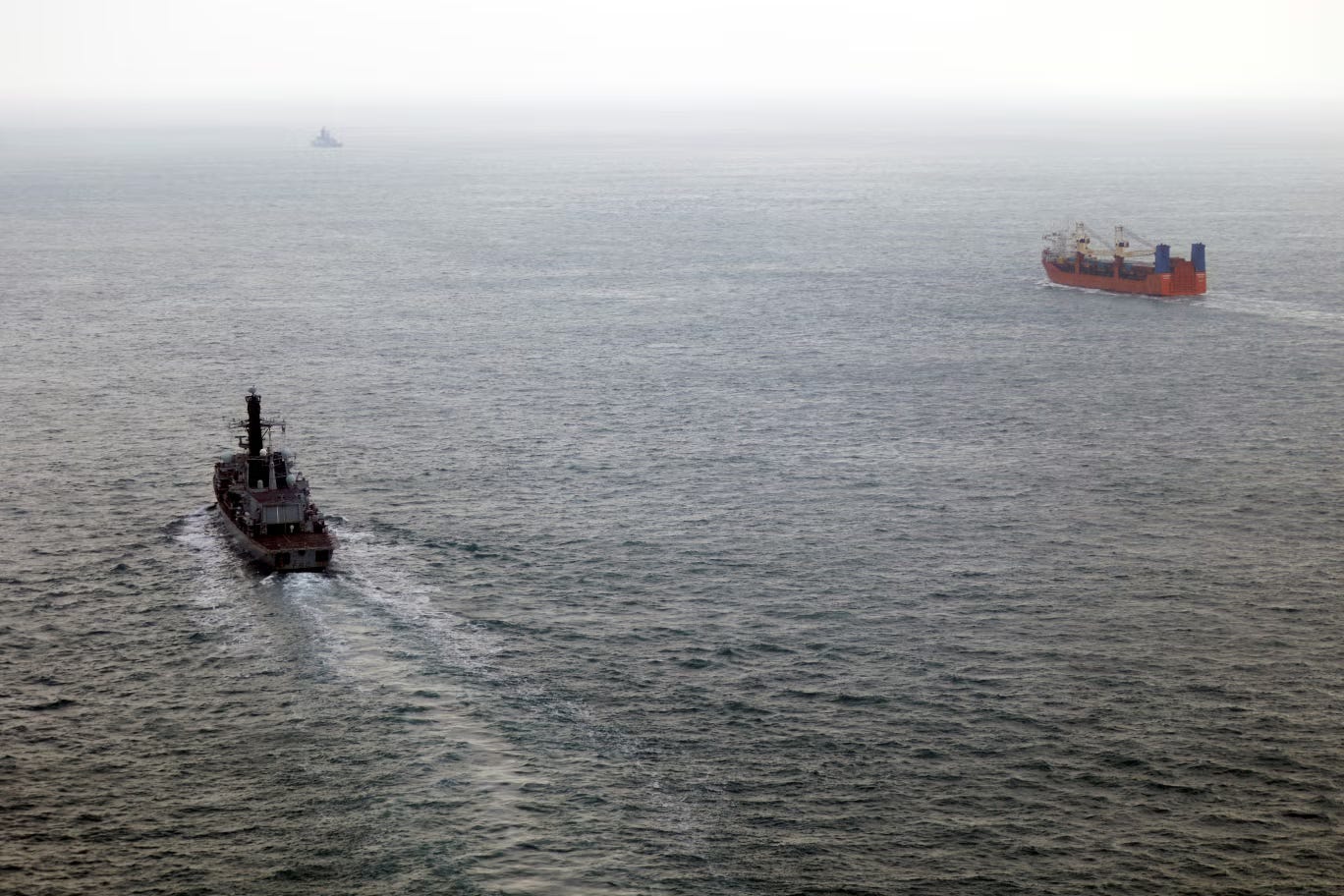
This land-centricity in government was already apparent by the lacklustre response to attacks on shipping in the Red Sea in 2023. Educated Governments in the past, understood not just the importance of shipping to Britain as an island nation but also the impact it could have on global security such as through the economic markets. Letting Shipping being unsafe would have been anti-thetical once to Admiralty and government alike. Elsewhere while America3 and France4 openly seize, tankers operating under false flags for Russia, Britain has been reluctant to directly act [seize] bar then to try and ‘shoo away like a bad smell’ hostile actor ships from its waters.5 Power responds to power, and a gentle nudge from a service once versed in making tough choices, is hardly in the tradition of the habit of victory. If enemies at sea are smelling weakness in the White Ensign, the mythos and respect the RN once carried is all but dead. This is something further compounded as its fleet has withdrawn permeant presence entirely from ‘East of Suez’ while struggling to maintain presence in the Atlantic and Mediterranean: anyone who has bothered to study 500 years of British history, knows is vital for the RN to keep these secure. It’s hardly a global presence: ambition, reality and warship maintenance programmes seem to have been all disconnected in the minds of some.
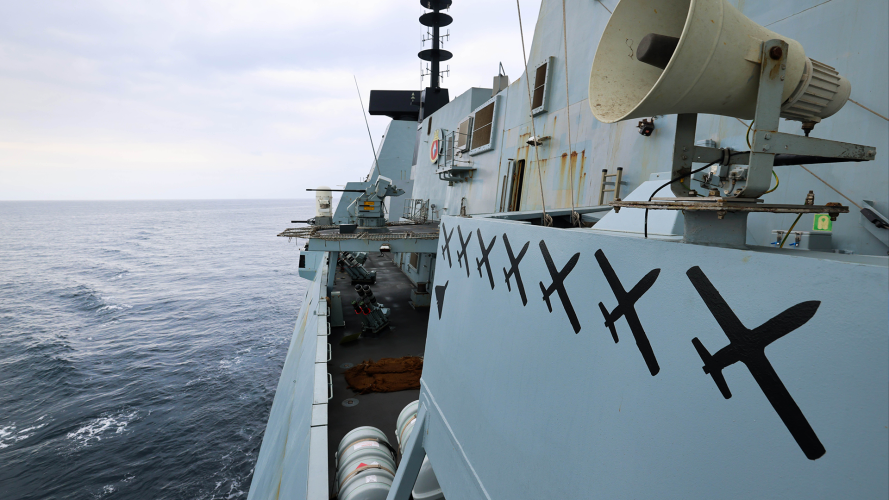
In response to sustained attacks on merchant shipping, the Royal Navy deployed HMS DIAMOND, a Type 45 destroyer, to the southern Red Sea in late December 2023. The ship arrived formally in early January 2024 and immediately integrated with United States Naval Command and allied forces. Over subsequent weeks, DIAMOND achieved multiple engagements, successfully shooting down hostile Houthi unmanned aerial vehicles (UAVs). The operation generated significant morale enhancement within the Royal Navy and reinforced confidence in the Type 45 air-defence systems. Recognizing the need for expanded protection, the navy ordered rapid augmentation. With no other immediately available Type 45 ships, HMS RICHMOND, a Type 23 frigate, underwent expedited re-tasking. Originally assigned to anti-submarine warfare operations in the North Atlantic and scheduled to join Britain’s Carrier Strike Group 25’s deployment, RICHMOND transitioned in short to open-ocean merchant ship escort. A useful reminder of the flexibility of well configured frigates––take note America. Differential performance emerged between the two vessels’ air-defence systems which was useful information. Either way, both ships spent months operating within high-threat environments. Prolonged periods at elevated readiness states: constant defense watches and action station became normal practice, granting ships companies with essential practice time, insight, data which is worth its weight in gold, when navies often fall short of having such experience: arguably some of the last times this type of experience was granted was in the 1982 Falklands War. This enabled changes across the fleet, honing experience into useful, practice improvements to systems, training and more. However instead of Britain maintain its presence, RICHMOND completed its tour and returned to UK waters by early May 2024. DIAMOND followed later.
No Royal Navy frigate or destroyer subsequently replaced these vessels in the region. The next meaningful RN presence materialized with Carrier Strike Group 25’s transit in summer 2025—a full calendar year later. The deployments remained notable for their rapid deployment characteristics, operational flexibility, and the practical insights gained through direct engagement with modern aerial threats. By comparison: The United States maintain a continuous, multi ship presence across the region. American surface ships view the southern Red Sea through a dual lens: as both a mission zone for merchant ship protection and as a deliberate training environment. Since the establishment of sustained Houthi threats, the US Navy has systematically cycled its ships through regional deployments. These missions expose sailors to real-environment operations. A distinctive feature of US Navy operations is the deliberate spreading of combat experience. By rotating ships through engagements, the service creates a distributed but credible experience base. This approach could yield significant value for potential conflicts in the South China Sea or around Taiwan within the next five years.
Other European navies demonstrate different approaches to regional presence. French, Italian, and Greek forces maintain consistent frigate and destroyer deployments. While their engagements remain less frequent to US operations, ships companies develop substantial practical expertise through prolonged, intensive interactions with adversaries.
A question remained: if this was a chance to test new systems and for sailors to gain experience that could contain great value for the future, why did the White Ensign essentially retreat?
The morale impact on the rest of the RN cannot be discounted. The work of DIAMOND and RICHMOND electrified the officer and rating cadres had been in the fight and had acquitted themselves well––in the highest traditions of the service. Subsequently an intriguing case study emerges from HMS DUNCAN’s 2024 Eastern Mediterranean deployment. The ship remained in the Eastern Mediterranean and did not transit into the Red Sea. Officers anecdote suggests this positioning was deliberate: DUNCAN maintained readiness to support a potential Non-Combatant Evacuation Operation (NEO) from Lebanon. Importantly, it would have helped take pressure of a strained US Navy which has too much placed on it already by lacklustre commitment of some nations to step up at sea.
The decision appears linked to organizational biases. Army officers, particularly since the 2021 Kabul evacuation, demonstrated heightened NEO preparedness come paranoia and have advised government to this, particularly when they hold positions of senior command over all British forces. The fault to not cycle more British frigates and destroyers through the Red Sea was jointly an operational level and reality that the Royal Navy is so short on assets, it can’t meet the demands required of it––blame successive cuts which at their root, is seablindness. Go anywhere outside the UK and North Atlantic, UK forces come under CJO’s Operational Command (OPCOM) from PJHQ, army officers’ rule here who in this case had little care for training sailors in a real world environment but turned their eyes to land events—which notably, did not occur.
The fall of Kabul triggered changes in military training priorities that persisted through early 2024. A consistent pattern emerged: army and Royal Marine leadership became primary architects of NEO doctrine, again, remove from core British needs. Exercises shifted to emphasize evacuation procedures, with staff teams spending significant time planning hypothetical saves. Differences in training intensity became apparent. UK Commando Forces conducted a January 2024 exercise focused entirely on NEO planning for a Philippines scenario involving hurricane damage and regional tension. Parallel high-intensity scenarios—such as Royal Marines transiting across a contested North Sea or landings in northern Norway—remained unrealizable for the 1* staff. That real experience against UAV’s and alike was deprioritised in a world where, in Ukraine, Asia and elsewhere, technologies such as this are moving to the centre ground, speaks volumes. This suggests selective operational validation where high intensity warfare, something sailors need experience in urgently was an afterthought and this shone through in the management in the Red Sea situation.
Some of this can be debated in professional circles, but it exposes that Britains navy is too stretched. For all the talk of hybrid navies, the reality is presence, capability and power counts and that means hulls in the water. However more importantly, the Red Sea situation exposed exactly that, the naval service is lacking experience. This is because there wasn’t a hand on the tiller with the authority to do it when it should have and others turned a blind eye to the sea and naval service. Those who have read more of my work, will know my investigation into the strengths and weaknesses of unified defence––the monolithic organisations like the UK Ministry of Defence–– read in “Endgame for Seablindness”6 I said the next step in unified defence was necessary but it had to acknowledge some things needed to be reversed. An army general, lacking the knowledge of running naval service demonstrates there is a limit to so called ‘jointness’. The point where operational jointness––forgo the rhetoric on reducing inter-service rivalry, it was a lie in the 1960s to help the Treasury case, and it still is now––undermines the quality of service emphasises how unified defence is not working. It is not centralisation that is needed but decentralisation of authority to avoid exactly the type of situation the Red Sea demonstrated. Britain needs to empower its service chiefs, not seek bland solutions disconnected from the ‘frontlines’. In short, one must be mindful the MoD was build at a land-centric ministry, in service to the treasury, hence, taxpayers must seek refuge and trust in the military to manage themselves not a MoD that produced better defence reviews with 500 staff in the 1950s, compared to now with over 90,000.
British ‘Naval’ Thinking: Or, What Actually Is It?
The amount of energy required to now refute the drivel, technobabble, terminology ridden gobbledegook and nonsense of the land-centric thinking that all services have had to endure, is an order of magnitude bigger than to produce it. British military doctrine has been profoundly shaped by concepts like “warfighting”—a word strikingly absent from Oxford dictionary–– yet evidently adopted from continental traditions. Island nations that treat possessing a “warfighting capability” as if it guarantees security reveal genuine confusion over strategy, again exposing unified defence is a land-centric school of thought not a maritime one. The persistent promotion of this framework suggests more than accident: the takeover of British defence by land-focused thinkers has over time forced the British military in a position which now every day is bringing it into question of it can defend Britain. An irony, that embracing tales told by idiots, full of sound and fury but nothing of substance, has broken British defence: exactly as the Admiralty in 1961 predicated would happen. Some equally may called this land-centricity the “The Continental Commitment” but it goes beyond that and is probably one of the worse things to befall British defence, something growing since at least 1914–I will not cover that here.7 Either way, the question is whether this will ultimately leave Britain defeated when theory collides with reality.
Elsewhere, by the end of the 20th century, British academics had become deeply embroiled in debates concerning the methodology, conceptual meaning, and practical application of seapower and maritime strategy—issues spanning the Navy’s future structure and theoretical foundations. Two schools emerged with prominence: first, the “Navalism and Sea Power” tradition, systematically advanced by Professor Geoffrey Till through PME (Professional Military Education). The other, Professor Andrew Lambert’s approach—the “civilian department”—which continued what had become known as the “Corbettian” school of applied history and maritime strategy philosophy. In Britain, the dependency on external defence educators and historians is how, generally, at least for navies, much thinking has been done, for all its benefits and a few detractors. To say the students of either school had not clashed would be a misunderstanding. It may even be the case and may have only muddied the waters with education to those outside the military then already was taking place. When I attempted to disseminate twenty years of research on seablindness––including how to fix it and ‘right the ship’––the response from certain segments of the naval and academic communities would have prompted whispers I was one of the ‘Four Horsemen of the Apocalypse’.8 In fact, a few wrote to my mentor at the College asking me to be silenced. Why such sensitivity when everyone is supposed to be on the same side? Did they really think that twenty years of research, a PhD, and verification of my data by King’s and some of the world’s top historians, military personnel, and defence professionals was suddenly invalid because someone’s feelings had been hurt? This was exactly like when Sir Julian Corbett was given the boot by the Royal Navy in 1920: history reflecting reality was being used to point out failure and what needed changing for the positive, and that did require some constructive criticism and finger-pointing.
The point was that one school, who had become predominate because that ‘educated’ defence civilians and military personnel and therefore ended up in positions of influence, had avoided addressing the first and only issue that mattered: education about the sea and navy. They ignored that for terms like ‘seablindness’ to exist, it can only be seen as a complete failure where things once known and understood yesterday are not known today. Repeating the same tactics since the late 1980s, which have delivered little, is a sign of failing to understand the problem and is akin to madness to continue in this manner. The decline in understanding of seapower, maritime strategy and its interface with national strategy and policy does not occur overnight and will not be solved quickly. How can it be that warnings of the recent past have come to fruition? Why are the fundamental tenants of seapower, naval power or maritime strategy—questions solved by great historians like Corbett—seemingly not understood today in many quarters, particularly by some who should know better or claim they do ‘get it’? What have some been doing all these years, if still government and the public must ask: ‘What is the navy for?” The answer to “What is the navy for?” should have been thrashed out and resolved long ago; it was an easy task for the answers lay in the past, and from that, the answer communicated full volume to those at the highest level of decision-making in the nation. That this was left to linger by some past generations has caused turmoil that cannot be overlooked, particularly by those who present nothing but a negative message about the navy who had an opportunity prior to do something to avoid the situation the service now finds itself. Younger generations should be rightfully frustrated and equally seeking to give those with closed minds and status quo attitudes, the hard boot.
In the past, having the constant capability, institutional knowledge and corporate experience in place to be aware that educating on seapower was a constant task led by civilians to educate others about the sea and navy. Subsequently, it freed naval officers to be the best sea professionals. This was how Britain ended up with the best naval officers like Lord Nelson and quality trained ratings, which ultimately led the Royal Navy to become the successful force that it was. This was also because Britain had no choice regarding its national defence strategy, where officers had to be freed to focus on that task, for failure at sea meant doom for the nation. At the same time, civilians ensured that the Government, Parliament and the public were educated about the Naval Service and why Britain had no choice but to have a maritime strategy. The fact that anti-maritime and anti-naval voices after 1964 could even present to the government the illusion of choice other than maritime strategy or Britain is a ‘land power’ should have been squashed at inception if there was an active naval and maritime system to counter such ridiculous and unfounded claims.
Growing cognitive dissonance appears in terminology like “hybrid navy” and “Atlantic Bastion.” Britain’s naval strategy of locking down the GIUK gap and maintaining control of the Mediterranean has been fixed for centuries. So, why is it currently being called something new? An invention for someone to justify their wages or try and look smarter than they are? Or complete ignorance of island nation history? Probably a mix.9 Elsewhere, the hybrid navy approach raises questions: if sea-time experience has plummeted? Why? Because wouldn’t someone point out that the ocean’s ruthlessness on equipment knows no bounds and requires sailors, let alone to maintain it, or do we face a navy where no sailors want to go sea or even the ability to do so? If so, ‘game over’. If anything, “hybrid” may be merely political cover—a way of avoiding confrontation about the uncomfortable truth: Britain’s warship numbers are at historical lows, critical equipment programs remain unfunded, and to be a seapower you need hulls, aka presence.
Britain should lead global intellectual thought on naval and maritime matters, irrelevant of the Royal Navy’s size or power. We maybe at a turning point: those who deliberately apply historical wisdom to future planning—what I’ll call “inheritance thinkers”—seem increasingly likely to emerge from nations like the United States, Australia, and Japan rather than Britain. For those who resist historical study, the maxim “everything old is new again” takes on urgent relevance. The British Army insists on framing continental commitment as permanent purpose,10 rather than acknowledging its historically limited role for an island force that should operate primarily as an expeditionary service. The army unwillingness to accept its role has caused issues for defence and the navy for centuries but ultimately has undermined the armies own ability to manage its equipment and force structure: blaming government for the army, although partially true isn’t the whole picture and goes to the heart of the destruction of national strategy. Meanwhile, the RAF has effectively grounded its identity in nostalgia — the only narrative it can construct. Any serious thinker understands that this cognitive stagnation may be terminal, and that is without throwing into the mix the future of defence organisation, budgets, and the ever-changing technological landscape which is shifting at rapid pace––from seabed to space. The historical omission is not accidental; it’s strategic blindness.
As I argued in my PhD research: when an organisational culture is existing opposite to the truth, deliberately emphasises land minded centricity, a falseness, how can we expect meaningful change? Official positions—civilian or military—and governments seeking education remain closed to historical wisdom precisely because the system was designed to resist realignment. The irony is this: Britain has long claimed expertise in strategy through to Cabinet level, yet its defence institutions are fundamentally structured to prevent the integrated maritime approach that was proven to have worked for centuries.
The harsh message is clear: since the late 1980s, by every metric: every tactic attempted to address declining understanding of the Royal Navy and maritime strategy have failed—exposing the hollow promises of “solution” frameworks and false prophets in British naval thinking that treated a deep structural problem as if it were solvable through programmatic fixes. Navalism and calls for things like a ‘Navy League’11 demonstrate a fundamental ignorance of history and national strategy—and more importantly, of how seablindness has historically been addressed. The result? Nothing substantive has shifted. This remains the status quo and from that, don’t expect the future––or fate––of British seapower and Royal Navy to change.
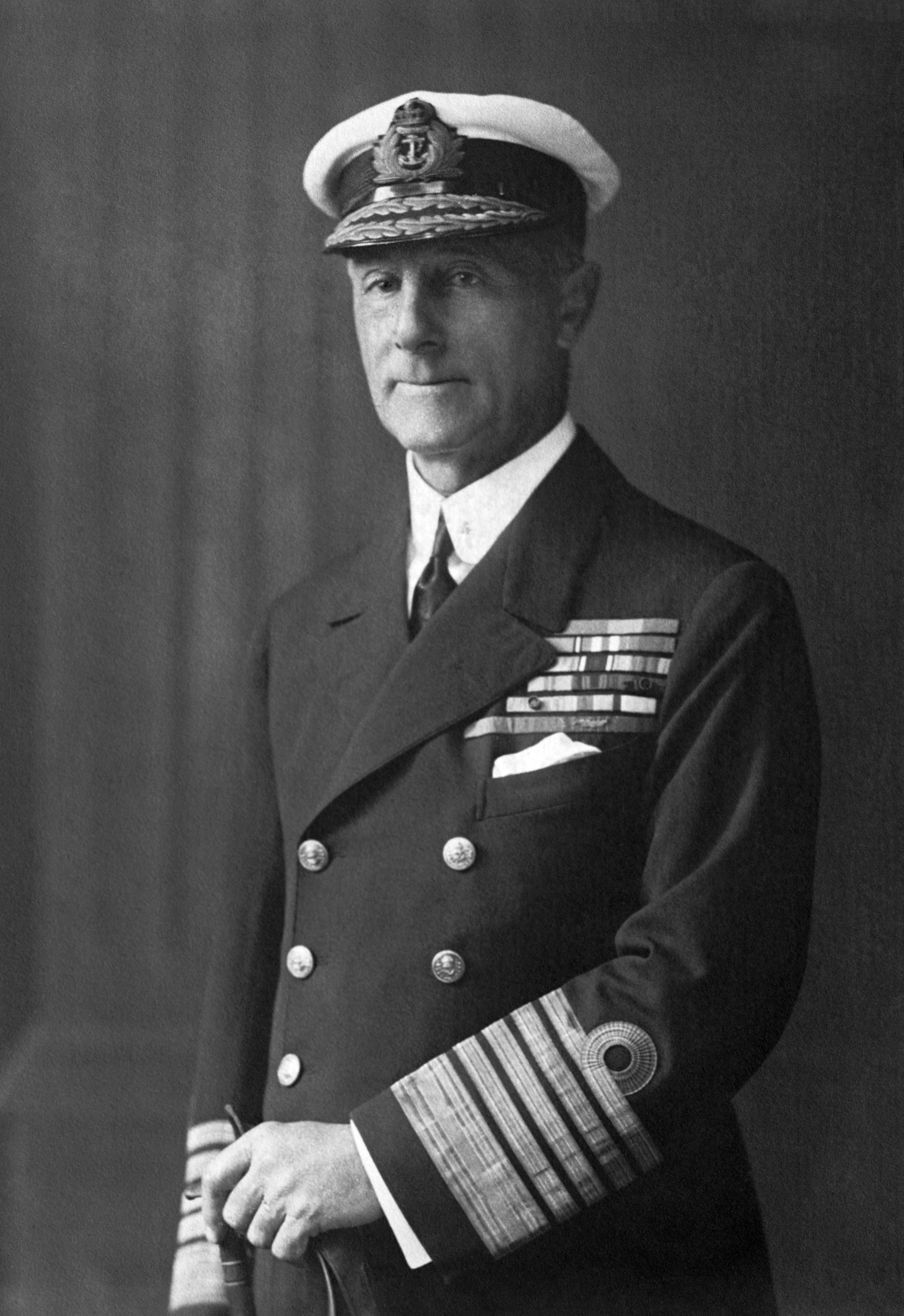
Again, we can turn to the wisdom of the past, as Admiral of the Fleet John Rushworth Jellicoe (1859-1935) told an American audience: 12
The worst possible people to talk about and promote the Royal Navy, are Royal Navy Officers.
Conclusion?
These few points, if thrown into a mixing pot, represent a perilous situation. As ever, organisational failure is a series of smaller mistakes that amount to a bigger one. The last great Admiralty Secretary warned, as he did to the US Navy, that constant change is tantamount to chaos and here we are.
In short, this article was for me to go back and test ‘Seablindness and Royal Navy’,13 to see if anything had changed. It has not, in fact it’s got worse. The Royal Navy may need Parliament or Cabinet to treat it differently—perhaps as a failing department or local council under special status. This would require a civilian leader with authority surpassing the First Sea Lord. “First Lord of the Admiralty” or “Admiralty Secretary” seems no less appropriate, though ironically, the previous holders had warned that current trends would inevitably play out this way. The land-centric MoD was successful in suppressing their warnings, it never intended to let official acknowledgment occur of what they said.
Fortunately, this will appear in my forthcoming book based on my PhD.
‘Seablindness' has done as much damage, if not more, to the Royal Navy than enemy action since 1945. The reality is you cannot live on reputation alone, and the hourglass seems nearly empty on that front."
Dr James WE Smith 2021
What is the 'Art of Admiralty'?

Today, the term ‘Admiralty’ for many has become a metonym. It is a particular irony that as we approach sixty years since the abolition of the Admiralty and the creation of the UK Ministry of Defence (MoD) in 1964 that the term can command prestige and inspire historical research but equally suffer abuse in its usage.
Note, some of these points are correct to the time of publishing.
https://www.bbc.com/news/articles/cdxj28xd542o
https://www.bbc.com/news/articles/cdexxr2y907o
https://www.royalnavy.mod.uk/news/2026/january/23/20260123-royal-navy-intercepts-russian-ships-in-the-english-channel
https://www.usni.org/magazines/proceedings/2025/november/endgame-seablindness-defence-organisation-and-future-royal-navy
James WE Smith “Deconstructing the Seapower State: Britain, America and Defence Unification 1945-1964,” PhD thesis., (King’s College London, 2021).
Note also some of my work was seized upon by think tanks who failed to cite me and attempted to claim it as their own, see Council of Geostrategy. They were contacted and have not responded. Equally the excellent leadership of the UK Naval Review have sought to protect my work.
Note, the Bastion concept has shades of Prussian come Soviet style land and naval designs. Notably, the plan is unfunded and much the equipment is not yet built. It also directly contradicts key maritime and naval strategic concepts in the idea of dominance which is not possible at sea, nor does the Royal Navy possess the sheer tonnage to even remotely achieve its objectives. It raises questions, as pointed out in the article, on the advice the naval service is being given, and the quality of said advice from think tanks and individuals who may have other agendas nor engaged in the sustain study required to turn the naval service around by utilising history to guide them.
https://www.bbc.com/news/articles/ckgln3lgl3jo
Navy Leagues and Maritime Leagues were an imperial constructs in the British context and not the system in how government was educated as this task was carried out elsewhere to better effectiveness and efficiency, this is different to countries like the United States who have more valid reasons to justify their existence.
Lord Jellicoe was educating American’s that civilians are best placed to educate about the navy and maritime strategy because they could talk the ‘lingo’ of civilian decision-makers better than any sailor could. Jellicoe has learnt this from Sir Julian Corbett. Equally, attempts of naval officers to focus too much on promoting the service became more about an individuals naval career than the good of the service. Jellicoe first hand had experienced this when deficiencies in naval officer training became apparent to him at various times during the First World War, particularly in 1916 at the Battle of Jutland. Britain having the best sailors, and building the world’s leading fighting force was a matter of sailors trained at sea [better than any other navy], not dinning out in ‘Whitehall’––something the Army and later RAF were far more apt at. A lesson of training sailors was learnt from the age of sail. See my PhD for more.
'Seablindness' and the Royal Navy Today

The term ‘seablindness’ is an excuse, a poor term in which to understand a phenomenon. I know; I spent the better part of fifteen years unravelling the devaluation of the sea, maritime strategy, and navies in national agendas and defence. The term ‘seablindness’, although never formally quantified, was created in the 1980s.…