
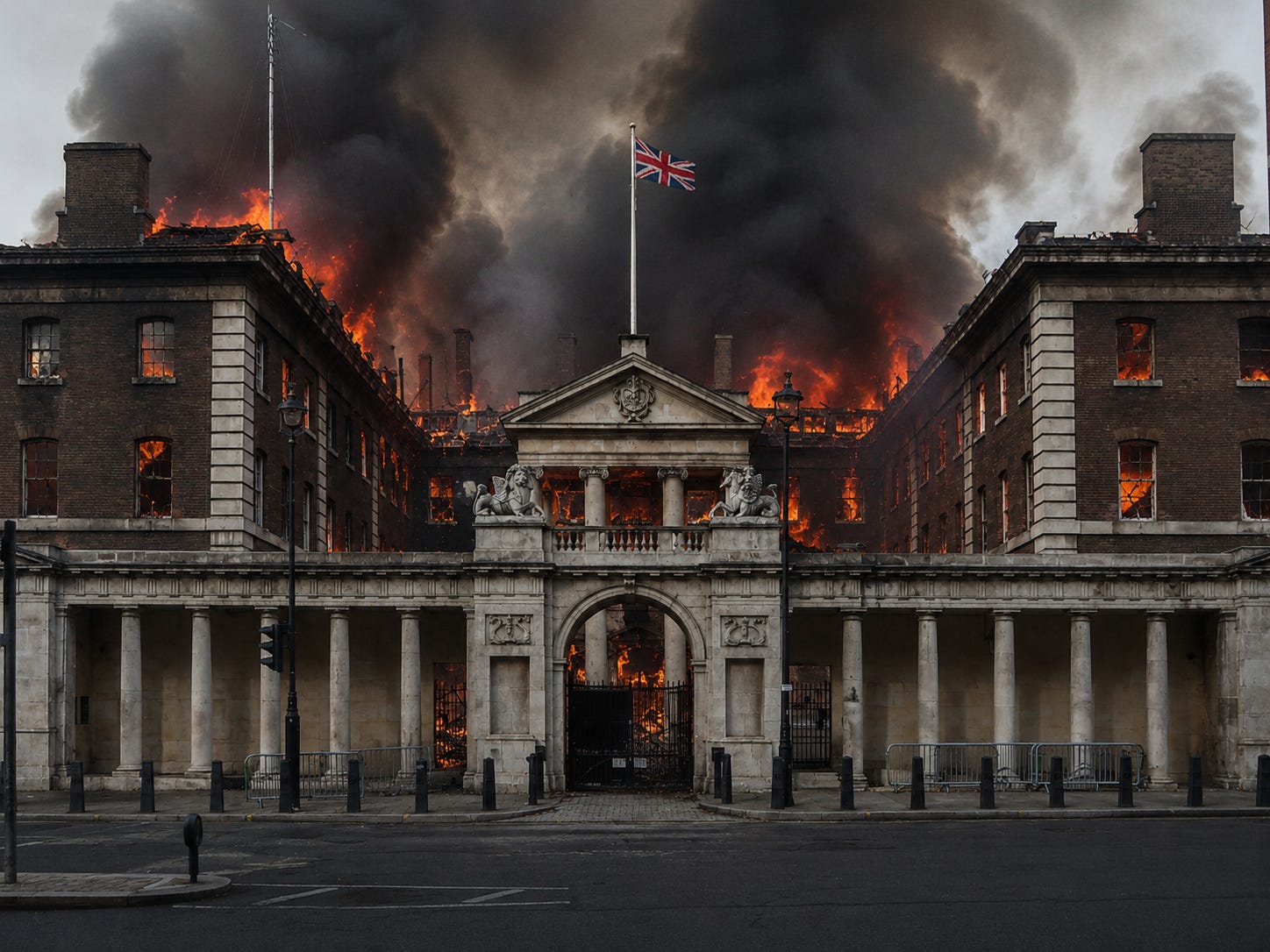
In March 2026, Britain failed to adopt its own definition of maritime nationhood, sea power, and naval strength—a framework ironically crafted by its intellectuals based on centuries of accumulated cultural, political, strategic, and operational experience.
The outcome was stark. The central question became whether the subsequent criticism—from media, politicians, academics, and veterans—would alert, or more crucially, educate the state to revise its plans. Some warnings had been too little, too late, as if their proponents had suddenly realized Britain was an island and they existed on planet mostly made of oceans. A nation that had long been educated to understand the necessity of their own seapower to assert order over everything they were vulnerable to: supply chains for energy, food, goods, and capital; the very mechanisms of global interaction had vanished at an alarming rate over the past four decades.
What remained unsettling was this: many of those who had engineered seapower’s collapse—civilians, politicians, even veterans—now raged about a ‘course correction’ precisely when resistance had already been futile. The rot had been deepening for generations, their active choices and actions merely accelerating the outcome, it was more for some covering their tracks they had played a part in this eventual downfall. They seemed to now be complaining for frantic off-ramps from an endpoint already unavoidable: national seablindness and flowing from that, an irreversible fading of the Royal Navy into irrelevancy.
Of course this could have been avoided. Warnings about the Royal Navy’s precarious position had persisted since the 1950s, through the 1980s. More importantly, the Admiralty—home to centuries of Britain’s seagoing expertise and strategic experience—had explicitly predicted how the Royal Navy could be neutralized by political choice or misguided military advice.
This foresight was largely superseded in the 1960s by those who sought their own agendas. The creation of the Ministry of Defence, adherence to the Treasury, and elimination of professional discourse that had advised the political body on why Britain’s national strategy remained as it had, and even—amid the pressures of running a nation—why defense must be funded through long-term planning.
The problem wasn’t sudden abandonment but systematic devaluation. The Admiralty had traditionally educated the state about the maritime core of national strategy—a function naval officers, once Britain’s seagoing experts, were neither trained nor interested in continuing. When the Navy was reduced to staffing rather than leading its own destiny, this knowledge atrophy became an institutional blindspot: one of the pillars of its eventual downfall. Naval and marine personnel left to execute professional tasks at sea or on station deliveveref for Britain because that is where they were best place, they rarely wasted time networking in Whitehall. The British Army and its subsidiary service, the Royal Air Force, by contrast, were highly proficient in networking. Their capacity to articulate excuses—against hundreds of years of strategic, tactical and operational experience for Britain—enabled a gradual yet determined shift away from maritime strength toward land and air dominance in Europe.
The arguments here extend from decades of research that culminated in a PhD on organization and national strategy. Over several years, I’ve shared findings through papers, lectures, and articles—nothing I’ll repeat now. Consistently, I’ve argued that language like “terminal decline” or “rise and fall” distorts what’s happening or how things got from ‘A to B to C’. The collapse of British national strategy and the Royal Navy’s shift from relevance to failure aren’t sudden—not tragedies waiting for acknowledgment. They’ve been unfolding against a longer trajectory.
When I wrote in March 2026, I noted one final pathway remained before having to concede that organisational terminal decline was more than speculation: the relationship between sea, navy and nation must be addressed as the number one priority, in short, education. That threshold has now been crossed because that priority was not addressed.
With evidence established and reversal highly improbable, I think it’s time to accept that the Royal Navy is becoming history—and the moniker: ‘1546-2026’ is a live point of debate. It’s not the point of this article to write the pathway of how the Royal Navy, or more importantly, British defences, got to this point, I explore this fully in my forthcoming book based on the PhD, but why the threshold has been met to consider that moniker.
The reality is that terminal decline was avoidable. Others and I warned were ignored if not ridiculed over recent years for pointing out a change of course was required. This is, unfortunately, somewhat a ‘I told you so’ moment. It equally serves as encouragement to those engaged in research to keep plodding on, irrelevant of head winds you may face.
For some, the Royal Navy has become merely a metric of material power. But even there, presence and strategic reach matter more than ship numbers—unless meaningfully integrated with broader national strategy. Ultimately, the question persists: What is this service intended to accomplish, and how should it do so?
The challenges resonate across many militaries, particularly around funding. But funding is hardly a new issue, financial concerns have been its defining characteristic since Henry VIII’s codification of naval power to the state in the 1500s, with other countries following suit. What demands greater examination is something different: the culture and attitudes toward the Navy within the unified defence framework [the MoD], and critically, who ultimately shapes policy and makes final decision—Cabinet, or more precisely the axis of Treasury and Prime Minister.
It’s evident that efforts to educate the nation—and particularly decision-makers—about seapower have long been absent. Decades of issues in defence that Parliament and public were promised were solved by reform, have not been. Again, something the Admiralty predicated would happen because the roots of the MoD were not sound, so matters like interservice rivalry, generic bland civil servants, and collapse in proffesinoal expertise are now playing out with a compound effect.
In the British characterises, Generals and their evolution, Air Marshals, think in tactical, land-narrow terms. This becomes critical when a military leader trained primarily in these frameworks leads the Royal Navy as it does now. During Middle East events in early 2026, the head of the naval service was conspicuously absent from defence planning, leaving professionals like the Chief of Defence Staff to make statements like “the land is an aircraft carrier”, so forget seapower.1[1] Consider this irony: The CDS, an RAF officer, employed language from 1960s RN-RAF disputes—specifically, the contested sea versus land air power. If the MoD and Joint Services College Shrivenham genuinely believe in jointness, how is it that an RAF officer used this narrow framework in the 21st century? How did he learn that? A hint that defence unification that controls service education was never about unifying anything.
The Admiralty in the early 1960s warned of something real: as defence thinking grows more ‘purple’—bruted through with the reasonable point of operational jointness—it becomes a front for army-RAF land-think. This shift matters because it fundamentally contradicts centuries of practical understanding about Britain’s strategic position and limited capability to influence events near and far. Remember: British power achieved great things through surgical application of that power, the relationship of army and navy, and based on experience—not on following the thinking of alien concepts that went against an island nation’s experience. Note that the CDS later claimed it was time to abandon historical understanding altogether.2Consider this: the greatest military operators from the classic period to 21stcentury conflicts and civilian strategists consider the study of history as indispensable—precisely because it’s all we have over theory and guesswork. That is because theory and guesswork remains the clearest and most rapid path to defeat. Again, this raises questions about professional military education in Britain, Perhaps Shrivenham deserves more than academic scrutiny. Military personnel need to develop expertise and grow the forum to evolve the art of war into something that will operate, not just get a pass in some classroom exercise with a nice certificate attached.
Again, as the Admiralty warned, this attitude, is exactly what the structure of the MoD would end up creating. Grabbing, experience: cultural, political, strategic, tactical, operational, technological, the art and science of warfare, everything Britain had hard learned and threw it to the wind. The price would be the Royal Navy. The level of arrogance that today's generations know better than centuries of experience arguably makes them worthy of learning the hard lesson of defeat or disaster at painful cost.
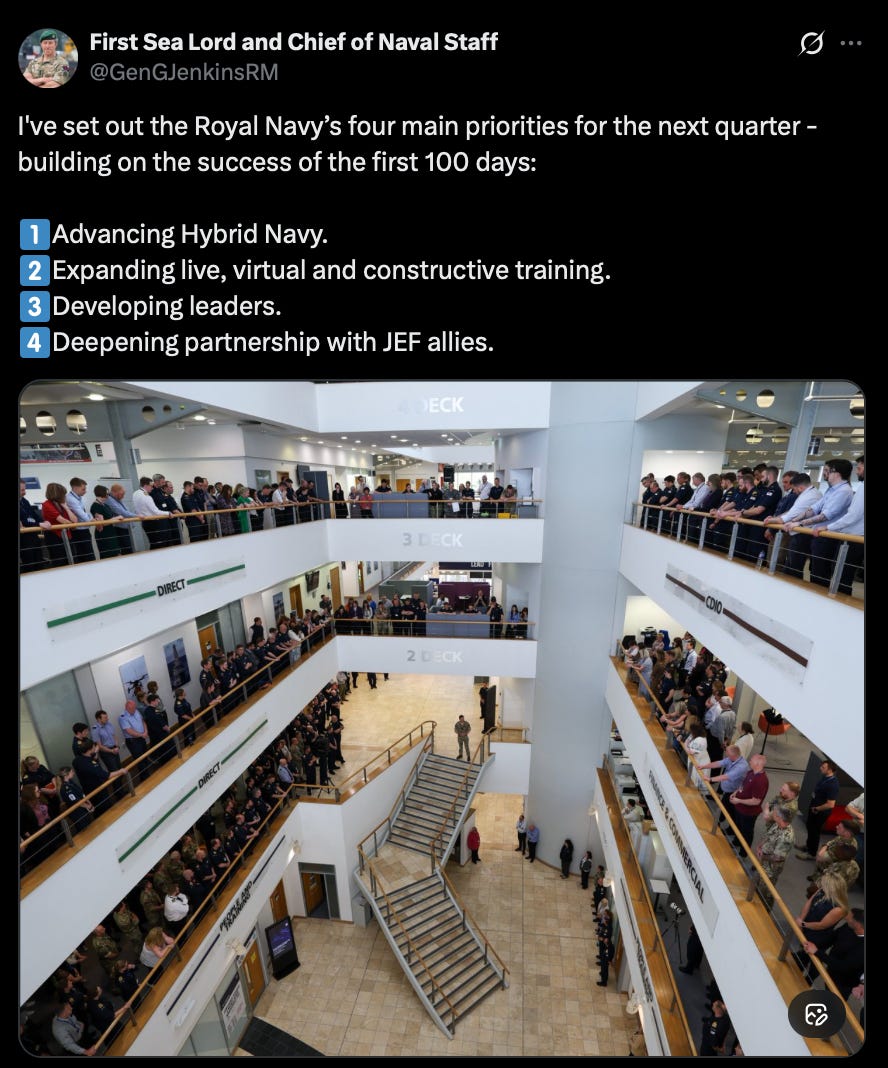
Where was the professional head of the naval service promoting seapower options to government advisors in 2026? Note that this occurs even as the same leader celebrates remarkable achievements in his first 100 days—only for Britain’s maritime identity, naval force, and seapower to crumble around him.3Ships take weeks to deploy. Ammunition stocks deteriorate. Sailors leave in droves, bored and demoralised by leadership’s apparent indifference to morale while dark fleets go unchallenged in UK waters, Britain’s defences are proceeded in the North Sea and High North while Russian warships feel emboldened due to the weakness of the Royal Navy to do as they please in English Channel: the channel that defined English culture, identity and defences for over half a millennia which previous generations saw as the last line of British defences else the nation has fallen. Perhaps there is a message in that.
It may very well be demonstrated that the first Royal Marine in charge of the Royal Navy will be the one who seals its fate. To abandon a naval officer as the professional head of the naval service, maybe one that seals the navy’s fate with terrible repercussions, equally a terrible legacy for the honourable Corps of Royal Marines. History may judge him as the very model of a modern major general.
The White Ensign’s prestige fades with each naval or political decision. Elsewhere, no one questions why the Royal Naval College consistently appears on protégé-cut lists while RAF Cranwell and Royal Academy Sandhurst escape scrutiny. Many have tried to silence British navalists, it’s a form of gaslighting when the evidence is laid bare, anti-naval sentiment is alive and kicking because simply put, the combination of agenda with poor-education has resulted in this sentiment. Elsewhere, Junior and mid -grade naval officers with senior ratings despair as they realise the organisation they serve in, fulfils the definition of an organisation in terminal decline: every time a problem is solved, two more pop up. They have also watched with concern as senior leadership also turned its back on the civilians, veterans and academics who could help them restore education about the service and maritime strategy. In short, an organisation cannot generate a response because other issues pile up continually. To use a nautical analogy: every time water breaches a bulkhead, the pumps can’t keep pace, and another compartment fills, accelerating the sinking process. The Royal Navy is dysfunctional, disorganised and barely functioning where standards, qualities and uniqueness that made the naval service what it was have been discarded. This is where things stand.
Equally troubling: senior naval officers reports allies reject British ‘hard seapower.’ 4But the United States rejected this framing, and Middle Eastern partners also dismissed it, clearly there maybe something wrong with the naval staff to be not only out of touch with allies but also the fundamentals of defence and warfare where hard power talks and the presence to protect citizens and shipping, the life line of Britain is a must. One might argue this was a cover to hide that Britain was in a position to shape events in the Middle East to at least protect merchant shipping, something Britain depends on, but again it was land-think that removed those assets even though they were aware they maybe needed there, because ultimately, the complete distortion of British strategy by land-think to be about fighting Russia was more important than national security where the sea comes first?5 So, what is ‘soft power’? Seamanship? Naval and military training? How can this claim hold when expertise has atrophied due to a fleet rarely at sea, submarines alongside, and resources so constrained that sailors gain little practical skill—once a defining characteristic that delivered countless victories for the Royal Navy.
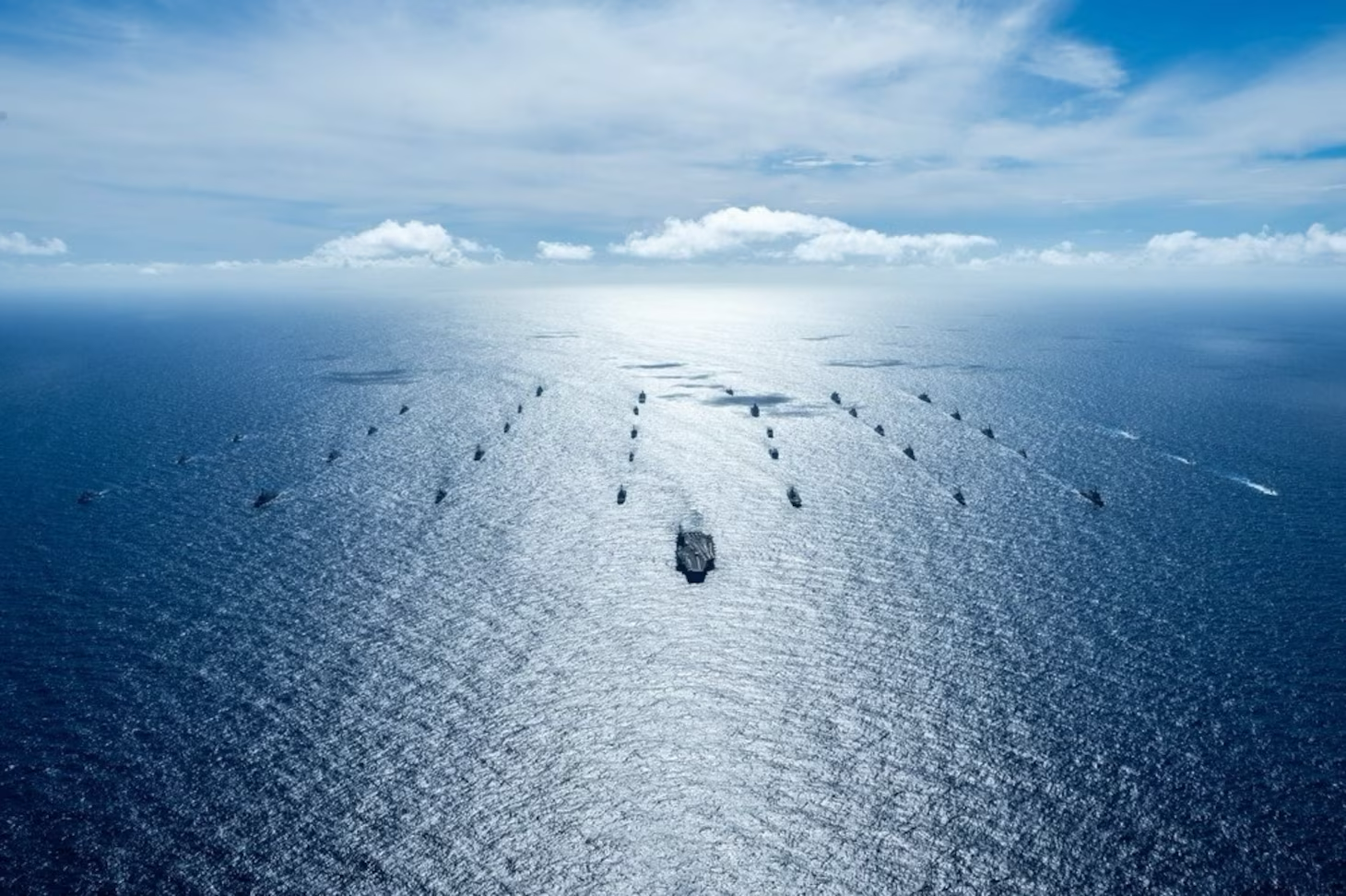
You cannot advise on something you cannot do yourself. The nation that defined seapower and maritime strategy remains clearly on the backfoot, even compared to continental powers. That in itself is shocking for not just British taxpayers but allies around the world. For example, Italy and Spain, along with other nations with less naval experience or less inherent need for sea power are attending RIMPAC,6 while the Royal Navy is absent.
So what is the government’s plan for the Royal Navy? Plans seems perhaps an award too far for the British government and MoD because if you analyse their defence decision-making at least since 2001, it would fit the definition of chaos. Why break a habit? So, by scrapping future frigates and destroyers, they show they have learned absolutely zero from decades of mismanaged programmes, wasteful exhumation of money and that any commitment to the navy is unthinkable. That would require an understanding of strategy: something seemingly so far out of grasp of those who apparently hold so many University degrees, but degrees does not mean well-read or understanding which may explain some of the MoD’s approaches.
So instead, championed by General in Chief of the Naval Staff, the so called ‘hybrid navy’ concept is the snake oil of the day. In other words, AI and autonomous maritime craft taking the place of warships. Let’s call it what it actually is: the Treasury does not want to commit to spending money on warships and long-term financial commitments and because land-think has hijacked British defence, misguided knee jerk analysis of the Russia-Ukraine War has drove a new technologist mafia to do what they have always done for hundreds of years: try to claim one weapon system as the next best thing since sliced bread. We’ve seen this before, strategic bombing, the big gun, tanks, stealth, cyber, space, nuclear weapons, some false prophet always lurks in the shadows to try and push something using dodgy data. Fortunately, history offers guidance. Naval technology has always evolved, even when the character and objectives of war remain relatively stable. The evolution of navies suggests a meaningful pattern: radical transformation often leads to disaster, whereas phased introduction, development, and perfection have allowed platforms like submarines and seaborne aircraft carriers to become indispensable over decades. The critical point is that these advancements have augmented—not replaced—naval power and seapower’s influence from seabed to space. To rephrase: the navy’s core has remained constant. A backbone of hard power, firepower, presence, reach, resilience, people, the best training and capability have always been primary considerations, ready and able before anything else. A hybrid approach—AI and autonomy—is no panacea: the core backbone of fleet must exist, augmented by new technologies. Throwing away centuries of proven platforms in frigates and destroyers, even submarines to some degree of no replacement or such low numbers to be of no major force, is boldly stupid. The Royal Navy has the hybrid fleet the wrong way around because the core fleet will not exist in sufficient form to be the enabler of national strategy and defender of security it should be. Either way, the rhetoric around hybrid navies it is dangerous. This must be accepted alongside the understanding that the sea is a complex environment, tough on equipment, and what works in test environments may not translate into the diverse geographic environments around the world.
This raises the point that the combination of government cost-saving measures and poor analysis of select events in Eastern Europe—then actually a naval technological revolution like that of propulsion or weapons from past eras—is now happening. Pinning the entire fate of the Royal Navy on it is reckless. What should concern us is that the naval staff and government have lost the expertise in seapower they once possessed. A good example relates to the hybrid navy: the Black Sea has seen drones used effectively by Ukraine against a substandard, poorly trained, and ill-defended Russian Navy. These successes occur on calm days in the Black sea and weather shielded ports, a far fetch from the Atlantic, High North, Pacific and the coastal turmoil of territorial waters. Yet the Atlantic—and by extension the high Atlantic—the area the MoD has informed government is the core focus of the navy, and therefore its hybrid approach. Here, the sea state differs radically: the Atlantic produces 15-25 times more waves and perilous conditions than a typical Black Sea day.
Yet the MoD wants to bet the entire Royal Navy on autonomy and unproven technology? Any sailor knows the sea—a cruel mistress—imposes real strain on equipment that requires human intervention often. Under the hybrid navy guise, vulnerabilities become obvious: systems can be hacked; defences will be built against them; connectivity may vanish; there is an acute shelf-life constraint. These technologies also deliver fewer capabilities than crewed warships: less reach, less time on station, less presence. Warships give nations capability and governments choices. They are platforms that, when built right, run right, and its people trained to the best they can be, become one of defence’s most potent tools and assets and not just war fighting such as diplomacy, disaster relief, and a vast range of other tasks. One-trick wonders cannot and will not provide what warships offer and knee-jerk responses to the sinking of Russian ships tells us little bar defend your ships, as its always been, and have enough of them because just like tanks and planes, they can be destroyed. Some of the childish thinking in defence commissariat demonstrated reactionary thinking for clicks then pausing to think while the reality of ‘having a fleet’ is now dissolving as existing fleet structure faces no replacement and only less capable hulls in fewer numbers.
Drones and AI will not make warships irrelevant, just like aircraft, torpedoes and missiles, they instead encourage reform of the offensive and defensive capabilities of warships.
The likelihood of the Royal Navy projecting any serious power is now unlikely as it will never be able to bring power to bear with the resources it has. This demonstrates that the fleet originally designed around the aircraft carriers should have been built, as planned in the 1990s. It has never emerged because it has been endlessly tinkered by pressured naval staff who are unable to generate naval answers to contemporary security questions quick enough, coupled with the fact that numerous governments saw the Royal Navy as a funding source to prop up other sectors of the nations spending, with questionable results.
Navies are long term projects that no British government has committed to after the 1960s, a benchmark every government thus has kept to. Meanwhile, the 2026 Defence Investment Plan reveals the RAF receives a new stealth fighter and nuclear-armed F-35s. Irony looms large: the hybrid navy exists to prove warfare is changing and technology enables easier neutralization of existing platforms. Consider too that British air-based nuclear deterrence was identified for cuts decades ago—the submarine option emerged as the ‘best case.’ The RAF’s mission to control nuclear deterrence and all military air power, including eliminating aircraft carriers—the oceans being one of the few places today easier to protect assets from compared to land–has never ceased because it is set out in their fabric of their identity since 1918 to become the senior service.
If any military service is willing to sacrifice best choices that maybe not under its guise and instead favours ideology, nostalgia and sentimentalism–tradition is different–they are not patriots to the defence of the nation.
The UK has long demonstrated a pattern of institutional ignorance: no internal knowledge exists for these decisions, a classic ‘reinventing the wheel’ scenario. Equally the Royal Marines who have no dedicated capability to go anywhere or do anything get money to do what, they increasingly look like spare members of the ships company than a professional force with little to do by land and sea? Funding an amphibious minded fleet for that is not something the anti-naval establishment in Whitehall will do because no one can answer what the navy is for as no one wants to think intellectually about the defence and national strategy as Britain once did.
In all, this is the MoD’s legacy as military and civilians predicated between the 1920s and 1960s would happen in a generic defence department setup as the UK has today: no strategy, no thought, short-term band-aids at every turn. They cannot generate a meaningful response because of generic civil servants, poorly educated military professionals, and a government that has deconstructed the very repositories of wisdom decision-makers need to navigate complex matters and educate themselves with.
This is but a taste of some of the issues that I could talk about, these points made are not abstract theory but active choices military and political leaders have made and have done so since 1964. Since completing my PhD in 2021 on the relationship between defense organisation and UK-US strategy making, I’ve databased these decisions — recorded tens of thousands of choices across levels of governance over twenty years of study. What emerges consistently: disaster is a tale of many small choices and mistakes compounding into one major problem. It’s easy to deconstruct or destroy; regeneration and reconstruction remains difficult but the fact that the UK Gov cannot find a way out of a defence mess is the fact that no-one understands the problem because it is long in root, complex in form and few have the willingness to face reality. This is always the problem with power and centralisation, generic solutions, generic thought, loss of expertise, grey thinking, too many moving parts of anyone to grasp coupled with that UK defence reviews would never work as they designed to suit the processes of a continental nation, the United States, alien to the UK process which had a fixed strategy and if that fixed strategy was followed things would easily flow from it. This won’t happen today as it would tear down vast portions of defence, cut the size of the MoD and simplify procurement: things that have been artificially inflated and generated to support the deceit that has replaced of what British national strategy should be.
Generic mindsets, collapse in expertise and centralisation is one of the ‘pillars’ of why the Royal Navy is no longer the navy it was, it has lost its way and so has the nation on defence—the Royal Navy remains in name but in reality, does not exist as it has for the most part over centuries since 1546—but also connected to why Britain is no longer a maritime nation, nor naval power or seapower. The character of the British way of war has always depended on expertise — strategic thought, seamanship, military skill across services, a holistic understanding that now has vanished. A cohesive way of thinking about the art of war and peace that emerges from decades of shared practice, geography, and institutional learning, now lost.
The point of this article was not to dissect every decision that got to the point but show some of the pillars that have now pushed the threshold in which to consider the end of the Royal Navy, as there are complex factors spanning decades across geopolitics, foreign policy, finances, culture, technology and more. However, I’ve tried to articulate: higher organisation matters; education shapes national capability; the relationship between nation and domain understanding (geography) determines victory or defeat. Our forebears knew this, the Admiralty warned in the 1960s of what might happen and has now happened as they predicted: a navy would be made to be seen as irrelevant and subsequently impact British security and world standing for they are tied as one.
Britain did not lose its power solely because it lacked ships—it lost it because it dismantled the institutions, expertise, and strategic culture that had sustained sea power for centuries, and rebuilding ships alone will not restore what has been discarded. The British people, the taxpayer, can not ignore that older generations today were handed better defences than those they hand on, yet they continually make decisions as they have for decades that amount to this point and yet many continue to trust them, it is perhaps time for younger generations to take them to account.
But as great philosophers and historians note, all organisations fall if they are not maintained and wisdom preserved while keeping a constant eye on the future, being open minded but no so opened minded they lose their way. So, the reality that the Royal Navy has been defeated without a single shot being fired fits in the trends of history, that all great things come to an end in less then obvious means. The Royal Navy’s defeat fits historical patterns of initial quiet, non-obvious decline that grow and evolve with time into something compounding to a runaway train. Great things don’t end dramatically, Rome didn't —they erode through slow shifts that decision-makers normalise as status quo particularly when the command and control function that was equally about educating the state, through the Admiralty, has been disbanded which would challenge that status quo.
Land-think—army and airforce— thinking versus maritime, is the battle the Royal Navy has lost. It’s why everything happening to the Royal Navy falls within expected parameters, as long predicated by the Admiralty, for there is insufficient understanding of the navy and of education of national strategy, which in the case of islands, is built on maritime foundations. The navy no longer has the intellectual heft to counter the land-think that the entire weight of the MoD and Government supports.
The philosophical point holds: wisdom requires active preservation, not assumption. The Royal Navy’s story isn’t anomalous; it reflects the tension between adaptation and identity, learning and decay, and now, likely the only path back would be to restore Admiralty, or a simplified version to enable education of the state to maritime strategy and about the Royal Navy. This won’t happen because it means those accustomed to centralised power, which also created the mess of British defence as is, won’t give that power back to decentralisation. After all, the art of Admiralty–educating the state to a national strategy with a maritime core–would present a dissenting voice against a land-think continental minded MoD who does not serve the military but its masters in the Treasury. Ultimately the end of the Royal Navy as it once was, in nation, in spirit, in an organisation of maintaining peace and winning at battle, is due to the culmination of decades of structural, cultural, and strategic drift in Britain, long warned about, with the intellectual foundations so vital to its success, discarded to now not be able to rebuild.
All of this discussed here, I explore this more in my forthcoming book, where I discuss all the ‘pillars’ over centuries that shaped the relationship of defence organisation in the U.K. and U.S. with thinking about strategy and acting strategically at the national level. I examine what the future may hold and explore these questions through the insight offered by a case study: how one of the world’s most successful fighting forces—the Royal Navy—was deconstructed, to the destruction of a national strategy.
Selected Further Reading:
'Seablindness' and the Royal Navy Today

The term ‘seablindness’ is an excuse, a poor term in which to understand a phenomenon. I know; I spent the better part of fifteen years unravelling the devaluation of the sea, maritime strategy, and navies in national agendas and defence. The term ‘seablindness’, although never formally quantified, was created in the 1980s.…
The Admiralty and the ‘Art of Admiralty’

An extended version of the paper ‘What is the Art of Admiralty?’.
Warships IFR Magazine (2026) | “How Britain squandered its naval might”. Warships IFR Magazine (2025) | “Timid Britain is afraid of Maritime-led Global Strategy”
Warships IFR Magazine (2025) | “Restore the British Way of War & Keeping the Peace”
Warships IFR Magazine (2024) | “Restoring British National Strategy and the Future of the Royal Navy”
Warships IFR Magazine (2024) | “Understanding Seapower transcends a change of Government”
Warships IFR Magazine (2024) | “The Art of Admiralty”
The Naval Review Journal (2024) | “Seablindness and the Royal Navy after 1964”
The Naval Review Journal (2024 | Reforge Britannia’s Trident or Close the Shop?
The Naval Review Journal (2023) | “The Art of Admiralty”
https://archive.is/93NE8#selection-1899.0-18
https://www.rusi.org/research-event-recordings/chief-defence-staffs-closing-keynote-land-warfare-conference-2026
As directly quoted below from this speech seen here:
https://www.telegraph.co.uk/world-news/2026/02/25/navy-hms-lancaster-middle-east-allies-ships-gone/

The world’s largest international maritime warfare exercise hosted by the US Navy.